TOKYO - Japan is stepping up efforts to reduce its dependence on China for essential medicines and rare earth minerals, with pharmaceutical giant Meiji Seika Pharma working to restart domestic penicillin production after more than three decades and a government-backed research project achieving a breakthrough in extracting rare earth-rich mud from the seabed near Minamitorishima Island.
The two initiatives reflect growing concerns over Japan's economic security as geopolitical tensions, disruptions to international shipping and China's dominant position in critical supply chains expose vulnerabilities in industries ranging from healthcare to electric vehicles and advanced electronics.
For Japan, the challenge extends beyond securing cheaper supplies. It involves rebuilding domestic production capabilities that have disappeared over decades of globalization while developing new technologies that could give the country greater control over strategically important resources.
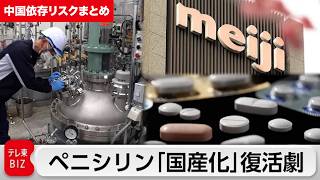
Meiji Seika Pharma, the pharmaceutical arm of Meiji Holdings, is pursuing an ambitious project to resume the domestic manufacture of penicillin, an antibiotic that transformed modern medicine but whose production in Japan ended in 1994 because of intense competition from lower-cost Chinese manufacturers.
The initiative gained urgency in early March when the conflict involving Iran disrupted international transportation routes, raising concerns about the reliability of pharmaceutical supply chains.
At Meiji Holdings' headquarters in Tokyo's Chuo Ward, Meiji Seika Pharma President Toshiaki Nagasato received emergency reports from overseas operations concerning the growing disruption to air freight services.
Military operations launched by the United States and Israel against Iran in February had led to the closure of Iranian airspace, adding to existing restrictions over Russia. Several major Middle Eastern airports used as international cargo hubs were also affected, while the closure of the Strait of Hormuz further complicated maritime transportation.
The disruption highlighted a longstanding weakness in Japan's pharmaceutical industry. Approximately 70% of the country's medicines depend on imported active ingredients or raw materials, leaving domestic manufacturers vulnerable to overseas production problems, transportation delays and geopolitical instability.
Meiji Seika Pharma procurement officials contacted multiple transportation companies and gathered information about alternative shipping routes, concerned that prolonged disruption could eventually affect the delivery of medicines to patients.
The company's more fundamental response, however, is to rebuild a domestic manufacturing capability abandoned more than 30 years ago.
Penicillin was discovered in 1928 by British bacteriologist Alexander Fleming and became one of the most important medical advances of the 20th century. Its widespread use during World War II saved countless lives, and the development of antibiotic treatment subsequently transformed healthcare by making previously deadly bacterial infections treatable.
Japan began expanding penicillin production after the war under the guidance of the Allied occupation authorities.
Meiji Seika, which later became part of the pharmaceutical business now operated by Meiji Seika Pharma, obtained a manufacturing and sales license for penicillin in 1946. Facing severe shortages of pharmaceutical equipment and supplies, the company initially used repurposed syrup containers to cultivate the microorganisms needed for production.
Drawing on fermentation technologies developed through its food business, Meiji expanded its antibiotic operations and eventually began exporting penicillin-derived medicines overseas.
In 1971, the company established a major penicillin active pharmaceutical ingredient production facility in Gifu Prefecture, which became one of the largest such plants in Japan.
At its peak, the facility produced more than 1,000 tons annually.
The business began to deteriorate following the 1985 Plaza Accord, which contributed to a sharp appreciation of the yen and undermined the international competitiveness of Japanese manufacturers.
At the same time, Chinese pharmaceutical companies were expanding production using lower-cost labor, energy and increasingly sophisticated manufacturing technologies.
In 1988, Meiji Seika launched an internal project to reduce the cost of penicillin production and preserve the industry in Japan.
Nagasato, then 30 years old, was selected as a member of the team, which was given just one year to develop substantial improvements in manufacturing efficiency.
The company sought fundamental technological changes that would allow Japanese penicillin production to compete with Chinese prices.
Despite those efforts, China's cost advantage continued to grow.
Meiji Seika eventually ended domestic penicillin production in 1994, bringing its involvement in Japanese manufacturing of the antibiotic's active ingredients to an end.
With no other domestic company continuing production, Japan became dependent on overseas suppliers.
China subsequently developed into the world's leading manufacturing center for antibiotic raw materials, supported by large-scale chemical industrial complexes, integrated production facilities and access to inexpensive electricity.
Some Chinese pharmaceutical industrial parks operate their own thermal power plants, enabling manufacturers to supply antibiotics and related materials to more than 20 countries.
Japan now relies on China for almost all of certain antibiotic raw materials, creating a potentially serious risk to its healthcare system if supplies are interrupted.
The consequences of such dependence have already been felt in Japanese hospitals.
At Tokyo Bay Urayasu Ichikawa Medical Center, a major regional hospital in Chiba Prefecture, medical staff recalled being suddenly informed that supplies of an antibiotic would be suspended, leaving them unable to use a medicine they had previously relied upon.
For healthcare providers, shortages of essential antibiotics are particularly serious because alternative treatments may not always be available or equally effective.
Medical professionals warned that an interruption in supplies could prevent patients from receiving treatment for otherwise manageable infections, potentially resulting in avoidable deaths.
The experience has reinforced the importance of maintaining domestic production capacity even when imported medicines are cheaper.
Meiji Seika Pharma's effort to restore penicillin manufacturing has become a personal priority for Nagasato, who experienced the company's unsuccessful attempt to preserve production in the late 1980s.
A central figure in the new project is 59-year-old engineer Koichiro Yamada, one of the few remaining specialists with firsthand experience of the company's former penicillin manufacturing operations.
Yamada played a key role in production three decades ago and is now involved in transferring that expertise to a younger generation of employees.
With his retirement approaching, the engineer has expressed a determination to pass on as much technical knowledge as possible before leaving the company.
The project represents more than the reopening of an old production line. Modern antibiotic manufacturing requires precise fermentation processes, contamination control, purification technology and strict quality management, making the restoration of lost industrial expertise a major undertaking.
For Meiji Seika Pharma, the objective is to establish a sustainable domestic production base capable of contributing to Japan's pharmaceutical security.
The same concerns about excessive dependence on China are driving a second initiative involving resources essential to advanced manufacturing.
Japan has achieved a major technological milestone by recovering rare earth-rich mud from the seabed approximately 6,000 meters beneath the Pacific Ocean near Minamitorishima Island.
The operation was conducted using the deep-sea scientific drilling vessel Chikyu, which returned to Shimizu Port in Shizuoka Prefecture on February 15 following an expedition lasting about one month.
The vessel, which measures approximately 210 meters in length and is equipped with a drilling structure rising about 130 meters, was built at a cost of approximately 56 billion yen.
The expedition successfully recovered dark-colored seabed sediment containing valuable rare earth elements, marking an important step toward the development of a potential domestic source of strategically important minerals.
The Japanese government has allocated approximately 40 billion yen to the development effort under the leadership of the Cabinet Office.
Researchers plan to analyze the recovered material before conducting a larger-scale demonstration in February 2027, with the government targeting industrial development from fiscal 2028 onward.
The program is part of a broader effort to strengthen Japan's economic security by reducing its reliance on imported critical materials.
China accounts for approximately 70% of global rare earth production, while Japan obtains around 63% of its rare earth supplies from China.
That dependence has become increasingly sensitive as Chinese authorities tighten export controls on certain rare earth materials, creating uncertainty for manufacturers of electric vehicles, industrial machinery, electronics and defense equipment.
Prime Minister Sanae Takaichi has identified the development of seabed resources near Minamitorishima as a strategic priority.
In a policy speech in February, Takaichi called for accelerating resource development and recycling initiatives, particularly the utilization of rare earth deposits in the waters surrounding the island.
During a speech in Okayama on February 4, she expressed confidence that Japan could eventually secure sufficient rare earth supplies for both current and future generations.
The scientific foundations of the project date back to 2011, when researchers at the University of Tokyo identified exceptionally rich deposits of rare earth-bearing mud in the Pacific Ocean.
Professor Yasuhiro Nakamura, who has been involved in research on the deposits, said surveys had revealed enormous quantities of potentially valuable material.
Researchers estimate that an area of approximately 2,500 square kilometers near Minamitorishima contains around 16 million tons of rare earth elements.
The surveyed area represents less than 1% of Japan's exclusive economic zone, suggesting that the wider seabed may hold additional resources.
Japan consumes approximately 20,000 tons of rare earth elements annually, meaning the estimated deposits could theoretically represent around 800 years of consumption at current levels.
The figures, however, describe estimated resources rather than commercially recoverable reserves, and significant technical and economic challenges remain before the deposits can be converted into a reliable industrial supply.
Rare earths comprise 17 metallic elements used in relatively small quantities to improve the performance of a wide range of industrial materials.
Often described as the vitamins of modern industry, they are essential for smartphones, LED lighting, electric vehicle motors, advanced magnets and numerous other technologies.
The Minamitorishima deposits are particularly notable for their concentrations of certain heavy rare earth elements, which are more difficult to obtain and often have greater strategic importance than more abundant varieties.
Researchers estimate that the seabed deposits contain enough yttrium, used in lighting and other applications, to meet Japan's current consumption for approximately 780 years.
Dysprosium, an important component of high-performance magnets used in electric vehicle motors, is estimated to be present in quantities equivalent to around 730 years of Japanese consumption.
Scientists have also identified an unusual geological process responsible for the accumulation of the minerals.
The rare earth elements are associated with microscopic fragments of fish bones and teeth that accumulated on the deep seabed over millions of years.
The calcium phosphate contained in these biological remains has an affinity for rare earth elements, allowing the minerals to become concentrated as sediment accumulated over more than 30 million years.
Nakamura said researchers were surprised by the unusually high concentrations discovered near Minamitorishima, which exceeded those found in many other seabed sediment samples collected across the Pacific.
The discovery raised hopes that Japan could develop a substantial domestic resource base despite having relatively limited conventional mineral deposits on land.
Another potential advantage is the relatively low concentration of radioactive substances in the deep-sea mud.
Conventional rare earth mining and processing can produce waste containing radioactive materials, creating environmental management costs and potential risks.
According to the researchers, the Minamitorishima sediment contains very little radioactive material, potentially simplifying some aspects of mineral extraction and waste treatment.
Nevertheless, the commercial viability of the deposits remains uncertain.
Extracting mud from depths of approximately 6,000 meters requires specialized equipment capable of operating under extreme pressure, while transporting large quantities of sediment to the surface presents major engineering challenges.
Once recovered, the material must be transported, processed and refined to separate the individual rare earth elements.
These processes are technically complicated because rare earth elements possess similar chemical properties and are difficult to isolate from one another.
Some estimates suggest that rare earths produced from deep-sea mud could cost as much as 20 times more than comparable materials supplied by China.
Industry specialists caution that successfully collecting sediment from the ocean floor is only the first stage in building a commercially sustainable supply chain.
Large-scale extraction, efficient mineral separation, environmental protection and cost reduction will all be necessary before domestic rare earth production can become competitive.
Even with government support, establishing a mature industrial operation could take 10 to 20 years, considerably longer than the timetable for initial demonstration projects and early commercialization.
Production costs are expected to decline as equipment improves and larger facilities spread fixed costs across greater output. However, reaching China's price levels may remain difficult, particularly during the initial years of operation.
The strategic argument for continued investment is that economic security cannot always be measured through immediate production costs alone.
A domestic rare earth supply, even if more expensive than imports, could provide Japanese manufacturers with an alternative during periods of international trade disruption.
Similar considerations have influenced the development of other costly domestic energy and resource technologies, including geothermal power.
The urgency of securing alternative supplies has increased as Chinese export restrictions begin affecting Japanese manufacturers.
Companies producing permanent magnets, including smaller manufacturers that depend heavily on imported raw materials, have reportedly experienced substantial disruptions.
Some businesses have reported that imports from China have fallen to roughly one-third of their previous levels in 2026.
Even where export permits are eventually approved, uncertainty over delivery schedules has created serious problems for manufacturers that must fulfill contractual commitments to their customers.
The most vulnerable materials include neodymium, terbium and dysprosium, which are used in high-performance permanent magnets.
These magnets are vital components in electric vehicle motors, smartphones, industrial equipment and military systems.
Because the minerals are often required in small but indispensable quantities, the absence of a single material can prevent the completion of an entire product.
This creates a supply-chain risk disproportionate to the value or volume of the minerals involved.
Japan's efforts to restore penicillin production and develop deep-sea rare earth resources illustrate two different approaches to the same underlying problem.
In pharmaceuticals, the country is attempting to revive an established manufacturing technology that was abandoned because foreign competitors could produce essential materials more cheaply.
In rare earths, it is investing in an emerging technology that could eventually unlock substantial domestic resources but remains far from achieving commercial competitiveness.
Both initiatives require substantial investment and long-term commitments that may be difficult to justify through conventional short-term profitability calculations.
They also highlight the extent to which Japan's industrial economy has become dependent on international supply chains optimized for cost rather than resilience.
The challenge facing policymakers and manufacturers is to determine how much additional expense Japan should accept to maintain secure access to medicines, minerals and other materials essential to public health and advanced manufacturing.
For Meiji Seika Pharma, the immediate goal is to preserve the expertise needed to manufacture a lifesaving antibiotic domestically.
For the deep-sea rare earth project, the next challenge is demonstrating that an extraordinary geological discovery can be transformed into a practical industrial operation.
Whether either initiative can compete commercially with established Chinese suppliers remains uncertain, but both signal a shift in Japanese industrial policy toward treating reliable access to critical materials as a strategic national priority.
Source: テレ東BIZ