News On Japan

Revised Imperial House Law Takes Effect

TOKYO - Japan's revised Imperial House Law took effect on October 24, allowing female members of the Imperial Family to retain their royal status after marriage and permitting the adoption of male descendants from former imperial family branches, marking the first substantive amendment to the law's main provisions since its enactment in 1947.

The legislation, passed during the recent extraordinary session of the Diet, is intended to address the declining number of Imperial Family members by introducing two measures aimed at maintaining and expanding the royal household.

Under the revised law, female members of the Imperial Family will be able to retain their imperial status after marriage, reversing the previous requirement that they leave the royal household upon marrying a commoner.

The legislation also allows male descendants in the paternal line of former imperial family branches to be adopted into the Imperial Family, creating another avenue for increasing the number of male royal members.

Chief Cabinet Secretary Minoru Kihara emphasized the importance of both measures, describing the retention of female royals' status as a key step toward preventing a further decline in Imperial Family membership.

"Allowing female members of the Imperial Family to retain their status is an important measure to prevent the number of royal family members from decreasing," Kihara said.

He also stressed that adoption would play an essential role in expanding the Imperial Family and securing male members who could not be added through the retention of female royals alone.

"Adoption into the Imperial Family is an indispensable measure for increasing its membership and is also meaningful in securing male royal family members who cannot be obtained simply by allowing female members to retain their status," Kihara said.

The changes represent a historic revision of Japan's Imperial House Law, which has governed the structure and membership of the Imperial Family since 1947. Although the law has undergone amendments in the past, this is the first time its main provisions have been substantively revised since its establishment.

Source: TBS

News On Japan
POPULAR NEWS

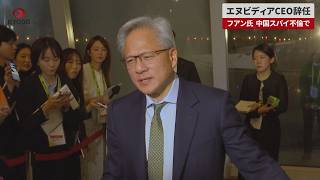
The resignation of Nvidia CEO Jensen Huang on November 12 following allegations involving a woman suspected of links to Chinese intelligence has raised concerns in Japan over the potential impact on semiconductor investment, financial markets and the yen, as uncertainty surrounding the American AI chipmaker threatens to disrupt the global technology industry.

Japan launched a new national disaster management agency on November 2nd to strengthen its response to major emergencies, just days before a powerful earthquake struck Aichi Prefecture, injuring 24 people and renewing concerns over the possibility of a catastrophic Nankai Trough earthquake.

Russia's Foreign Ministry on November 11 defended the government's unilateral decision to place the local subsidiary of Japan Tobacco (JT) under the management of a Russian company, describing the move as a countermeasure against what it called Japan's "blatantly hostile actions."

East Japan Railway (JR East) announced on November 10th that it will introduce touch-free ticket gates at 40 stations, including every station on Tokyo's Yamanote Line, from spring 2028, allowing passengers using Mobile Suica to pass through without taking their smartphones out of their pockets or bags.

Japan's Children and Families Agency unveiled its first national guidelines on November 10th for parental involvement in children's internet use, dividing those aged 0 to 18 into six developmental stages as the government considers tighter regulations on social media platforms to protect young people from online bullying, exploitation, and other growing risks.

MEDIA CHANNELS
         

MORE Politics NEWS

The Hokkaido Shimbun newspaper identified its correspondent detained in Russia on espionage allegations as Yuki Imai on November 12, one month after his arrest by Russia's Federal Security Service (FSB), with no indication of when he might be released.

The Japanese government is considering formally allowing exceptions to its longstanding ban on bringing nuclear weapons into the country during national emergencies, as part of revisions to its three key national security documents scheduled for completion by the end of 2026.

The mayor of Awa City in Tokushima Prefecture and two other people have been arrested on suspicion of defrauding the municipal government of 3.5 million yen by inflating the cost of a city contract to cover vehicle repair expenses arising from an accident caused by the mayor, prompting police to search city hall on November 10th.

Japan's ruling Liberal Democratic Party reprimanded former Prime Minister Shigeru Ishiba and three other lawmakers on November 9th for leaving the House of Representatives before a vote on legislation to reduce the consumption tax on food, as party leaders sought to prevent further defections that could jeopardize the bill's passage through the upper house.

Russian President Vladimir Putin has signed a decree placing the Russian operations of Japan Tobacco (JT) under the temporary management of a local company, effectively stripping the Japanese tobacco giant of control over its business in the country and prompting a formal protest from Tokyo demanding that the measure be immediately withdrawn.

The Japanese government approved the allocation of 10 billion yen from its fiscal 2026 general account reserve funds on November 6 to strengthen cybersecurity measures, including inspections of vulnerabilities in government computer systems and upgrades to security equipment.

A government bill to reduce Japan's consumption tax on food from 8% to 1% for two years starting in April 2027 was approved by the House of Representatives Committee on Financial Affairs on November 6, with the ruling Liberal Democratic Party and Japan Innovation Party securing a majority in favor of the legislation.

The Japanese government is preparing to establish a new cybersecurity response team comprising experts from the public and private sectors, with plans to dispatch specialists to companies and organizations facing serious cyberattacks following a series of unauthorized intrusions and information leaks.