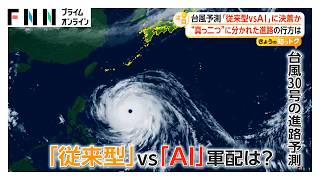
TOKYO - Artificial intelligence has demonstrated greater accuracy than conventional supercomputer models in predicting the path of Typhoon No. 30, which was forecast to approach Okinawa before turning northeast toward Japan, highlighting the growing potential of AI in weather forecasting while raising questions about how its predictions can be verified and used in disaster preparedness.
The storm, which was moving across waters south of Japan, helped draw warm air into the country, contributing to unusually high temperatures in several regions on October 21. Its projected course also changed substantially over several days, providing another opportunity to compare AI-based forecasts with traditional numerical weather prediction models.
Typhoon No. 30 was initially expected to move toward mainland China, but subsequent forecasts indicated that it would turn northeast after approaching Okinawa, potentially bringing it closer to Japan's main islands than previously anticipated.
The changing outlook followed a similar case involving Typhoon No. 25 in September, when AI forecasting attracted attention for accurately predicting the storm's path despite considerable uncertainty in conventional forecasts.
An examination of the two forecasting approaches for Typhoon No. 30 revealed significant differences in how the models interpreted atmospheric conditions over the western Pacific.
Traditional forecasts, calculated using supercomputers and serving as a basis for Japan Meteorological Agency predictions, initially indicated a curved track similar to that projected by AI models. However, the two approaches diverged sharply over the following three days.
While the AI forecast continued to show the storm curving northeastward, the conventional model shifted toward a straighter westward track, suggesting the typhoon would move toward mainland China.
The difference appears to have been linked to how the models assessed the Pacific high-pressure system over waters south of Japan.
According to a weather forecaster involved in the analysis, the conventional model may have anticipated that the Pacific high would strengthen and extend farther westward, steering the typhoon toward China rather than allowing it to curve toward Japan.
The AI model, by contrast, continued to predict the northeastward turn, making its forecast more consistent with the storm's subsequently projected path.
The result suggested that AI had performed better in predicting the direction of Typhoon No. 30 at that stage, although the storm's eventual track had yet to be determined.
Kohei Sakamoto, a specialist in meteorological data and AI analysis at the Weathernews Forecast Center, said AI forecasting systems have particular strengths in predicting typhoon tracks and longer-term weather patterns.
However, the technology remains less reliable when estimating a typhoon's intensity or forecasting the strength of rainfall.
This distinction is important because predicting where a storm will travel is only one part of assessing its potential danger. The strength of winds and rainfall can determine the scale of damage, flooding and other hazards, making accurate intensity forecasts essential for disaster preparedness.
AI's growing ability to predict storm movements has attracted attention as conventional forecasting methods face challenges in interpreting complex atmospheric conditions.
Unlike traditional numerical weather prediction, which uses physical equations to simulate changes in the atmosphere, AI models identify patterns in large volumes of meteorological data and use those relationships to generate forecasts.
The two approaches can produce different results even when assessing the same weather system, as demonstrated by Typhoon No. 30.
However, one of the biggest obstacles to wider adoption of AI forecasting is the difficulty of understanding how the technology reaches its conclusions.
AI predictions are often described as a "black box" because the reasoning behind a particular forecast cannot easily be reconstructed or independently verified.
In the case of Typhoon No. 30, for example, it remains difficult to establish exactly why the AI model anticipated that the Pacific high-pressure system would not extend as far westward as conventional calculations suggested.
This lack of transparency presents a significant challenge for weather agencies responsible for issuing warnings that can influence evacuation decisions and other measures affecting public safety.
Even when an AI forecast proves more accurate, forecasters may struggle to explain why it was correct or determine whether the same approach can be trusted under different atmospheric conditions.
The difficulty of verifying the underlying reasoning has so far limited the scope of AI forecasting in operational meteorology.
Japan's Meteorological Agency plans to develop AI technology for use in weather forecasting by 2030, but questions remain over how the systems should be developed, evaluated and integrated into existing forecasting operations.
Some overseas meteorological organizations have already begun using AI-based forecasts in cooperation with private companies, placing additional attention on Japan's approach to adopting the technology.
AI predictions were reportedly more accurate than conventional forecasts for several typhoons during the summer of 2026, adding to expectations that the technology could become an increasingly important tool in monitoring tropical cyclones.
Nevertheless, specialists caution that the accuracy of weather forecasting cannot be judged simply by whether an individual prediction proves right or wrong.
Typhoon forecasts are closely connected to public safety, and unexplained errors could have serious consequences if authorities rely too heavily on systems whose internal decision-making processes remain difficult to examine.
Rather than replacing supercomputer-based forecasts, AI may increasingly be used alongside conventional numerical models, allowing forecasters to compare different projections and identify areas of uncertainty.
Such a combined approach could help improve forecasting accuracy while retaining the physical explanations and established verification methods associated with traditional meteorological models.
For Typhoon No. 30, the comparison demonstrated both the promise and limitations of AI forecasting. Although the AI model more accurately anticipated the storm's projected northeastward turn, uncertainty remained over its final course and intensity.
With considerable variation still possible in the storm's path, residents in potentially affected areas were advised to monitor the latest weather information and take precautions early rather than relying on a single forecast.
Source: FNN