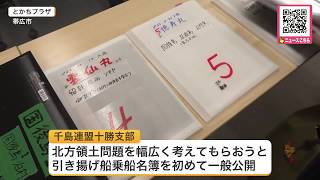
HOKKAIDO - Passenger lists documenting approximately 8,800 former residents who were forced to leave Japan's Northern Territories after World War II were made available to the general public for the first time in Japan on November 14th in Obihiro, Hokkaido, offering families a rare opportunity to trace their ancestors and learn more about their origins.
The records were released by the Tokachi branch of the Chishima League, an organization representing former residents of the Northern Territories and their descendants. Previously accessible only to people connected with the organization, the documents were opened to the wider public to encourage greater awareness and discussion of the longstanding territorial dispute between Japan and Russia.
The passenger lists contain the names of approximately 8,800 people who boarded evacuation ships after being displaced from the islands, along with details including their former residential addresses.
For some visitors, the records provided an emotional discovery about their family history. One relative of a former islander, who had been uncertain about where their family originally came from, found evidence of their journey. "Apparently, it was just my grandmother and a little girl who came over. So they were on the ship. I never knew where I came from," the visitor said.
Another visitor, a second-generation descendant of a former islander, described the significance of finding their family's name in the historical documents. "Seeing our name recorded in materials related to the Northern Territories made me realize once again that I am a second-generation descendant of a former islander," the visitor said.
The Northern Territories, comprising four islands northeast of Hokkaido, were occupied by Soviet forces at the end of World War II in 1945. Japanese residents were subsequently forced to leave, with many resettling in Hokkaido. The islands remain under Russian administration, while Japan continues to claim sovereignty over them.
The newly accessible passenger lists provide a historical record of the displacement of thousands of Japanese residents and offer their descendants a tangible connection to family histories that have been passed down through generations.
Source: 北海道ニュースUHB