News On Japan

Foreign Companies Entering Japan: Entity, Branch or Partner – Choosing an Entry Structure and Settling Compliance First

TOKYO - Japan is undeniably an attractive market for international businesses. It offers a large consumer economy and established industries ranging from electronics to automotive manufacturing. However, entering the Japanese market isn't quite as simple as finding customers and opening an office in Tokyo.

Foreign Companies Entering Japan: Entity, Branch or Partner – Choosing an Entry Structure and Settling Compliance First

Foreign companies face several choices about how to establish themselves. Each comes with different costs and responsibilities. Subsidiary options are possible but some businesses achieve their goals through a branch office or even a local commercial partner.

What Are the Options for Entering Japan?

The right structure depends on what a company intends to do in Japan. Selling products through a distributor is quite different from employing a permanent team or operating a manufacturing facility.

GoGlobal provides market entry advice that can help a company understand the practical requirements of establishing operations in Japan and choose a structure that fits.

A subsidiary is one common approach. This involves creating a separate Japanese company, usually as a Kabushiki Kaisha (KK) or Godo Kaisha (GK).

A KK is a joint-stock company. A GK is a limited liability company with a generally simpler management structure. Both allow foreign businesses to establish a separate legal entity in Japan.

A subsidiary can employ staff directly and enter into local commercial agreements. It also provides some separation between the Japanese operation and its overseas parent company.

Incorporation creates ongoing accounting and administrative responsibilities, which makes it more suitable for businesses with a long-term commitment to the market.

Could a Branch or Local Partner Work Instead?

A branch office allows a foreign company to conduct business in Japan without establishing a separate Japanese corporation.

With a branch, the overseas parent remains directly responsible for liabilities arising from the branch.

A registered branch also needs at least one representative who resides in Japan. Companies expanding into the market also need to keep up with changes to visa and employment laws. In October 2025 Japan revised the Business Manager residence status: the minimum capital requirement rose sixfold, from 5 million yen to 30 million yen, and applicants must now hire at least one Japanese national or permanent resident.

Working with a local distributor or commercial partner offers another possibility. A foreign manufacturer can potentially sell through an established Japanese distributor rather than immediately creating its own sales operation.

The arrangement can provide access to existing customer relationships and local market knowledge, although businesses may sacrifice some control over pricing or customer relationships.

Partnership agreements therefore need careful attention around exclusivity and how either party can end the relationship.

Japan also permits representative offices for certain preparatory activities like market research. These cannot conduct ordinary sales operations, so they aren't a substitute for a trading business.

Why Does Compliance Matter Before Launch?

Choosing a business structure is only part of the work.

Companies establishing a Japanese presence must consider registration and employment requirements before operations begin.

Branches and subsidiaries have different registration responsibilities and levels of liability, so those differences need to be understood before launch. Certain foreign investments may also require advance notification under Japan's foreign exchange and trade rules.

Hiring brings further obligations, including payroll administration and social insurance contributions.

Businesses transferring overseas managers to Japan must also examine immigration requirements, which, as the Business Manager changes show, can tighten quickly. Registering a company and qualifying for permission to live and work in Japan are separate matters.

Choosing a Structure That Supports Growth

A business testing Japanese demand through a distributor has very different needs from one planning a permanent workforce in Tokyo or Osaka.

Subsidiaries offer a lasting corporate presence and commercial partnerships can help businesses enter the market with less infrastructure (and potentially less investment). Businesses should spend time researching these matters before committing to one type of business structure.

News On Japan
POPULAR NEWS

Tamagotchi, the Japanese virtual pet that became a global sensation after its launch in 1996, celebrated its 30th anniversary on November 23rd, marking three decades of popularity with worldwide shipments exceeding 100 million units.

Mount Takao in western Tokyo is attracting large crowds as its autumn foliage reaches its peak, with visitors drawn by spectacular mountain scenery, popular local food and relaxation facilities, while a cable car offering access to a scenic observation deck in just six minutes is making the destination increasingly popular among younger generations.

The restored main hall of Shuri Castle in Naha, Okinawa, opened to the public on November 23rd for the first time in seven years, drawing large crowds eager to see the historic landmark brought back to life after a devastating fire in 2019 destroyed much of the castle complex.

A 38-year-old construction worker died on November 23 after being crushed beneath more than a dozen heavy glass panels at Tokyo Electric Power Company's Kashiwazaki-Kariwa nuclear power plant in Niigata Prefecture, according to police.

Residents of Okinawa's remote islands are struggling to secure airline tickets as travelers seeking to accumulate loyalty points flood short-haul flights, with some boarding as many as 12 planes a day without stopping to sightsee, leaving essential routes fully booked and prompting calls for Japan Airlines (JAL) to reconsider its promotional campaign.

MEDIA CHANNELS
         

MORE Business NEWS

Japan is undeniably an attractive market for international businesses. It offers a large consumer economy and established industries ranging from electronics to automotive manufacturing. However, entering the Japanese market isn't quite as simple as finding customers and opening an office in Tokyo.

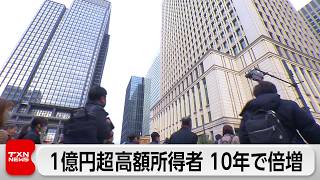
The number of people in Japan earning more than 100 million yen annually has more than doubled over the past decade, reaching 38,000 in 2024 as rising stock prices, higher land values and increased corporate executive compensation drive growth in personal wealth, according to an analysis of tax data by Kyodo News.

Japan's financial markets face a critical week from November 24th to 27th as investors assess the fallout from one of the largest stock market declines in the country's history, with mounting concerns over artificial intelligence valuations, a weakening yen, rising government borrowing costs and the prospect of another Bank of Japan interest rate increase threatening to undermine confidence in the economic outlook.

Tower Records announced that approximately 11 million customer records may have been compromised in a cyberattack on November 19th, 2026, with millions of records containing personal details such as names, dates of birth and delivery addresses, although the company said no credit card information had been leaked.

A sharp selloff in artificial intelligence stocks has raised concerns that Wall Street's technology-driven rally may be approaching a turning point, as Anthropic's shares plunged on their second day of trading on November 20, semiconductor stocks suffered heavy losses, and investors increasingly questioned whether the enormous investments flowing into AI infrastructure could generate sufficient returns.

US artificial intelligence developer Anthropic made its Nasdaq debut on November 19, with its shares finishing 17% above their offering price despite sharp declines in Japanese and American technology stocks, highlighting growing concerns that the enormous investments driving the AI boom may be outpacing the industry's ability to generate sustainable profits.

Honda unveiled its new Avancier SUV on November 20th, marking its entry into the large SUV segment with a three-row hybrid model scheduled to go on sale in Japan in spring 2027 as part of a broader effort to revive its automobile business.

Japan's rice harvest is expected to remain at a high level in 2026 despite prolonged rainfall and insufficient sunshine in some regions, with the Ministry of Agriculture, Forestry and Fisheries announcing on November 20 that production of rice for direct consumption is projected to reach 7.365 million tons.