News On Japan

Tokyo Moves to Curb "KasuHara"

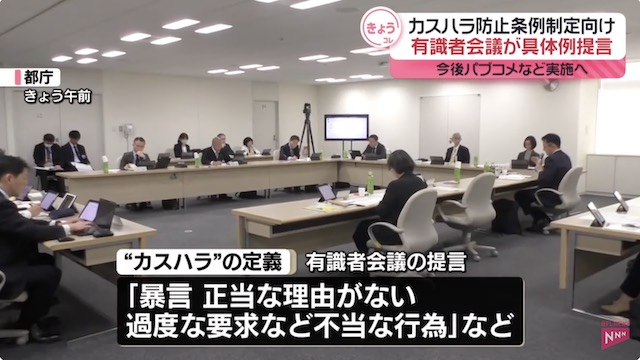
TOKYO - Tokyo Metropolitan Government officials say "customer harassment" of service staff and other workers is a growing problem across the capital.
Tokyo Moves to Curb

They're considering an ordinance that would provide a clear definition of abusive and unreasonable demands in a bid to deter potential offenders.

An advisory panel of experts has provided the Tokyo government with a working definition of customer harassment. They say it includes "assault, intimidation and other unlawful acts, or unreasonable behavior -- such as verbal abuse and excessive demands -- that harm workplace environments."

The metropolitan government is also considering providing examples in guidelines to accompany the law.

One example would involve a situation where a confectioner puts the wrong name on a birthday cake. In this case, a demand for excessive compensation would amount to abusive behavior. Politely requesting a refund would not.

News On Japan
POPULAR NEWS

Japan began applying a new numerical alcohol threshold for dangerous driving offenses on July 21, introducing a clearer standard for cases involving impaired driving that could lead to fatal accidents.

Prime Minister Sanae Takaichi's government approved its first annual basic economic and fiscal policy on Tuesday, pledging "responsible and proactive fiscal policy" and envisioning about 370 trillion yen in public- and private-sector investment in strategic industries through fiscal 2040.

A covert network of shuttle tankers is carrying crude through the increasingly dangerous Strait of Hormuz as renewed fighting between the United States and Iran disrupts shipping and raises concerns over how Japan will secure the oil it needs.

Russian Deputy Foreign Minister Andrey Rudenko has criticized moves by Japanese and Ukrainian companies to cooperate on drone technology, warning that such ties would be regarded by Moscow as a "clear hostile act."

The rainy season ended in the Kanto-Koshin and Tokai regions on July 20 as strengthening high pressure brought intense heat across Japan, with temperatures forecast to reach 38 C in Kumagaya, Saitama Prefecture, and Kofu.

MEDIA CHANNELS
         

MORE Politics NEWS

Prime Minister Sanae Takaichi’s first economic policy roadmap took center stage on July 21, setting out a long-term investment strategy aimed at reviving growth, but the plan was immediately overshadowed by concerns in the bond market over fiscal discipline and the Bank of Japan’s independence.

Asset reports for all 465 members of Japan's House of Representatives elected in February 2026 have been released, showing average declared assets of 32.78 million yen, up 6.09 million yen from the previous disclosure.

Russian Deputy Foreign Minister Andrey Rudenko has criticized moves by Japanese and Ukrainian companies to cooperate on drone technology, warning that such ties would be regarded by Moscow as a "clear hostile act."

Prime Minister Sanae Takaichi entered the week of July 20 with her government facing a shortened but politically important stretch before the extended Diet session ends, as debate continued over Bank of Japan independence, domestic investment policy, the revised Imperial House Law and the ruling coalition’s unfinished legislative agenda.

Japan's revised Imperial House Law was enacted after clearing the House of Councillors with majority support, allowing female members to retain royal status after marriage and male-line descendants of former imperial family branches to enter the Imperial Household through adoption.

Prime Minister Sanae Takaichi closed the Diet session on July 17 under pressure from both parliament and financial markets, as lawmakers enacted a revised Imperial House Law while the government moved to clarify that monetary policy tools remain under the sole authority of the Bank of Japan.

A bill to revise the Imperial House Law was approved by an Upper House special committee on July 16, paving the way for its expected enactment on July 17.

A protest against Prime Minister Sanae Takaichi was held in Tokyo's Shibuya district on July 16 as public concern grew over a bill that would impose criminal penalties for damaging the Japanese flag.