News On Japan

From Part-Time Worker to CEO: The Journey of a 22-Year-Old at CoCo Ichibanya Franchise

TOKYO - In an extraordinary promotion, 22-year-old Rino Morosawa has risen from a part-time worker to CEO. She is now the new president of Skyscraper, a company that operates CoCo Ichibanya Curry House franchises. Here is the story behind her rapid ascent to the top in just seven years.
From Part-Time Worker to CEO: The Journey of a 22-Year-Old at CoCo Ichibanya Franchise

From this month, Morosawa has been working as the president of Skyscraper, a company that runs 18 CoCo Ichibanya stores in Tokyo, Gunma, and other locations, with annual sales of about 2 billion yen and approximately 400 employees. On her first day as CEO on May 1, Morosawa expressed her enthusiasm: 'I am very motivated and love everyone here. I look forward to working with you all. Thank you very much.'

The day after assuming her role, Morosawa was seen in her uniform, actively engaging in customer service and preparation tasks at one of the stores. Despite being the CEO, she moved around the store more than anyone else.

Morosawa started working part-time at CoCo Ichibanya during her first year of high school. She appeared in the company’s PR videos and was passionate about customer service. After graduating from high school, she continued working part-time and at 19, she received the title of Customer Service Specialist, becoming the youngest to earn the 'Customer Service Star' designation.

Her life changed during a celebratory event, leading her to say, 'I was excited and thought, if I’m suitable, I’d love to do it.' Remarkably, in just seven years, she became the CEO. However, she admits that she has faced significant challenges, especially with managing sales targets and controlling food costs.

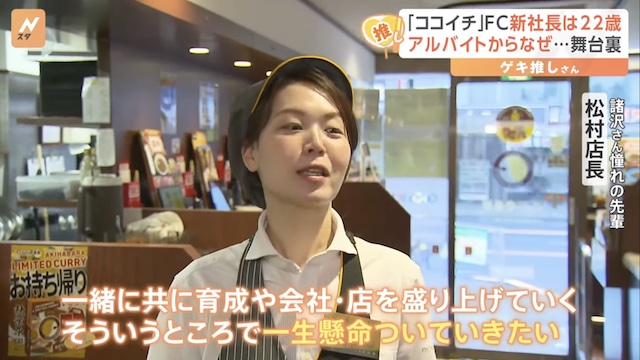
Reflecting on her promotion, the store manager she admires said, 'It’s not about having qualifications. It’s about working together to develop the company and the stores.' Morosawa is determined to follow this approach.

Skyscraper Chairman Nishiwaki, who selected Morosawa for the CEO role, listed essential qualities such as trustworthiness, a love for the company, dedication to on-site work, and honesty. Nishiwaki noted that age and gender were not factors in the decision. Since she lacked management experience, Morosawa underwent a two-year training program starting at age 20, learning various aspects of business management.

The new CEO has already begun implementing changes, such as offering eyelash perm vouchers as gifts to female employees, instead of the traditional celebratory dinners. This approach has impressed Nishiwaki, who believes that understanding what employees appreciate is crucial.

Looking ahead, Morosawa aims to continue being a hands-on CEO, stating, 'I want to be a president who works alongside everyone, sweating together and saying, "We did well today."' She also plans to open a new store with her own efforts by the end of the year.

Morosawa’s achievements and positive attitude demonstrate that age is not a barrier to leadership. Her journey is seen as a bold and challenging step by the company, and her willingness to learn and grow inspires support and encouragement from those around her.

Source: TBS

News On Japan
POPULAR NEWS

Japan is likely to face increasingly long and dangerously hot summers as global temperatures continue to rise, with advanced climate simulations also pointing to more frequent torrential rain, rising seas and accelerating ice loss by the end of the century.

A tropical depression near the Truk Islands is expected to strengthen into a typhoon within 12 hours, but forecasters say it is unlikely to have any direct impact on Japan.

A protest against Prime Minister Sanae Takaichi was held in Tokyo's Shibuya district on July 16 as public concern grew over a bill that would impose criminal penalties for damaging the Japanese flag.

Tobu Railway has introduced walk-through facial recognition ticket gates at Ikebukuro and Kami-Itabashi stations on the Tobu Tojo Line, allowing registered commuters to enter without presenting a ticket or IC card.

A system failure at frozen food giant Nichirei has disrupted shipments and logistics, raising the risk of product shortages and temporary closures at some Kentucky Fried Chicken restaurants while also affecting major supermarket and retail chains.

MEDIA CHANNELS
         

MORE Business NEWS

Seven & i Holdings is considering investing several hundred billion yen in Zabka Group, Poland's largest convenience store operator, as the Japanese retailer seeks to expand its presence in Europe.

Japanese manufacturers including Fanuc, Yaskawa Electric, Fujitsu, Hitachi, Kawasaki Heavy Industries and Komatsu announced new artificial intelligence initiatives on July 16 as Nvidia expanded its partnerships with Japan's robotics and industrial sectors.

Tokyo stocks fell sharply on July 16 as renewed selling in South Korean semiconductor shares spread to Japan’s AI and chip-related names, while household inflation expectations hit a record high and kept pressure on the Bank of Japan to maintain a tightening bias.

Many beginner forex traders often frown upon the Tokyo trading session because of its low trading volume and liquidity levels. However, it can be a gold mine if you know which currencies to trade.

A system failure at frozen food giant Nichirei has disrupted shipments and logistics, raising the risk of product shortages and temporary closures at some Kentucky Fried Chicken restaurants while also affecting major supermarket and retail chains.

Japan's core machinery orders fell 12.4% in May from the previous month to 962 billion yen, marking the first decline in two months, the Cabinet Office said on July 15.

The Ministry of Economy, Trade and Industry said it will provide up to approximately 159 billion yen in subsidies to Israel-based chipmaker Tower Semiconductor to expand production capacity at facilities in Niigata and Toyama prefectures.

Japanese companies announced new cybersecurity services, investment products and technology initiatives on July 14, while earnings releases highlighted sharply different conditions across the housing and food-import sectors.