News On Japan

Election Staff in Mini-Skirt Raises Questions

Election Staff in Mini-Skirt Raises Questions

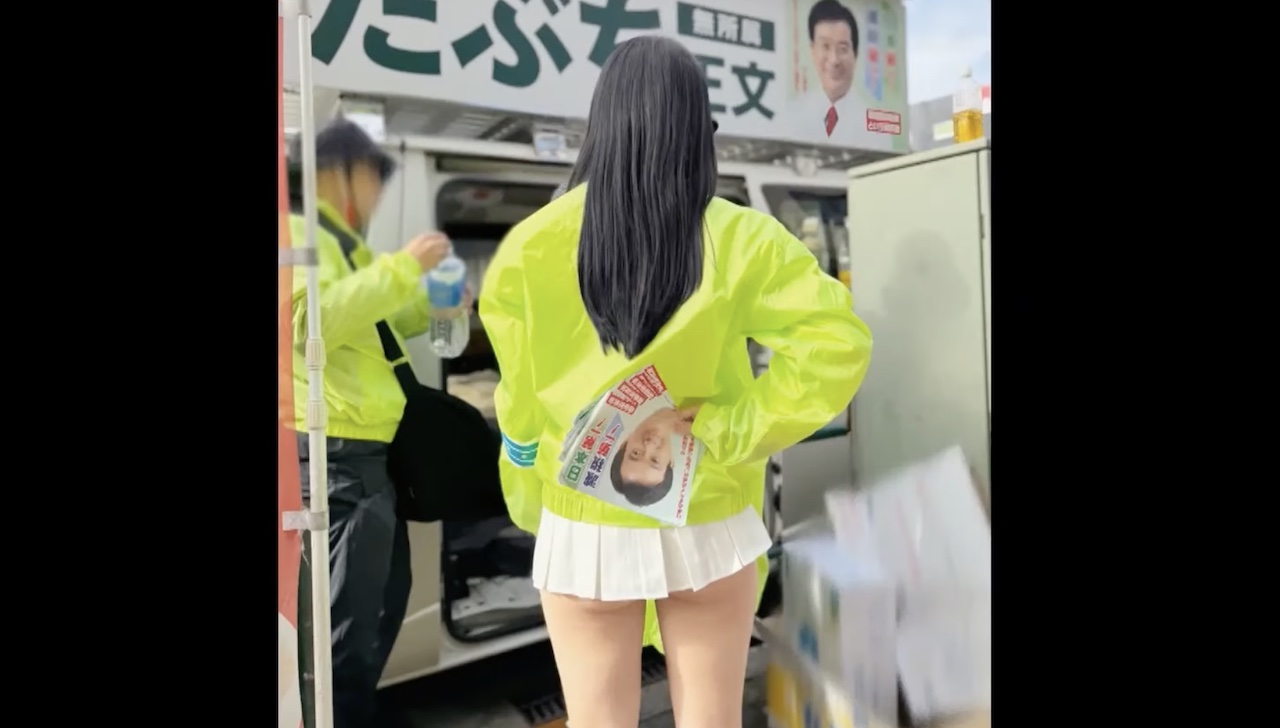
TOKYO - A woman in a neon-colored jacket and mini-skirt was seen supporting a candidate in Japan's latest Lower House election, sparking public debate on extremely short skirts, shorts, and other revealing outfits worn by female campaign staff.

This approach was adopted by the campaign team of Masafumi Tabuchi, an independent candidate and physician running in Tokyo’s 26th district.

Tabuchi and his campaign staff were seen moving around Tokyo’s Meguro Ward in matching jackets, with one team member in shorts.

The female staff member also wore fishnet tights at times, and another team member shared photos on social media, showing her mini-skirted support for Tabuchi.

Criticism soon followed, with comments like “Know your place,” and “Show real support.”

Other complaints included speculation that Tabuchi might have encouraged the attire, with some doubting the dignity of anyone who approves of such choices.

Candidate Masafumi Tabuchi responded to the backlash over his staff’s attire, saying: “I found the visible outlines shocking, but it was not my directive. We had only agreed that staff would wear lime-green jackets during campaign activities, without specific regulations for below the waist. I now regret my lack of oversight.”

When asked why she dressed this way, the female staff member explained her choices in an interview.

Female Staff in Shorts: "It was simply because it was hot, and I’m used to wearing fishnets, so there was no particular meaning to it. Tabuchi was also like, ‘It’s fine.’ I thought it was a matter of personal choice."

Legal experts commented on the situation, with one expressing concern about the mini-skirted attire.

Takashi Matsukuma, Lawyer, Hashimoto Comprehensive Law Office: "Regarding the photo in question, the first issue that comes to mind is a potential violation of the Minor Offenses Act. Police could easily issue a formal warning."

Meanwhile, Tokyo’s Election Management Committee stated that they are "not aware of the situation."

Source: FNN

News On Japan
POPULAR NEWS

Prime Minister Sanae Takaichi has drawn criticism over a social media post describing five hours of sleep as a rare luxury, as the extended Diet session prepares to begin Upper House debate on a controversial bill to establish secondary capitals outside Tokyo.

Japan began applying a new numerical alcohol threshold for dangerous driving offenses on July 21, introducing a clearer standard for cases involving impaired driving that could lead to fatal accidents.

Breathtaking 4K footage filmed from a helicopter offers a sweeping aerial view of Mount Fuji and its majestic surrounding landscape.

A covert network of shuttle tankers is carrying crude through the increasingly dangerous Strait of Hormuz as renewed fighting between the United States and Iran disrupts shipping and raises concerns over how Japan will secure the oil it needs.

Russian Deputy Foreign Minister Andrey Rudenko has criticized moves by Japanese and Ukrainian companies to cooperate on drone technology, warning that such ties would be regarded by Moscow as a "clear hostile act."

MEDIA CHANNELS
         

MORE Politics NEWS

Prime Minister Sanae Takaichi’s first economic policy roadmap took center stage on July 21, setting out a long-term investment strategy aimed at reviving growth, but the plan was immediately overshadowed by concerns in the bond market over fiscal discipline and the Bank of Japan’s independence.

Asset reports for all 465 members of Japan's House of Representatives elected in February 2026 have been released, showing average declared assets of 32.78 million yen, up 6.09 million yen from the previous disclosure.

Prime Minister Sanae Takaichi's government approved its first annual basic economic and fiscal policy on Tuesday, pledging "responsible and proactive fiscal policy" and envisioning about 370 trillion yen in public- and private-sector investment in strategic industries through fiscal 2040.

A covert network of shuttle tankers is carrying crude through the increasingly dangerous Strait of Hormuz as renewed fighting between the United States and Iran disrupts shipping and raises concerns over how Japan will secure the oil it needs.

Russian Deputy Foreign Minister Andrey Rudenko has criticized moves by Japanese and Ukrainian companies to cooperate on drone technology, warning that such ties would be regarded by Moscow as a "clear hostile act."

Prime Minister Sanae Takaichi entered the week of July 20 with her government facing a shortened but politically important stretch before the extended Diet session ends, as debate continued over Bank of Japan independence, domestic investment policy, the revised Imperial House Law and the ruling coalition’s unfinished legislative agenda.

Japan's revised Imperial House Law was enacted after clearing the House of Councillors with majority support, allowing female members to retain royal status after marriage and male-line descendants of former imperial family branches to enter the Imperial Household through adoption.

Prime Minister Sanae Takaichi closed the Diet session on July 17 under pressure from both parliament and financial markets, as lawmakers enacted a revised Imperial House Law while the government moved to clarify that monetary policy tools remain under the sole authority of the Bank of Japan.