News On Japan

Ishiba Replaces Agriculture Minister with Popular Koizumi to Contain Fallout

TOKYO - Following intense criticism over a delayed response to growing political pressure, Prime Minister Ishiba dismissed Agriculture Minister Eto and appointed Koizumi as his successor in an effort to regain control of his administration.

The abrupt change comes amid mounting backlash from opposition parties and internal dissatisfaction within the ruling Liberal Democratic Party. Government sources revealed that Ishiba had initially intended to retain Eto but ultimately reversed course under increasing pressure. One official close to the prime minister admitted, "He hesitated because he had once decided to keep him." A senior aide later expressed regret, saying, "We should have removed him earlier."

Within the LDP, frustration over the timing was palpable. "The indecisiveness caused confusion. If he had been dismissed two days ago, it would have been 100 times better," said one party member, highlighting widespread disappointment over the delayed decision.

Koizumi’s appointment is seen as a strategic move to stabilize the administration ahead of the upcoming Upper House elections. Some within the ruling coalition hope that if he handles rice policy well, Koizumi could emerge as a central campaign figure. "Whether he can deliver results will determine his role," said one party insider. However, others cautioned that agricultural issues such as rice pricing are not easily resolved. "There’s no quick fix when it comes to rice," a cabinet member warned.

Meanwhile, opposition parties wasted no time in condemning the reshuffle. Constitutional Democratic Party leader Noda remarked, "The government is always a step behind. Delayed judgment has become a pattern." Democratic Party for the People leader Tamaki was even more direct: "Koizumi was part of the problem in the first place. Now he has no choice but to produce results. His capabilities will be tested."

As mixed reactions swirl around Koizumi’s promotion, Ishiba faces the ongoing challenge of maintaining stability in a politically volatile environment.

Source: FNN

News On Japan
POPULAR NEWS

Japan's World Cup campaign begins on June 14 when the Samurai Blue face the Netherlands at Dallas Stadium in Texas, a clash that will showcase some of the game's most talented players and pit two ambitious teams against one another in a crucial Group F opener. While Japan arrives without injured winger Kaoru Mitoma, one of its most recognizable stars, the squad still boasts a wealth of talent drawn from Europe's top leagues.

The Japan Meteorological Agency (JMA) announced that an El Niño phenomenon is believed to have developed this spring, warning that Japan is likely to experience above-average temperatures nationwide this summer despite the climate pattern's traditional association with cooler summers.

Narita International Airport Corporation is expected to announce next month that it will apply to the national government for project certification as part of the process to enable compulsory land acquisition for the construction of a new runway at Narita Airport, according to sources familiar with the matter.

A fire broke out at Arima Inari Shrine near the Arima Onsen hot spring resort area in Kobe on the night of June 9th, destroying multiple buildings and leaving an elderly Shinto priest and his wife with minor injuries.

Japan's national soccer team arrived in Nashville, Tennessee, on June 8th from Monterrey, Mexico, where it had been conducting a pre-World Cup training camp, and held its first practice session at its base camp for the FIFA World Cup in North America.

MEDIA CHANNELS
         

MORE Politics NEWS

Japan's parliament is expected to formally adopt a proposal on June 10th aimed at maintaining a stable number of Imperial Family members, endorsing measures that would allow female royals to retain their status after marriage and permit the adoption of male-line descendants from former imperial branches, while leaving the current line of succession unchanged.

Komeito has begun considering a plan under which all of its Upper House lawmakers would join the Centrist Reform Alliance, according to sources familiar with the discussions.

For several months, Japan has been moving in a more nationalist and conservative direction. The shift has been fuelled by economic challenges at home and growing regional tensions with China.

Prime Minister Sanae Takaichi's administration is facing mounting scrutiny over allegations that members of her campaign were involved in distributing online videos that disparaged rival candidates during the February House of Representatives election, with opposition parties intensifying their questioning in the Diet and demanding further clarification.

The Japanese government approved its 2026 Environment White Paper at a Cabinet meeting on June 5th, warning that a record-high 50,000-plus bear sightings recorded nationwide during fiscal 2025 have become a serious threat to public safety while also highlighting growing concerns over Japan's aging hunting population and the need to train a new generation of hunters.

Prime Minister Sanae Takaichi faced intense questioning in the House of Representatives Budget Committee on June 4th over allegations surrounding defamatory campaign videos, telling lawmakers she had not verified newly released audio published by Weekly Bunshun because she had no intention of becoming a paid subscriber to the magazine's online service.

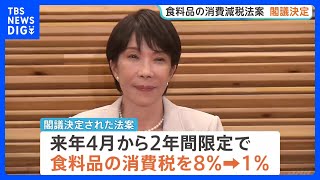
The Japanese government has presented estimates showing how long it would take to implement a reduction in Japan's consumption tax on food products, indicating that cutting the rate to either zero percent or 1 percent would require significant preparation time.

The Japanese government approved a supplementary budget proposal exceeding 3 trillion yen on June 3rd, including the creation of a new contingency reserve aimed at responding to developments in the Middle East and addressing rising energy prices.