News On Japan

Japan Faces Growing Threat as North Korea's Nuclear Arsenal Expands

TOKYO - Japan faces growing uncertainty over North Korea's expanding nuclear arsenal after Chinese President Xi Jinping concluded his first visit to Pyongyang in seven years without mentioning denuclearization, raising concerns that the long-standing international goal of eliminating North Korea's nuclear weapons may be steadily losing support among the region's major powers.

Xi was personally welcomed by North Korean leader Kim Jong Un during the high-profile visit, which featured elaborate ceremonies designed to showcase the close relationship between Beijing and Pyongyang. Yet for Japan, the most significant aspect of the visit may have been what was left unsaid. Despite growing international concern over North Korea's nuclear program, Xi made no public reference to denuclearization.

The omission comes as North Korea continues to expand its nuclear capabilities. Earlier this month, state media released photographs showing Kim inspecting what appeared to be a uranium enrichment facility used in the production of nuclear weapons material. According to a report released this week by a Stockholm-based research institute, North Korea is now estimated to possess about 60 nuclear warheads.

For decades, denuclearization of the Korean Peninsula formed the foundation of regional diplomacy. Japan participated in the Six-Party Talks alongside the United States, China, Russia, South Korea and North Korea, while successive Japanese governments supported international efforts to dismantle Pyongyang's nuclear weapons program.

That framework has gradually weakened. Although the first Trump administration held historic summits with Kim and secured renewed commitments toward denuclearization, no agreement was ultimately reached. More recently, Trump has made comments that some observers interpret as treating North Korea as a de facto nuclear weapons state rather than a country expected to surrender its arsenal.

At the same time, North Korea's strategic position has strengthened. Pyongyang has deepened military cooperation with Russia, supplying troops and weapons in support of Moscow's war in Ukraine. In return, North Korea is believed to have gained access to advanced missile and military technologies. Russian President Vladimir Putin visited North Korea last year, highlighting the growing partnership between the two countries.

China also faces a more complicated relationship with Pyongyang than in the past. As competition with the United States intensifies and North Korea's ties with Russia deepen, Beijing appears increasingly reluctant to pressure Kim's government over its nuclear program. Xi's decision to avoid discussing denuclearization publicly during the visit has fueled speculation that China may be placing greater emphasis on strategic stability than on achieving complete nuclear disarmament.

For Japan, the concern is that a gradual shift by Washington, Beijing and Moscow toward accepting North Korea's nuclear status could leave Tokyo confronting a permanent nuclear threat on its doorstep. North Korea has repeatedly tested ballistic missiles capable of reaching Japan and continues to develop more advanced delivery systems designed to evade missile defenses.

Analysts say Japan may need to take a more active diplomatic role if it hopes to keep denuclearization on the international agenda. That could involve urging both the United States and China to maintain pressure on Pyongyang while strengthening security cooperation with regional partners.

As North Korea's international standing rises and its relationships with both Russia and China evolve, Japan faces the prospect that the debate may no longer be how to eliminate North Korea's nuclear arsenal, but how to manage the risks posed by a nuclear-armed North Korea that has no intention of giving it up.

日本、拡大する北朝鮮の核兵器庫で高まる脅威に直面

中国の習近平国家主席が7年ぶりの平壌訪問を終えたものの非核化に言及しなかったことで、北朝鮮の拡大する核兵器庫をめぐる日本の不安が高まっている。北朝鮮の核兵器廃絶という長年の国際目標が、地域の主要国の間で徐々に支持を失いつつあるとの懸念も強まっている。

日本面临朝鲜核武库扩张带来的日益严峻威胁

中国国家主席习近平时隔七年结束对平壤的访问,却未提及无核化问题,这加剧了日本对朝鲜不断扩大的核武库的担忧。同时,人们越来越担心,消除朝鲜核武器这一长期国际目标正逐渐失去地区主要国家的支持。

Source: TBS

News On Japan
POPULAR NEWS

When Japan kicks off its World Cup campaign against the Netherlands at 5:00 a.m. Japan time on June 15 at Dallas Stadium in Texas, the Samurai Blue will do so without one of their most influential players. Liverpool midfielder and former captain Wataru Endo has been ruled out through injury, prompting coach Hajime Moriyasu to hand the captain's armband to Ajax defender Ko Itakura while relying on Leeds United midfielder Ao Tanaka and Crystal Palace playmaker Daichi Kamada to help fill the void left in central midfield.

A fire broke out at a Buddhist temple in Obihiro, Hokkaido, on June 13th, sending flames soaring from the building and causing temporary alarm in a nearby residential neighborhood before being largely extinguished about two hours later.

The Japanese government on June 12th released new guidelines calling for women’s toilets to have at least as many fixtures as men’s toilets in public facilities, seeking to address the persistent problem of long queues at women’s restrooms in places such as train stations and event venues.

Japan captain Wataru Endo has withdrawn from the national team's World Cup squad due to injury and announced his retirement from international soccer, dealing a major blow ahead of Japan's Group F opener against the Netherlands on June 14th (June 15th Japan time), as the team continued preparations near Nashville, Tennessee, on June 11th.

As bear sightings continue at an unusually high pace across Akita Prefecture, a veteran wildlife photographer who has spent nearly 30 years observing and photographing Asian black bears says the animals are appearing more frequently, moving closer to human settlements, and increasingly adapting their behavior to survive.

MEDIA CHANNELS
         

MORE Politics NEWS

Japan faces growing uncertainty over North Korea's expanding nuclear arsenal after Chinese President Xi Jinping concluded his first visit to Pyongyang in seven years without mentioning denuclearization, raising concerns that the long-standing international goal of eliminating North Korea's nuclear weapons may be steadily losing support among the region's major powers.

Japan's parliament is expected to formally adopt a proposal on June 10th aimed at maintaining a stable number of Imperial Family members, endorsing measures that would allow female royals to retain their status after marriage and permit the adoption of male-line descendants from former imperial branches, while leaving the current line of succession unchanged.

Komeito has begun considering a plan under which all of its Upper House lawmakers would join the Centrist Reform Alliance, according to sources familiar with the discussions.

For several months, Japan has been moving in a more nationalist and conservative direction. The shift has been fuelled by economic challenges at home and growing regional tensions with China.

Prime Minister Sanae Takaichi's administration is facing mounting scrutiny over allegations that members of her campaign were involved in distributing online videos that disparaged rival candidates during the February House of Representatives election, with opposition parties intensifying their questioning in the Diet and demanding further clarification.

The Japanese government approved its 2026 Environment White Paper at a Cabinet meeting on June 5th, warning that a record-high 50,000-plus bear sightings recorded nationwide during fiscal 2025 have become a serious threat to public safety while also highlighting growing concerns over Japan's aging hunting population and the need to train a new generation of hunters.

Prime Minister Sanae Takaichi faced intense questioning in the House of Representatives Budget Committee on June 4th over allegations surrounding defamatory campaign videos, telling lawmakers she had not verified newly released audio published by Weekly Bunshun because she had no intention of becoming a paid subscriber to the magazine's online service.

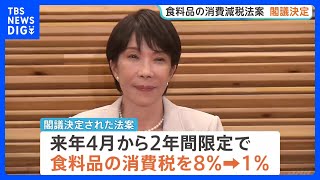
The Japanese government has presented estimates showing how long it would take to implement a reduction in Japan's consumption tax on food products, indicating that cutting the rate to either zero percent or 1 percent would require significant preparation time.