YAMAGATA - A bear was seen walking openly through a residential street in Tsuruoka, Yamagata Prefecture, on the morning of July 3, appearing in a popular hot spring area with a history of 1,200 years that attracts many tourists.
The bear appeared in a corner of the tourist district, startling residents at close range. A person who filmed the scene said the encounter happened while taking a daughter to nursery school. "When I put my daughter in the child seat, she said, 'Ah! A bear,' and when I turned around, it crossed right in front of us. It was within about 5 meters. I was surprised it was walking that close," the person said.
Bears are now in the middle of their breeding season, and their range is expanding as they search for food.
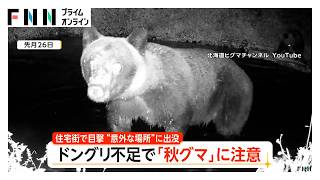
In Towada, Aomori Prefecture, a bear was recorded on July 2 sniffing a fixed camera as if checking whether it was food. The footage was captured by Takabuchi, who observes wild animals. He said the location was about 1.5 kilometers from his home and close to the area where he takes walks.
Hideo Takabuchi, head of the Tohoku Giant Tree Survey Research Group, said he has never seen a bear directly but that they are often captured by cameras. "They always come close to the camera. The footage shows them acting cautiously so they do not encounter humans. I think they are very smart," he said.
As bears move closer to areas where people live, their intelligence is becoming a major concern for hunters.
Footage shows a large brown bear approaching a box trap and showing interest in bait inside. The bear gently touches the trap with a front paw, then quickly pulls away, making movements that clearly suggest caution, almost as if it understands the danger.
The footage of the bear, believed to weigh more than 200 kilograms, was filmed around autumn 2025 in Nishiokoppe, a village in northern Hokkaido.
Shinichi Nakahara, head of the Nishiokoppe branch of the local hunters' association, said the animals are cunning and highly intelligent. "They are crafty, or rather, smart. They learn, so if they have had an experience before, they are not likely to go into a trap," Nakahara said.
In the summer of the same year, another bear, believed to be a different individual, appeared in a field of feed corn. After approaching an electric fence, the bear began digging a hole. It then used the hole to quickly pass under the fence, suggesting it may have learned how the electric barrier works.
The footage also showed two cubs watching the behavior.
"The cubs follow the parent as it goes under, so the cubs learn too," Nakahara said. "If they touch the electric fence, about 7,000 volts run through it, so it hurts. I think they understand the fear of it."
After entering the field, the bear emerged again about two and a half hours later, slipping back under the electric fence and disappearing.
Another bear drew attention in June after attacking four people and barricading itself inside a factory in Fukushima City. Witnesses said the bear turned a water tap to drink. It was also reported to have unlocked a window on its own, slid open the glass and escaped.
In Nishiokoppe, sightings of smart bears continue. Because they are highly cautious, hunters have not yet been able to capture even one bear in a box trap this season.
"With traps, bears are becoming harder to catch because they are learning," Nakahara said. "We have to think carefully about what bait to use and how to scatter it."
The battle of wits between hunters and smart bears is continuing.
Source: FNN