News On Japan

Takaichi Announces 1% Food Consumption Tax From April 2027

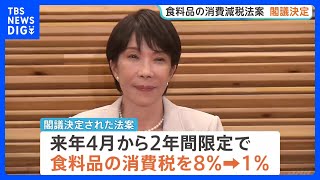
TOKYO - Prime Minister Sanae Takaichi announced that Japan will cut the consumption tax rate on food and beverages to 1% from April 2027, pledging to secure the necessary funding without relying on deficit-financing bonds and to restore the rate to 8% after two years.

Takaichi said she decided to proceed with the reduction after taking seriously the strong public support for a lower tax rate. She emphasized that the government would fund the measure without issuing special deficit-covering bonds in order to maintain market confidence.

"We take seriously the high expectations of the public," Takaichi said. "We will secure the necessary funding without relying on special deficit-financing bonds so that we can maintain the confidence of the markets. During the upcoming budget compilation process, we will assess tax revenue trends and respond to necessary fiscal demands."

The prime minister also rejected suggestions that restoring the food and beverage tax rate to 8% after two years could prove politically difficult because it would be perceived as a tax increase.

"I will take responsibility and ensure that the rate is returned to its original level after two years," Takaichi said.

She said political parties that participated in the national council on social security shared the understanding that consumption tax revenue serves as an important source of funding for the social security system.

"From the perspective of achieving fiscal sustainability and maintaining market confidence, I will take responsibility and ensure that the tax rate is returned to its original level after two years," she said.

The next challenge for Takaichi will be securing support within the ruling Liberal Democratic Party, where opposition to raising the tax rate again remains strong.

Resistance surfaced on July 30, when former Digital Minister Taro Kono publicly argued against the plan. LDP lawmaker Yuko Obuchi also formally resigned from a senior position on the party's Tax System Research Commission, which oversees discussions on consumption tax policy.

The LDP plans to reach an internal agreement before the Cabinet formally approves the proposal next week. The party is scheduled to hold a general meeting of all its lawmakers on July 31.

It remains unclear whether party members will accept Takaichi's explanation. One mid-ranking lawmaker predicted that the discussions would become highly contentious, saying, "It will be a major uproar."

Source: FNN

News On Japan
POPULAR NEWS

Typhoon No. 13 (Dolphin) is expected to approach the Ogasawara Islands early next week with very strong winds and rough seas before continuing westward, with some forecast models indicating a possible move toward waters south of Kyushu and western Japan later in the week.

The death toll from the powerful Kumamoto earthquake rose to 30 as of 12:30 p.m. on July 30, including people whose deaths were still being investigated for a possible connection to the disaster, while rescue crews continued searching collapsed buildings and other damaged sites.

Five people have been confirmed dead, one person remains in cardiopulmonary arrest and another person is being rescued after a powerful explosion devastated Aeon Mall Kumamoto following the magnitude 7.1 earthquake that struck Kumamoto Prefecture on July 28.

Typhoon No. 13 (Dolphin) continued to intensify over the Marshall Islands on July 29 and is forecast to become a violent typhoon by July 31 before approaching the Ogasawara Islands early next week, potentially bringing severe winds, high waves and other effects to Japanese territory.

Prime Minister Sanae Takaichi said on July 29 that 13 people had died following the powerful earthquake that registered the maximum seismic intensity of 7 in Kumamoto Prefecture, including cases still being investigated for a possible connection to the disaster.

MEDIA CHANNELS
         

MORE Politics NEWS

Prime Minister Sanae Takaichi announced that Japan will cut the consumption tax rate on food and beverages to 1% from April 2027, pledging to secure the necessary funding without relying on deficit-financing bonds and to restore the rate to 8% after two years.

Prime Minister Sanae Takaichi moved on July 30 to turn food-tax relief from a campaign promise into government policy, instructing the ruling Liberal Democratic Party to proceed with a temporary cut in the sales tax on food as the Bank of Japan began a policy meeting that could shape the next phase of Japan’s currency, inflation and fiscal debate.

Prime Minister Sanae Takaichi moved closer on July 29 to adopting a sharp temporary cut in Japan’s food sales tax, turning cost-of-living relief into the next major political test for her government as markets remained uneasy over the weak yen, rising bond yields and the administration’s expansionary fiscal agenda.

Prime Minister Sanae Takaichi’s government moved on July 28 to reassure investors that it respects the Bank of Japan’s independence, as Finance Minister Satsuki Katayama said relations between the government and the central bank remain smooth despite market concern over rising bond yields, yen weakness and the administration’s growth-oriented fiscal agenda.

Prime Minister Sanae Takaichi entered the final week of July facing the sharpest political test of her administration so far, as a fall in public support exposed growing unease over the weak yen, rising living costs and doubts about whether her growth strategy can reassure both households and financial markets.

Artificial intelligence could bring changes equal to or greater than the Industrial Revolution, reshaping the role of government, society and policymaking, Mirai party leader Takahiro Anno said in an interview broadcast on July 26.

The Trump administration imposed new additional tariffs on Japan and 59 other countries and regions at 1:01 p.m. Japan time, shortly after President Donald Trump praised Shohei Ohtani and Yoshinobu Yamamoto during a White House ceremony honoring the Los Angeles Dodgers.

Japan's parliament enacted legislation on July 24 to establish a secondary capital capable of maintaining legislative and administrative functions if Tokyo is struck by a major disaster, while also seeking to reduce the excessive concentration of population and economic activity in the capital.