News On Japan

Tokyo Seniors Learn How to Use AI

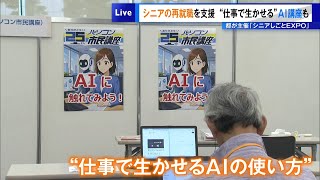
TOKYO - Tokyo hosted an employment support event for older workers on October 6, offering job consultations, interviews, hands-on work experience and training in artificial intelligence as the number of people aged 65 and over in the workforce continues to rise.

The Senior Job Expo, organized by the Tokyo Metropolitan Government in Bunkyo Ward, attracted large numbers of older people seeking new employment opportunities or considering a return to work.

The number of employed people aged 65 or older in Japan has increased for 22 consecutive years, reaching a record 9.43 million in 2025.

The event included booths where visitors could receive employment counseling and take part in recruitment interviews with companies. Other areas allowed participants to experience different types of work, including customer service and food presentation.

A 65-year-old woman who retired from an office job in June said she wanted to continue working rather than spend her retirement at home. "I've never been a full-time housewife, so I want to continue living while working," she said. After trying customer service work for the first time, she added, "It was fun. I thought it might be something I could actually do as a job."

The expo also featured a booth where visitors could gain practical experience using artificial intelligence, reflecting the growing number of companies introducing AI into their operations.

Participants were able to use the conversational AI service ChatGPT to perform computer-based tasks, including creating images, giving them an opportunity to become familiar with technology increasingly used in the workplace.

One 59-year-old man, who has been out of work after developing problems with his leg about 10 years ago, said he had been looking for employment that could be performed from home.

He previously worked in construction and had initially preferred physically active jobs, but said his condition had made returning to such work difficult. "I used to work in construction, so I thought a job where I could move around would be good, but after my leg became bad, I was rejected every time I went for an interview," he said. "If you're going to work from home, it really comes down to using a computer. I thought that in the future it might be inconvenient if I couldn't use ChatGPT."

Tokyo officials said the AI program was designed not simply to introduce participants to the technology, but to show them how it could be applied efficiently in actual workplaces.

"Recently, there have been more opportunities to use AI at work," a Tokyo Metropolitan Government official said. "We want participants to learn not only the ordinary ways of using AI, but also how they can use it efficiently in their jobs."

The metropolitan government hopes the courses will help older job seekers acquire practical AI skills that can improve their employment prospects as technology becomes increasingly integrated into everyday business operations.

Source: TOKYO MX NEWS

News On Japan
POPULAR NEWS

Typhoon Nos. 28 and 29 are expected to remain well away from Japan, but waves of 3 to 4 meters could reach parts of the country's Pacific coast from around October 10, with Typhoon No. 28 moving west near Minamitorishima at about 40 kilometers per hour as of 6 a.m. on October 8.

Tokyo University of Science professor emeritus Kenzo Soai has been awarded this year's Nobel Prize in Chemistry together with French chemist Henri B. Kagan for discoveries that transformed scientists' understanding of how chemical reactions can favor one of two mirror-image forms of a molecule.

The US military suspended activities by all forces stationed in Okinawa for 48 hours from noon on October 7, an unusual measure following the arrest of a US Marine in connection with a robbery and murder case that has renewed scrutiny of crimes involving American service members.

A core member of the international ransomware group Qilin was detained in Japan and handed over to German authorities, according to people familiar with the case, as Japanese companies and institutions face a growing wave of cyberattacks that has exposed nearly 15 million pieces of personal information this month alone.

New Year postcards for 2027 arrived at post offices across Hokkaido on October 6, with designs featuring sheep for the upcoming Year of the Sheep as Japan's traditional New Year card market continues to shrink.

MEDIA CHANNELS
         

MORE Web3 NEWS

Tokyo hosted an employment support event for older workers on October 6, offering job consultations, interviews, hands-on work experience and training in artificial intelligence as the number of people aged 65 and over in the workforce continues to rise.

Kawasaki Heavy Industries has unveiled a prototype next-generation shipbuilding robot that can climb vertically along ship hulls, part of an effort to use physical AI to address labor shortages and preserve skilled manufacturing techniques.

Panasonic Holdings is pushing ahead with one of the most sweeping restructurings in its 108-year history, cutting about 12,000 jobs, selling major businesses and reorganizing operations as the Japanese electronics group seeks to build new sources of growth around artificial intelligence, data centers and recurring service revenue.

A Tokyo court has recognized the commercial rights of performers over their voices for the first time, ruling that unauthorized use of AI-generated voices resembling those of celebrities can constitute an infringement of publicity rights in a landmark lawsuit brought by popular voice actor Kenjiro Tsuda against the operator of TikTok.

The Asia-Pacific gaming market has been having a pretty serious moment.

Tokyo Metro has launched a trial using artificial intelligence and floor projections to guide passengers toward less crowded train cars, introducing a new approach to easing congestion on subway platforms.

When a friend leans across a loud izakaya table to tell you something, where do your eyes go?

Japan’s character culture extends far beyond major anime studios and established toy manufacturers. Independent illustrators, small creative teams and dōjin artists also develop original characters for exhibitions, games, merchandise and personal projects.