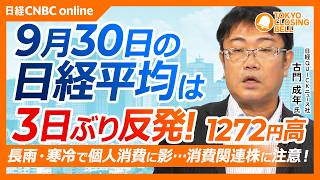
TOKYO - Tokyo stocks rose on July 23, with the Nikkei 225 closing at 66,422.60, up 307.00 points, as investors bought back semiconductor and artificial intelligence-related shares despite renewed concern over the yen’s weakness near 40-year lows and oil prices driven higher by Middle East tensions.
The broader TOPIX also advanced, extending its winning streak to a third session. The split between the indexes again showed that investors were buying selected technology and materials shares while also maintaining interest in banks, nonferrous metals and machinery stocks.
The Nikkei started 305.41 points higher at 66,421.01 and ended the morning at 66,424.44, up 308.84 points. Buying was strongest early in the session as investors continued to cover short positions and rebuild exposure to stocks that had been hit during last week’s AI-led correction. The index remained firm into the close, but gains were limited by profit-taking, oil-market anxiety and caution ahead of major corporate earnings.
Nikkei CNBC’s market framing centered on a more stable but still fragile recovery in the AI trade. Tokyo followed renewed buying in parts of the U.S. and Asian semiconductor complex, with investors focusing on whether the steep fall in Kioxia, Advantest, Tokyo Electron, SoftBank Group and other AI-related shares had created a short-term buying opportunity.
The recovery remained selective rather than euphoric. Investors were willing to return to high-conviction AI and semiconductor names, but the market lacked the broad momentum that characterized the first-half rally. The mood was closer to cautious repositioning than a full return of risk appetite.
Sector rotation favored nonferrous metals, electrical machinery, chemicals, metal products and machinery, while real estate, retail, fisheries, rubber products and warehouse-related shares were weaker. That pattern reflected demand for cyclical and technology-linked areas while investors remained cautious toward domestic consumption and property-related names.
Semiconductor-related shares supported the market. Advantest rose 4.10% to 30,800 yen, Lasertec gained 4.97% to 45,130 yen, Murata Manufacturing climbed 2.65% to 8,538 yen and SoftBank Group advanced 3.76% to 5,918 yen. SCREEN Holdings added 0.90% to 16,650 yen, while Renesas Electronics rose 0.57% to 4,199 yen.
Kioxia Holdings remained one of the most closely watched stocks after its violent swings over the previous week. The memory-chip maker has become a key barometer of investor confidence in AI servers, data centers and high-bandwidth memory. Its stabilization has helped calm concern that the AI correction could deepen, although investors remain wary after the stock’s sharp fall from its June peak.
Tokyo Electron was almost unchanged, slipping 0.01% to 65,950 yen, showing that investors remain cautious toward semiconductor equipment shares despite the broader recovery in AI-related names. The stock’s muted performance suggested that investors are still waiting for clearer confirmation from global chipmakers and equipment makers before pushing valuations higher again.
Materials and industrial names also drew buying. Sumitomo Metal Mining rose 5.06% to 7,902 yen, JX Advanced Metals climbed 4.64% to 3,946 yen, IHI gained 3.95% to 2,889 yen and Yaskawa Electric rose 2.34% to 5,335 yen. Disco added 1.19% to 69,410 yen, while Mitsubishi Heavy Industries gained 0.97% to 3,930 yen.
The strength in nonferrous metals and machinery suggested that investors were looking beyond pure AI names for companies tied to infrastructure, defense, energy transition and factory automation. Those areas are also linked to the government’s longer-term investment agenda, including semiconductors, robotics, energy security and industrial competitiveness.
Fast Retailing fell 1.89% to 77,090 yen, limiting the Nikkei’s advance because of its large weighting in the index. NTT dropped 1.51% to 149.7 yen, while Seven & i Holdings declined 0.57% to 2,080 yen. Toyota Motor edged up 0.37% to 2,950 yen, while Sony Group was almost flat at 3,445 yen.
The yen remained the central macro risk. The dollar traded around 163 yen after the Japanese currency briefly weakened to 163.24, keeping it near its lowest level in about 40 years. Finance Minister Satsuki Katayama repeated that the government was ready to take decisive action in foreign-exchange markets if necessary, but her comments offered little new direction and had limited impact on trading.
The yen’s weakness is becoming more difficult for the equity market to interpret. Exporters benefit when overseas earnings are translated back into yen, but the currency’s decline raises the cost of imported oil, gas, food, industrial materials and consumer goods. With energy prices rising, the weak yen is increasingly being treated as an inflation risk rather than only an earnings tailwind.
Japanese government bonds also remained under close watch. The benchmark 10-year yield has stayed below the politically sensitive 3% level, but investors remain concerned that rising import prices, oil shocks and fiscal expansion could push yields higher again. Bond-market volatility has become one of the main constraints on Japan’s equity recovery.
Bank shares stayed supported by expectations that Japan’s interest-rate environment will remain more favorable for lenders. The Bank of Japan raised its policy rate to 1% in June, and a Reuters poll published on July 23 showed that 86% of economists expect another 25-basis-point increase to 1.25% by the end of 2026, with some seeing a move as early as October.
The poll reflected growing concern that a weak yen and higher oil prices will revive inflation pressure. Economists also remain sensitive to Japan’s debt burden and the possibility that higher yields could increase government financing costs. That makes the BOJ’s July 30-31 meeting a key event, even though markets generally expect no immediate policy change.
Policy attention remained focused on the government’s economic blueprint and the Bank of Japan’s independence. Earlier draft language had unsettled investors by appearing to place stronger emphasis on coordination between monetary policy and the government’s growth strategy. The final version includes language intended to reassure markets that specific policy tools remain under the BOJ’s authority.
Prime Minister Sanae Takaichi’s administration is seeking more than 370 trillion yen in public and private investment through fiscal 2040, targeting semiconductors, artificial intelligence, energy security, defense, shipbuilding, space, robotics and other strategic sectors. The plan is designed to raise Japan’s growth potential, but investors continue to question how it will be funded without worsening fiscal concerns.
For households, the policy challenge is becoming sharper. TV Tokyo’s business coverage has continued to focus on the effect of inflation, wages, energy costs and the weak yen on daily life. Wage growth has improved, but a weaker yen and higher crude oil threaten to raise gasoline, electricity, food and transport costs faster than income gains.
The government is also weighing measures to ease household pressure, including possible relief related to food prices. Any such measure could support consumption, but it would also add to debate over fiscal discipline if replacement revenue is not clearly identified.
Japan’s trade position has become another source of concern. The weak yen and higher oil prices are increasing import costs even as export values rise. For a country heavily dependent on imported energy, a sustained combination of yen weakness and crude oil above $90 would worsen the trade balance and increase pressure on household purchasing power.
The global backdrop remained mixed. U.S. stocks slipped overnight as higher oil prices and interest rates weighed on sentiment, even as some companies reported stronger earnings. Investors remained focused on results from major technology companies, particularly Alphabet, Tesla and Intel, to judge whether AI-related investment remains strong enough to support valuations.
Alphabet’s plan to increase capital spending reinforced expectations that demand for AI infrastructure will remain strong, helping support Japanese suppliers of semiconductor equipment, electronic components and data-center-related materials. However, investors are also aware that rising capital spending can raise questions about margins and future cash flow.
Oil prices remained the biggest external risk. Renewed tension between the United States and Iran pushed crude higher and kept attention on shipping routes through the Strait of Hormuz. Brent crude traded in the mid-$90 range, while U.S. crude also remained elevated. For Japan, any further disruption would feed quickly into import costs and inflation expectations.
Asian markets were mixed but generally more constructive for technology shares. South Korean chip stocks remained a key reference point for Tokyo because overseas investors have increasingly treated Japan and South Korea as a combined regional AI and memory-chip trade. Stability in Seoul helps support Tokyo’s semiconductor names, while renewed weakness there would likely pressure Kioxia, Advantest and Tokyo Electron.
What to watch next: whether the Nikkei can hold above 66,000 and build on the July 23 rebound, whether TOPIX strength continues, and whether buying in Advantest, Lasertec, Murata Manufacturing and SoftBank Group broadens into a more durable AI recovery.
Investors will also monitor the yen around 163 to the dollar, the risk of currency intervention, oil prices in the mid-$90 range, and the 10-year JGB yield’s distance from 3%. The next major tests will be U.S. technology earnings, Japan’s upcoming corporate results, the BOJ’s July 30-31 policy meeting and any further government comments on currency policy, inflation relief and the 370 trillion yen investment roadmap.
Source: 日経CNBC 公式チャンネル