News On Japan

Japan Land Prices Rise for Fifth Straight Year

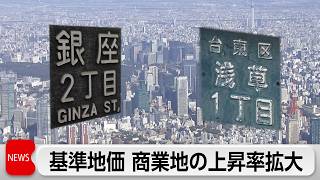
TOKYO - Japan's benchmark land prices rose for a fifth consecutive year on average, with commercial land posting stronger gains as demand for hotels and other properties remained firm in major cities, according to figures released by the Ministry of Land, Infrastructure, Transport and Tourism.

The nationwide average price across all land-use categories rose 1.5%, while residential land increased 1.0% and commercial land climbed 2.9%, with the pace of growth in commercial areas accelerating.

The Meidi-Ya Ginza Building in Tokyo's Ginza district remained the country's most expensive commercial site for the 21st consecutive year, valued at 52.5 million yen per square meter.

In the Tokyo metropolitan area, The House Asakusa in Taito Ward recorded the largest increase, with its benchmark land price rising 26.9%.

The pace of land price increases expanded in the Tokyo and Osaka metropolitan areas, while the rate of increase slowed in the Nagoya metropolitan area, as well as in Sapporo and Fukuoka.

The latest land price survey also showed particularly strong gains in Osaka Prefecture, where seven of the 10 commercial sites with the highest rates of increase were located in Osaka City's Nishi Ward.

Residential land prices in Osaka Prefecture rose 3.0%, while commercial land prices climbed 8.8%. It was the first time in 36 years that residential land prices had risen by 3% or more and the first time in seven years that commercial land had gained at least 8%.

The prefecture's most expensive residential site was in Shinpo-incho in Osaka City's Tennoji Ward, an area known for its concentration of educational institutions. The site, which has ranked first for 27 consecutive years, was valued at 874,000 yen per square meter.

It also recorded Osaka Prefecture's highest residential land price increase at 11.2%.

The rise is believed to have been driven in part by so-called "education migration," in which wealthy families from Japan and overseas move to the area to gain access to sought-after educational opportunities.

Naniwa Ward, which had recorded Osaka City's highest rate of land price growth last year as demand for short-term rental accommodation increased, disappeared from the top 10 this year following the suspension of new special-zone minpaku applications.

In the commercial category, the Deka Ebisubashi Building in Osaka City's Chuo Ward returned to the top position for the first time in seven years, replacing the South Building of Grand Front Osaka in Kita Ward.

The Ebisubashi property was valued at 25.8 million yen per square meter, up 7.1%.

The Umekita area around Osaka Station, which has recorded sharp land price increases in recent years, saw growth slow across many locations. The area contains numerous large development sites, making projects particularly exposed to rising construction costs.

By contrast, Nishi Ward accounted for seven of the 10 commercial locations with the largest increases in Osaka Prefecture.

The ward offers convenient access to both Umeda and Namba, and is expected to benefit further from the opening of a new station on the Naniwasuji Line.

An appraiser involved in the survey said future trends will require close attention to the possibility of a further decline in demand for short-term rentals as regulations are tightened, as well as the impact of rising interest rates on property values.

Source: テレ東BIZ

News On Japan
POPULAR NEWS

A tropical depression far south of Japan is expected to develop into a typhoon as early as the night of September 15, potentially approaching Okinawa during the Silver Week holiday period before changing course and bringing heavy rain to other parts of the country.

A Japan Air Self-Defense Force Global Hawk unmanned reconnaissance aircraft went missing over international waters about 50 kilometers north of Tottori Prefecture on September 15, with floating debris and oil later found in the area where communications were lost.

GO, Waymo and Nihon Kotsu said they aim to launch Japan's first commercial fully driverless taxi service in Tokyo during 2027, using Level 4 autonomous vehicles that can operate without a driver on board under specified conditions.

Kajima Corp. has unveiled the construction site of KAJIMA TREE, a roughly 60-meter wooden tower being built for the International Horticultural Expo that will open in March 2027.

Climbers who get into trouble on Mount Fuji during the official closed season could be charged for rescue by disaster-prevention helicopters under new safety measures being considered by Yamanashi Prefecture.

MEDIA CHANNELS
         

MORE Business NEWS

Japan's benchmark land prices rose for a fifth consecutive year on average, with commercial land posting stronger gains as demand for hotels and other properties remained firm in major cities, according to figures released by the Ministry of Land, Infrastructure, Transport and Tourism.

Tokyo stocks ended almost unchanged on September 15, with the Nikkei 225 closing around 63,485, down about 8 points, as a rebound in SoftBank Group and selected artificial intelligence-related shares offset caution over oil above $107, rising bond yields and this week’s Federal Reserve and Bank of Japan policy meetings.

The Osaka prefectural and municipal governments said on September 14 that they have set a minimum sale price of 92.113 billion yen for the second-phase development area on Yumeshima, the site of the Osaka-Kansai Expo.

Rising long-term interest rates in Japan and the United States are increasing pressure on households and businesses, with more than 5,600 additional small and midsize Japanese companies at risk of falling into the red if borrowing rates rise by 0.5 percentage point.

Rakuten Mobile said on September 14 that it has withdrawn a plan to forcibly cancel mobile service contracts for customers who fail to link their accounts to a Rakuten ID by the end of November.

Tokyo stocks were mixed on September 14, with the Nikkei 225 closing at 63,499, down 511.89 points, as selling in artificial intelligence and semiconductor-related shares weighed on the headline index, while the broader TOPIX rose 32.88 points to 4,061.18 on buying in value, defensive and domestic-demand shares.

Japan's major banks are intensifying competition for household money as rising interest rates revive the appeal of deposits, prompting lenders to launch new savings products, wealth-management services and point-based incentives.

Japan is facing growing pressure over its treatment and recruitment of foreign workers, with serious allegations of abuse emerging even as companies compete for a shrinking pool of overseas labor and some industries approach government-set limits on the number of workers they can accept.