Japan has one of the strictest crypto rulebooks among major economies. A trader in Tokyo can open a licensed exchange app and buy USDC with yen. If the same trader searches for USDT, nothing comes up.
That gap isn't an accident. It comes from law, reserves, and one question Japanese regulators always ask: who is responsible here if something breaks?
The split looks odd at first. USDT is the largest stablecoin by supply, and it's the default trading pair on most global venues. So why would a large, wealthy market skip it?
The answer matters beyond exchange order books, because it shapes where Japanese users can actually spend their dollars. A person who keeps USDC on a licensed local exchange but wants to play at BetFury, a Tether online casino, soon learns that the two coins don't travel the same roads inside Japan.
How Japan Defines a Stablecoin Under the Payment Services Act
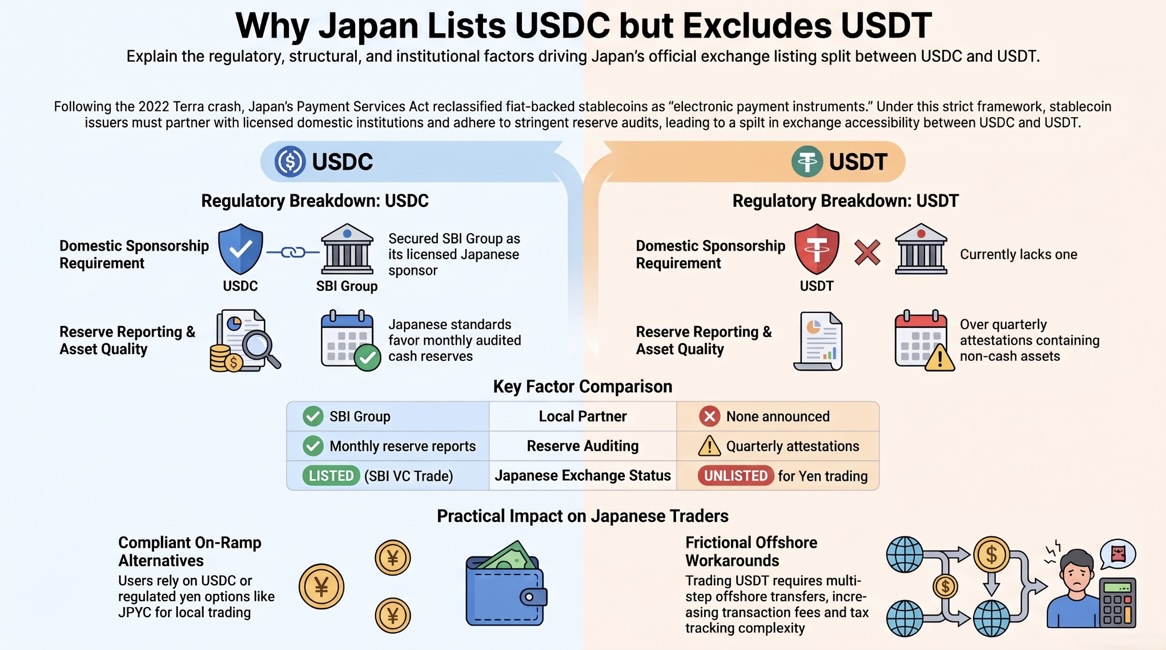
Japan didn't start from zero. It reacted to real losses. The government had banned the use and distribution of foreign-issued stablecoins in the country after the Terra collapse in 2022, and new rules took effect in June 2023. Under those rules, a fiat-backed stablecoin is treated as an "electronic payment instrument," which puts it closer to digital cash than to a speculative token. Only three kinds of licensed domestic entities can issue these coins: banks, fund transfer service providers, and trust companies. That design leaves little room for an offshore company with no Japanese license. And that's the whole point.
The Extra License Exchanges Need
A normal crypto exchange license isn't enough. Since June 1, 2023, firms that distribute stablecoins linked to legal tender must register under the Payment Services Act or the Banking Act. So an exchange that wants to list a foreign stablecoin needs a second registration, plus a coin that meets Japan's standards.
How USDC Got Through the Door
USDC entered through a partnership, not a loophole. SBI Holdings signed a memorandum of understanding with Circle, the issuer of USDC, in November 2023. Then on March 4, 2025, SBI VC Trade completed its registration as an "Electronic Payment Instruments Exchange Service Provider," becoming the first firm in Japan able to handle USDC. A beta version of USDC services opened for certain users on March 12.
A useful way to see this is through Japanese pharmacy rules. A foreign drug can't just show up on a shelf in Osaka. A registered local company has to hold the marketing authorization and answer to regulators. USDC found its local license holder in SBI. USDT, so far, hasn't.
Here's how the two coins compare on the points Japanese regulators seem to care about most:
| Factor | USDC | USDT |
|---|---|---|
| Issuer | Circle | Tether |
| Reserve reporting | Monthly reserve reports | Quarterly attestations from BDO Italia |
| Japanese partner | SBI Group | None announced |
| Status on FSA-registered exchanges | Listed on SBI VC Trade since 2025 | Not listed for yen trading as of July 2026 |
Why USDT Hasn't Qualified in Japan
No single rule says "USDT is banned." The problem is a pile of smaller gaps. Some matter more than others.
Reserve Structure and Reporting
Tether's reserves are large. Its June 30, 2026 report showed $187.75 billion in total assets against $183.64 billion in liabilities. But Japanese rules favor cash-like backing held under strict custody, and Tether's mix has included assets such as Bitcoin and gold. Its reports are attestations, not full audits. There's also history. In 2021, Tether settled with the New York Attorney General for $18.5 million and with the CFTC for $41 million over past reserve claims. For a regulator that rebuilt its rules after the Terra crash, that record probably carries weight.
No Local Sponsor
This one is simple. Analysts point to the absence of a licensed Japanese distribution partner as a major hurdle for USDT. Without one, there's no domestic firm to hold accountable.
Does Tether Even Want Japan?
It might not be a priority. Tether earns its volume in markets where people lack stable local currency, and Japan has a stable yen and a deep banking system. Asking Tether to rebuild its reserve setup for one strict market could simply cost more than it's worth. That's an inference, though. Tether hasn't said so publicly.
The June 2026 Rule Change and What It Means
Japan recently made the path for foreign coins more formal. The FSA amended its rules to recognize certain foreign-issued stablecoins as electronic payment instruments, with the framework taking effect on June 1, 2026. It applies to foreign trust arrangements that the agency sees as equivalent to Japan's own stablecoin regime.
Does that open the door for USDT? Not yet. The FSA hasn't confirmed that USDT qualifies, and there's no official statement saying it does. The equivalence test, if anything, raises the bar, because it asks whether the issuer's home-country supervision looks like Japan's.
Japan isn't alone in this stance. Tether's USDT hasn't received MiCA authorization in the European Union, and several Canadian platforms dropped USDT in 2023 after regulators there required stablecoin undertakings. The pattern in Canadian crypto rules looks a lot like Japan's: clear guardrails first, listings second.
What This Means for Everyday Users in Japan
For most people, the effect is practical rather than legal. Holding and trading USDT is legal for Japanese residents. It just isn't sold on domestic licensed exchanges.
Anyone who has tried to move USDT into a Japanese exchange account knows the routine. The deposit screen doesn't list it. So the usual workaround is to buy a major coin locally, send it abroad, and swap it there. It works. It's also slower, and each hop adds fees and tax paperwork.
A few other effects show up in daily use:
- USDC is the easier dollar option for anyone who wants to stay inside the regulated system.
- Yen stablecoins are growing too. JPYC launched in October 2025 as the first fully regulated yen-pegged stablecoin.
- Some traders turn to self-custody wallets and on-chain swaps, which means learning the difference between centralized and decentralized exchanges and accepting that no Japanese regulator stands behind a decentralized trade.
- Taxes don't change based on the coin. Crypto gains in Japan are taxed as miscellaneous income, and stablecoin swaps get no special break.
The official rules sit on the Financial Services Agency website, and Tether publishes its reserve data on its transparency page. Reading both side by side explains more than most headlines do.
Japan's position is less about picking a winner and more about picking a structure. USDC fit that structure because a Japanese financial group agreed to stand behind it. If Tether ever finds a local partner and changes how it reports reserves, the listing question could look very different. Until then, the yen-to-USDT button on Japanese exchanges will likely stay missing.