News On Japan

Okinawa Kids Munch on Traditional Sweets

NAHA - A long-established tofu shop in Naha, Okinawa Prefecture, provided traditional Japanese sweets made from tofu byproducts to elementary and junior high school students on November 2nd to celebrate the completion of Shuri Castle's restored main hall.

The initiative was organized by Shuri Tofu, a longstanding tofu maker based in Naha's Shuri district, which wanted to share the celebration of the reconstruction of Shuri Castle's main hall, a symbol of Okinawa's culture and history.

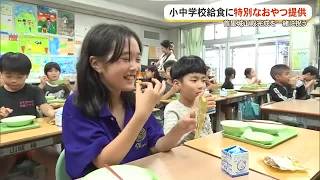
The company prepared karinto, a traditional crunchy Japanese snack, using okara, the soybean pulp left over from tofu production. The sweets were distributed as part of school lunches at elementary and junior high schools across the city.

At Josei Elementary School, located next to Shuri Castle, students received the special treats alongside their regular lunch.

Fourth-grade student Anna Kishikawa praised the snack's flavor and texture, saying, "It tastes like brown sugar. It's crunchy and has a really nice texture. It's delicious."

Another fourth-grade student, Ema Taba, expressed excitement about the castle's restoration after it was destroyed by fire in 2019. "It burned down once, but I'm happy to see it gradually coming back," she said. Asked whom she would like to visit the completed castle with, she replied, "My mom and dad."

The children enjoyed the traditional sweets while looking forward to the official unveiling of Shuri Castle's reconstructed main hall, marking another milestone in the recovery of one of Okinawa's most important cultural landmarks.

Source: 沖縄ニュースOTV

News On Japan
POPULAR NEWS

Northern Japan experienced record-breaking cold on the morning of November 11th, with temperatures plunging to minus 20.2 degrees Celsius in Horokanai, Hokkaido, marking the first time in Japan's recorded history that temperatures have fallen below minus 20 degrees during the first half of November.

East Japan Railway (JR East) announced on November 10th that it will introduce touch-free ticket gates at 40 stations, including every station on Tokyo's Yamanote Line, from spring 2028, allowing passengers using Mobile Suica to pass through without taking their smartphones out of their pockets or bags.

Japan's Children and Families Agency unveiled its first national guidelines on November 10th for parental involvement in children's internet use, dividing those aged 0 to 18 into six developmental stages as the government considers tighter regulations on social media platforms to protect young people from online bullying, exploitation, and other growing risks.

As of 3 a.m. on Wednesday, November 11, Typhoon No. 32 was moving east-northeast over waters east of Chichijima in the Ogasawara Islands, gradually heading away from the Japanese archipelago after passing near the island between late Tuesday night and early Wednesday morning.

Odakyu Electric Railway unveiled images of its next-generation Romancecar limited express train on November 10, revealing a striking blue-green design featuring enormous circular windows that will allow passengers to enjoy panoramic views from ceiling to floor when the new trains enter service in March 2029.

MEDIA CHANNELS
         

MORE Education NEWS

A 31-year-old Japanese researcher who moved to an indigenous village in eastern Taiwan four years ago to study the Rukai people has become an active member of the community, helping preserve traditional ceremonies and customs while learning the importance of protecting cultural values that remain unchanged across generations.

Shizuoka City, which promotes itself as the "World Capital of Models," is using plastic model kits as teaching materials in junior high schools, hoping to cultivate future leaders in the model industry.

A Japanese slang term describing children hooked on the instant stimulation of short videos and social media has been nominated for the country's 2026 New Words and Buzzwords Awards, highlighting growing concerns about declining attention spans and the pressure to consume digital content at ever-increasing speeds.

Delivery rooms in Japan are some of the safest with fewer than two infant deaths per 1,000 births. As a result, many families may assume that complications during delivery are unlikely to happen to them.

Late-night Slack pings, back-to-back video calls, and relentless release cycles have become routine for many working in technology. Employees are often handed access to meditation apps, yoga classes, or lunchtime breathing sessions as a way to “beat burnout.”

Japanese calligraphy is set to be added to UNESCO's Intangible Cultural Heritage list after an evaluation body recommended its registration on November 5th, paving the way for the traditional art form to become Japan's 24th entry and its first since traditional sake brewing was recognized in 2024.

A long-established tofu shop in Naha, Okinawa Prefecture, provided traditional Japanese sweets made from tofu byproducts to elementary and junior high school students on November 2nd to celebrate the completion of Shuri Castle's restored main hall.

Most conversations about depression care in Japan stop at stigma. That's a real barrier, and it keeps a great many people from ever naming what they're experiencing, let alone booking an appointment. But there's a second barrier, and it sits on the other side of the door.