TOKYO - Japanese companies are facing growing pressure to redesign their investor relations strategies as institutional and individual investors increasingly rely on artificial intelligence to analyze corporate information, identify investment opportunities and make financial decisions.
Companies that fail to make their information accessible to AI risk being overlooked entirely by investors, regardless of their underlying business performance or growth potential.
Research firm Envalis provides commissioned analyst reports to companies, distributing them to institutional investors worldwide while publishing information through its own website and social media platforms.
Its president, Koichi Kawai, spent 13 years at Goldman Sachs before establishing the company last year. During his time at the investment bank, Kawai witnessed the sophisticated investor relations practices of major corporations. However, his subsequent experience working on an initial public offering and investor relations at a startup exposed him to the difficulties facing smaller companies.
Japan has approximately 4,000 listed companies, around 3,000 of which have a market capitalization of less than 100 billion yen. Many struggle to attract meeting requests from institutional investors, limiting opportunities to build relationships and gain recognition in capital markets.
The shortage of equity analysts is compounding the problem. Younger analysts are increasingly moving into activist funds, private equity and institutional investment roles in pursuit of higher returns, while the average age of established top analysts has exceeded 50.
Approximately 70% of Japan's listed companies receive no analyst coverage. For some businesses, going public effectively becomes the ultimate objective rather than the beginning of a new phase of growth. The lack of research coverage also makes it difficult for existing listed companies to promote a better understanding of their businesses and improve trading liquidity.
Kawai believes companies must fundamentally rethink how they communicate with capital markets as the primary audience for corporate disclosures gradually shifts from humans to AI.
According to figures cited by Kawai, 62% of individual investors in the United States and 87% of institutional investors use AI to explore and compare investment strategies and identify opportunities to generate returns above market benchmarks.
When investors use AI-powered financial platforms to identify promising companies within a particular industry, businesses whose information cannot be processed by AI may not even appear among the candidates.
"Information that cannot be read by AI is effectively the same as not existing in the capital markets," Kawai said.
A significant disparity already exists between the volume of information available about prominent companies with market capitalizations exceeding 1 trillion yen and the approximately 3,000 smaller listed companies valued at less than 100 billion yen. Investor relations departments at small and midsize companies are also not necessarily proactive in expanding their disclosures.
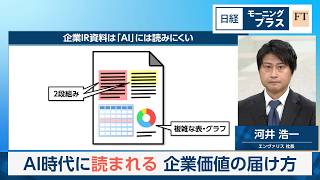
Another major obstacle is the widespread reliance on PDF documents. Japanese companies typically publish earnings summaries, securities reports, investor relations presentations and integrated reports in PDF format.
Although these documents are designed to be visually accessible to human readers, AI systems may interpret them largely as collections of positional data intended for printing.
Charts, two-column layouts and complex financial tables can make it difficult for AI to correctly associate figures with corresponding reporting periods or business segments. Important context explaining changes in financial performance may also be lost during automated analysis.
Kawai believes publishing corporate information in HTML rather than relying exclusively on PDFs would make disclosures more accessible to AI systems.
Envalis identifies three priorities for effective corporate communication in the AI era: presenting conclusions first, structuring information so that individual sections can be extracted independently, and maintaining a consistent corporate narrative.
The company publishes its research on openly accessible websites without requiring users to log in. Information is available in Japanese, English, Chinese and other languages, with text used in place of PDFs and images wherever possible to facilitate automated processing.
Reports begin with a single-line conclusion, followed by concise points summarizing key findings. Reporting periods, comparison benchmarks and units of measurement are explicitly stated to ensure that AI systems can accurately identify which business segments are growing and by how much.
Such structures are particularly important because generative AI systems often extract individual passages relevant to an investor's question rather than processing entire documents as a continuous narrative.
For Japanese companies seeking greater visibility in global capital markets, making corporate disclosures accessible to AI is becoming an increasingly important part of communicating business strengths, improving investor understanding and ensuring that corporate value is accurately recognized.
Source: テレ東BIZ