News On Japan

Efforts underway to end 'period poverty' in Japan

Apr 30, 2021 (Japan Times) - As the coronavirus pandemic puts strain on the economy, Japan is finally moving toward tackling the phenomenon of “period poverty” facing many women. But campaigners say there are a number of hurdles still to overcome in a country that has often treated menstruation as a taboo subject.

The central government last month decided to set aside funds to support women who cannot afford to purchase sanitary items such as pads or tampons, while some municipalities have launched programs to distribute the goods for free.

The moves come amid growing calls for gender equality in Japan, a country that languishes in last place among developed nations in female empowerment, with a big gender gap in earnings.

Most women, for whom monthly menstruation generally lasts from their teens into their 50s, in principle need to keep purchasing sanitary goods, and sometimes painkillers, too, for dozens of years.

However, cuts in jobs and wages due to the economic downturn spurred by the coronavirus pandemic have shed light on the difficulties many women face in paying for such products — an issue that had previously gone under the radar.

Despite menstruation being a natural bodily function, discussion of related issues has been hampered in a country whose two major religious traditions — Shinto and Buddhism — have long shunned blood for its “uncleanliness.”

According to the World Economic Forum report, the average Japanese woman’s income was 43.7% lower than that of a Japanese man’s.

#MinnanoSeiri, an advocacy group calling for equal access to period products, said about 20% of its survey respondents struggled to purchase such item due to financial reasons.

News On Japan
POPULAR NEWS

Two aircraft believed to be Russian briefly violated Japanese airspace over Okinoshima Island in Fukuoka Prefecture on November 17th before flying between Okinawa and Taiwan toward the Pacific Ocean, prompting Japan's defense minister to condemn the incursions as a serious violation of national sovereignty.

A woman in her 20s was stabbed to death on a residential street near JR Nakano Station in Tokyo on the evening of November 16th, with police arresting a man in his 30s or 40s approximately 90 minutes later on suspicion of attempted robbery-murder after he allegedly attacked the woman with a knife and fled with her handbag.

Japan's Fugaku supercomputer has been temporarily shut down following unauthorized external access to a system used to connect to the facility, raising concerns that user information may have been leaked, the Riken research institute announced on November 16th.

A 42-year-old man has been arrested on suspicion of murdering former fashion model Kanako Kawabata, 36, who was found dead in her apartment in Tokyo's Ikebukuro district in July, with investigators believing she was repeatedly beaten across her body, leaving her with severe head injuries and multiple fractured ribs.

A historic guest hall at Kodaiji Temple in Kyoto, closely associated with Nene, the wife of warlord Toyotomi Hideyoshi, has been reconstructed for the first time in approximately 240 years, restoring a lavish space once used by Hideyoshi to entertain feudal lords.

MEDIA CHANNELS
         

MORE Society NEWS

A 30-year-old man known as the "Emperor of Guri-Shita" among young people gathering beneath a popular landmark in Osaka's Dotonbori entertainment district has been arrested on suspicion of sexually assaulting a girl and illegally referring four young people to a demolition contractor in exchange for fees, Osaka Prefectural Police said.

A 42-year-old man has been arrested on suspicion of murdering former fashion model Kanako Kawabata, 36, who was found dead in her apartment in Tokyo's Ikebukuro district in July, with investigators believing she was repeatedly beaten across her body, leaving her with severe head injuries and multiple fractured ribs.

Three people, including a popular Instagram influencer with more than 800,000 followers, have been arrested on suspicion of operating a bar offering customer entertainment services without a license in Nagoya.

Japan's Emperor Naruhito and Empress Masako released young fish into Osaka Bay on November 15 during a national marine conservation event, where around 100 fishing boats flying colorful flags welcomed the imperial couple with a parade despite rainy weather.

A crowd of 2,300 people dressed as Santa Claus marched through Tokyo's Shibuya district in the rain on November 15 as part of a charity event aimed at supporting children battling serious illnesses in Japan and those unable to receive adequate medical care overseas.

Japanese singer and actress Kyoko Koizumi has launched a forest restoration initiative aimed at planting 3,000 acorn-producing trees in the mountains of northeastern Japan, hoping to create a richer habitat for bears and other wildlife following a sharp increase in bear attacks across the country.

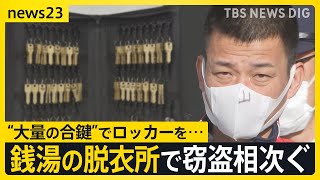
A series of thefts at public bathhouses across the Tokyo metropolitan area has been linked to a large organized Chinese theft ring suspected of using hundreds of duplicate locker keys to steal cash and replace credit card IC chips while customers are bathing, leaving victims unaware that their cards have been compromised.

An artwork installed in Kyoto's historic Takase River has been broken in half during an autumn art festival, with organizers expressing anger after discovering that the sculpture had suffered further damage despite already being found broken two days earlier.