SHIZUOKA, May 09, 2024 (News On Japan) - During the second round of the Super GT at Fuji Speedway on May 4th, Tsuchiya Takeshi, director of the "Hoppy Team Tsuchiya," set a simple yet profound goal before the staff: "First and foremost, our goal is to take the chequered flag. That's my primary goal, to do it in front of everyone here."
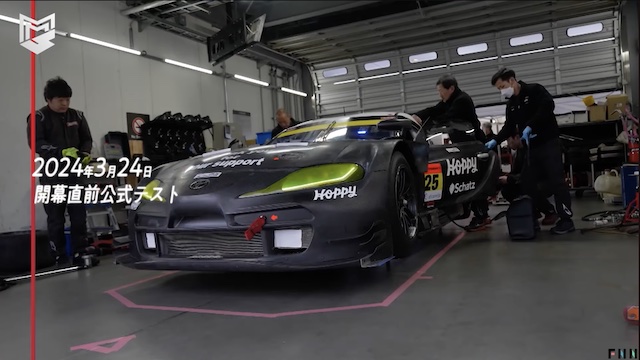
About six weeks prior to this day, on March 24th, the team was at Fuji Speedway for the pre-season official test. The team's car, still not fully painted, was wrapped in a stark black body. Despite the pouring rain, Tsuchiya watched over the black car completing laps like a parent watching over a child. "This really feels like the first real shake-down. Being here, able to do this, feels incredibly fortunate," he said.
In the frantic rush to develop and set up the car just before the season opener, being at the track felt like a blessing. Aiming for victory yet setting the primary goal of merely taking the chequered flag highlights the trials the team has faced.
Located in Fujisawa City, Kanagawa Prefecture, "Hoppy Team Tsuchiya's" base, Tsuchiya Engineering, was founded in 1971 by Tsuchiya Takeshi's father, Haruo. It has been a small town factory team, known as a "fighting privateer," building cars independently of major automotive manufacturers and winning races with craftsman skills and ingenuity for over 50 years.
Taking over the team founded by his father, the second-generation director, Tsuchiya Takeshi, has continued the legacy. The team's car, nicknamed "Hopi-ko" after the main sponsor's name, has been a beloved figure among fans.
However, on August 6th last year, during the fourth round of the Super GT at Fuji Speedway, Tsuchiya witnessed a sight he wished he hadn't: "On August 6th, it's etched in my mind – during the middle of the race, an exhaust problem led to the car catching fire and burning completely. It was like a nightmare."
The car was engulfed in flames and smoke, completely burned down. The team was forced to withdraw from racing for the rest of the season as there were no funds left to prepare a new car.
Was this the limit for a privateer team?
What saved Tsuchiya from this dark time was the voice of fans hoping for "Hopi-ko's" revival. "On social media, so many fans were saying 'don't give up.' Being so wanted by so many people, the only thing I can do is to move forward."
Spurred by fans, Tsuchiya launched the "Hopi-ko Revival Project." Approximately 30 million yen in support was gathered from enthusiastic fans and stakeholders.
By September, there was a glimpse of light for the team. "First, we'll respond to everyone's feelings. We'll revive this car and get it back on the race track."
The revival of Hopi-ko and its return to racing were largely due to the younger members of Tsuchiya Engineering, inheriting the craftsman spirit, who rebuilt about 90% of the car based on the miraculously remaining main frame.
The "fighting privateer," Team Tsuchiya, had its daily routine back.
This journey brought the team to the initial shakedown just before the season opener on March 24th.
Then, on April 14th, at the Super GT 2024 season opener at Okayama International Circuit, Hopi-ko appeared fully painted from its plain black body.
The car finished 14th in this race, marking a successful return to racing. The team was rejuvenated, and Tsuchiya's spirits were high.
"Instead of feeling sentimental about the comeback race, there was none of that. I just wanted to race, honestly. It's been a long time since I've felt this much love for racing, all thanks to Hopi-ko and everyone's support."
On the day of the Super GT's second round, last August, Hopi-ko had burned down at Fuji Speedway, where Tsuchiya now faced the final race.
His thoughts were clear: "Just take the chequered flag. Coming back here, the biggest hurdle is to take the chequered flag, which we couldn't last year."
Facing the home straight, in the grandstand directly in front of the team's pit, many fans gathered, sharing their emotions for Hopi-ko.
"Firstly, thank you for coming back. Just finishing the race safely and seeing Hopi-ko healthy again makes us happy," shared a fan from the stands.
Minako Ishiwatari, co-team owner, also shared her deep feelings while caressing Hopi-ko, "It's really good. Truly, thanks to everyone, Hopi-ko could come back."
With all these sentiments, Hopi-ko raced through Fuji's course, aiming for the chequered flag that was unattainable that day.
The final was a three-hour race, passed among three drivers, and eight months after the nightmare, Hopi-ko splendidly took the chequered flag, achieving the team's goal.
Tsuchiya rushed to the pit wall, waving to the fans in the stands, "Finishing a race might seem quite normal, but it's really a joy."
"After that incident here at Fuji, we've managed to give a little back to everyone. I want to race in a way that makes everyone even happier."
On the sticker plastered at the top of the front window read, "Racing again with you!"
Now, it's Hopi-ko pushing everyone forward. "It feels like Hopi-ko is kicking our backsides, telling us 'you all need to work harder.' We really have to try."
Looking forward to the Super GT's third-round final on June 2nd, Tsuchiya was also facing forward.
Source: FNN