Building a circle in Minecraft without help is a geometry problem most players don’t want to solve.
The block grid doesn’t cooperate with curves. Every diameter requires a different block pattern.
What a Minecraft Circle Graph Actually Shows
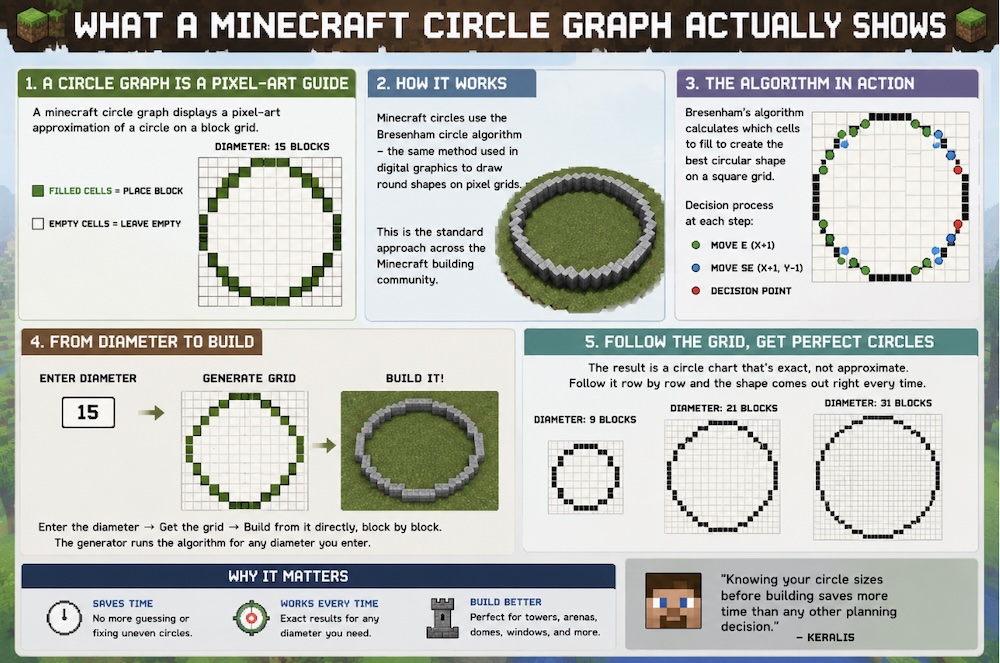
A minecraft circle graph displays a pixel-art approximation of a circle on a block grid. Each cell represents one block. Filled cells are placed. Empty cells aren’t.
This works because Minecraft circles use the Bresenham circle algorithm — the same method used in digital graphics to draw round shapes on pixel grids. Kotaku’s building-guide coverage has pointed to this as the standard approach across the building community, confirming it as the go-to method for curved builds in the game rather than one option among many.
A circle generator minecraft solves the underlying geometry problem with a visual circle chart. Enter the diameter. Get the grid. Build from it directly, block by block. The generator runs that algorithm for any diameter you enter, and the result is a circle chart that’s exact, not approximate. Follow it row by row and the shape comes out right every time.
How to Read and Use the Circle Chart
Reading a circle Minecraft chart is straightforward once you understand the grid:
The generator displays a square grid with filled and empty squares
Each filled square is a block you place in-game
Read the grid row by row, left to right
For 3D builds, use the same pattern at each height layer
For domes, use decreasing diameters as you build upward
The minecraft circle graph adjusts automatically for odd and even diameters. Odd diameters have a clear center block. Even ones have a 2×2 center. The chart handles both without any extra math from you.
Circle Chart Minecraft: Which Sizes Work Best
Not all circle sizes work equally well on a block grid. Smaller circles (under 10 blocks) tend to look more like octagons. Sizes from 15 blocks and up produce rounder, more convincing results.
A circle chart minecraft builders commonly use for:
Towers: 15–25 block diameter gives good wall thickness with interior room
Arenas: 40–60 block diameter creates a proper fighting space
Domes: stack multiple decreasing circles from 30+ blocks down to 1
Decorative details: 7–12 block circles for windows, portals, or floor patterns
Architect and Minecraft builder Keralis, known for his large-scale city projects, has noted that knowing your circle sizes before building “saves more time than any other planning decision.” The chart makes that knowledge instant.
Fixing a Circle That’s Already Gone Wrong
Even with a chart, mistakes happen — usually from losing track of which row you’re on partway through a large build. If a circle looks off once you’ve placed a dozen rows, the fastest fix isn’t to tear it all down. Compare your current row against the generator’s output at that same height, find where the count diverges, and correct outward from that point rather than redoing the whole shape. This is one of the main reasons builders work in quarters rather than going around the full circle in one pass — a mistake in one quarter stays contained instead of throwing off the entire structure.
Big Circles Need a Server That Can Keep Up
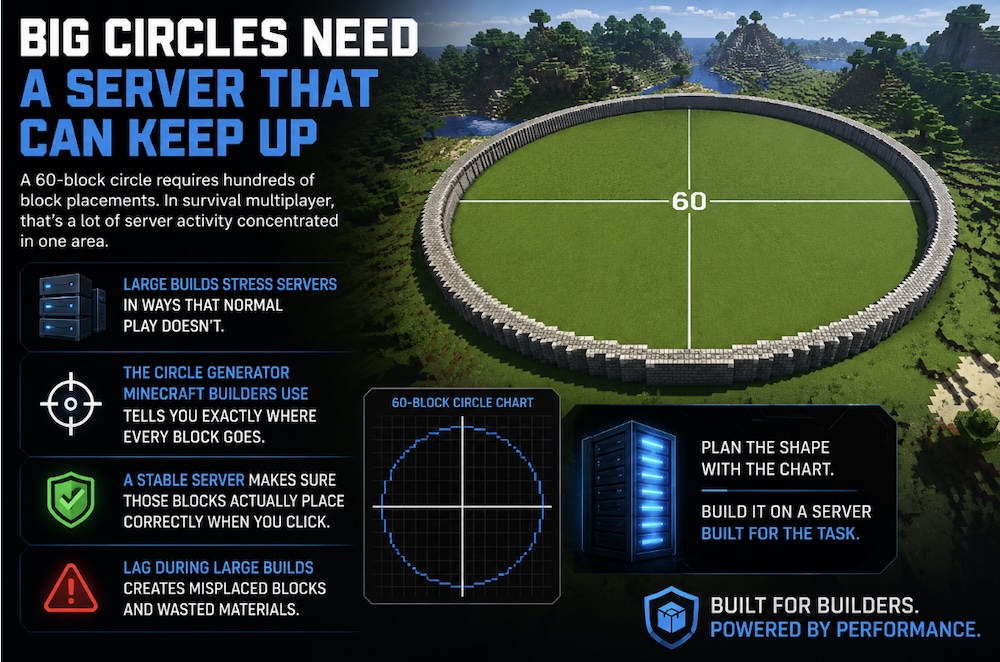
A 60-block circle requires hundreds of block placements. In survival multiplayer, that’s a lot of server activity concentrated in one area. Large builds stress servers in ways that normal play doesn’t.
The circle generator minecraft builders use tells you exactly where every block goes. A stable server makes sure those blocks actually place correctly when you click. Lag during large builds creates misplaced blocks and wasted materials.
Plan the shape with the chart. Build it on a server built for the task.