TOKYO - Tokyo stocks ended mixed on September 3, with the Nikkei 225 closing at 64,214.48, down 111.16 points, as uncertainty over interest rates and currencies kept pressure on risk assets, while the broader TOPIX rose 0.5% to 4,102.04.
The Nikkei fell for a fourth straight session and posted its lowest close in about a month. The index opened higher after Wall Street gained overnight, briefly recovered in morning trading, then lost direction as investors weighed a stronger yen, Bank of Japan rate-hike expectations, falling energy shares and renewed caution toward artificial intelligence and semiconductor-related stocks.
Prime Market trading value totaled about 7.5770 trillion yen, remaining below the 10 trillion yen level that had characterized more active sessions earlier in the summer. Trading volume was about 2.18832 billion shares. Market breadth was mildly positive, with 805 stocks rising, 685 falling and 65 unchanged, showing that the broader market was firmer than the Nikkei’s decline suggested.
The Nikkei briefly fell as low as 63,772.80, slipping below 64,000 for the first time since early August, before recovering part of the loss into the close. The rebound from the day’s low suggested that investors were still willing to buy dips, but the index could not return to positive territory.
The TOPIX’s gain again highlighted a widening split inside the Tokyo market. While the Nikkei remained vulnerable to weakness in high-priced technology, retail and AI-related shares, money continued to flow into trading houses, selected financials, machinery and value-oriented stocks.
Nikkei CNBC-style market commentary would likely focus on the market’s struggle for direction after the previous day’s oil- and bond-driven selloff. The Nikkei avoided another sharp fall, but investors were reluctant to chase shares higher because the main macro risks remained unresolved.
The first risk was currency volatility. The yen strengthened sharply, rising to around 156.71 per dollar after briefly reaching its strongest level in about a month. The move followed hawkish comments from Bank of Japan board member Hajime Takata, who said the central bank should raise rates nimbly to prevent inflation from overshooting.
The yen’s rebound changed the tone of the equity market. A stronger yen helps reduce imported inflation pressure for households and companies, but it also weighs on exporters by reducing the yen value of overseas earnings. That hurt sentiment toward some manufacturing and export-linked names.
The yen’s move also revived debate over whether Japan’s currency is now being driven more by BOJ expectations than by intervention risk. Traders stopped short of attributing the latest rally to official action, instead pointing to the market’s reassessment of the likely pace of Japanese rate increases.
Markets are now close to fully pricing in a BOJ rate hike at the September 17-18 meeting. That has become the central domestic event for investors after Governor Kazuo Ueda said the board would debate whether inflation risks were increasing and whether the economy remained on track with the BOJ’s baseline scenario.
Ueda said the BOJ wants to continue raising interest rates while financial conditions remain accommodative, but also needs to assess the cumulative impact of five previous rate increases. His comments suggested that a September hike is possible, though not guaranteed.
Takata’s comments were more hawkish. He argued that the BOJ should raise rates flexibly rather than follow a fixed semiannual pace, adding to market expectations that the central bank may tighten sooner than previously assumed.
The BOJ kept its policy rate at 1% at the July 30-31 meeting, but Takata dissented in favor of raising it to 1.25%. Since then, the weak yen, higher oil prices, elevated producer prices and stronger inflation signals have pushed investors toward the view that another increase is likely this month.
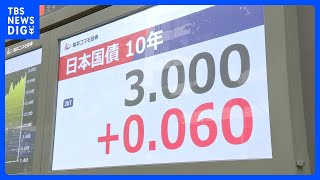
The second risk was the bond market. Japan’s 10-year government bond yield had touched 3% earlier in the week for the first time since 1996, before easing. The move above 3% marked a major psychological shift after decades of ultra-low interest rates.
On September 3, bond markets showed some relief, with longer-dated Japanese yields retreating after a 30-year bond auction drew decent demand. That helped reduce immediate concern over a disorderly bond selloff, but yields remained high enough to keep pressure on equity valuations and fiscal policy.
Higher yields are especially difficult for technology and growth shares because they raise the discount rate applied to future earnings. That makes investors less willing to pay high multiples for companies tied to AI, semiconductors and other long-term growth themes.
The third risk was oil. Crude prices eased slightly on September 3 after the previous day’s surge, but energy markets remained volatile because of the U.S.-Iran confrontation and concern over shipping routes. For Japan, oil remains a major inflation risk because the country imports most of its energy.
The combination of a stronger yen and softer oil helped reduce some inflation pressure, but not enough to remove concerns over household costs. Food, gasoline, electricity, transport and services remain expensive, and consumers are still sensitive to further price increases.
Energy shares were among the weakest parts of the market. Reuters said Japan’s energy explorer sector fell 3.26%, making it the worst-performing group among the Tokyo Stock Exchange’s 33 industry sectors. Inpex dropped about 4%, while Yokogawa Electric also fell sharply.
The fall in energy names reflected lower crude prices and profit-taking after oil-linked shares had benefited from the September 2 spike. It also showed that investors were rotating away from sectors that had risen on geopolitical risk once oil eased.
Technology and AI-related shares were mixed. Advantest fell 0.8% and Fujikura lost 2.73%, while Kioxia rose 1.31% and Tokyo Electron gained 0.36%. That split showed that the market is no longer treating AI as a single trade.
Kioxia’s rise helped stabilize sentiment toward memory-related shares. The company remains one of Tokyo’s clearest gauges of confidence in high-bandwidth memory, AI servers and data-center demand. Its recent volatility has made it a key reference point for whether investors still trust the AI hardware cycle.
Tokyo Electron’s modest gain suggested that some investors were willing to buy semiconductor-equipment shares after the previous day’s selloff. The company remains central to Japan’s role in global chip manufacturing, but it is still vulnerable to swings in U.S. technology sentiment and bond yields.
Advantest’s weakness weighed on the Nikkei because of the stock’s large influence on the price-weighted index. The chip-testing equipment maker remains one of Japan’s most direct beneficiaries of advanced AI semiconductor demand, but high valuations make it sensitive to interest-rate expectations.
Fujikura’s decline showed that caution also extended to second-wave AI infrastructure names. The company has benefited from demand for optical fiber, cables and high-speed data-center networks, but investors remain quick to take profits after sharp rallies.
SoftBank Group was firm, helping offset some pressure from other technology shares. The company remains one of Tokyo’s most visible proxies for global AI investment sentiment because of its exposure to OpenAI, robotics, digital infrastructure and large-scale technology themes.
Trading houses were among the strongest areas of the market. Mitsubishi Corp., Itochu, Mitsui & Co., Sumitomo Corp. and Marubeni all gained, helping lift TOPIX. Their strength followed reports of comments from Berkshire Hathaway Chief Executive Warren Buffett and renewed interest in Japanese companies with exposure to commodities, global trade, capital efficiency and shareholder returns.
Trading houses continue to attract investors because they combine resource exposure, global earnings, cash-flow generation and shareholder-return potential. In a market unsettled by AI volatility and rate uncertainty, those characteristics remain appealing.
Nitori Holdings jumped 8.41%, making it one of the strongest Nikkei components. The furniture and home-goods retailer benefited from the stronger yen, which can lower import costs and improve margins for companies that source products overseas.
Nitori’s rally showed how quickly currency moves affect sector rotation. When the yen weakens, exporters benefit; when the yen strengthens, importers, retailers and household-goods companies can attract buying.
Sumitomo Heavy Industries rose 5.09%, reflecting buying in machinery and industrial names. Investors continued to seek companies with exposure to infrastructure, energy systems, defense, capital investment and global industrial demand.
Lasertec, Kioxia and Tokyo Electron were firm, while Renesas, Nippon Steel, Resona Holdings, SUMCO, Sumitomo Metal Mining and Mitsubishi Heavy Industries also attracted buying during the session. The strength in these names showed that investors were still willing to buy selected cyclicals, banks, materials and strategic-industry shares.
On the weaker side, Fast Retailing declined and weighed on the Nikkei. Advantest, Ibiden, Fujikura, TDK and Disco also struggled, keeping pressure on the index’s high-priced growth components.
The mixed stock performance showed that Tokyo is now being driven less by a simple AI boom and more by a complicated rotation between rate beneficiaries, importers, exporters, value shares, defensive names and selected AI winners.
Japan’s services data gave investors a stronger domestic backdrop. A private survey showed that the services sector expanded at its fastest pace in five months in August as domestic demand lifted business activity and new work. The broader composite PMI also improved, suggesting that the economy remains resilient enough to handle some further BOJ tightening.
The services data are important because private consumption had looked fragile in recent GDP figures. If services demand is improving, the BOJ has more room to argue that the economy can absorb another rate increase.
However, the same data may also strengthen rate-hike expectations. A stronger domestic economy, combined with sticky inflation and a weak yen, gives the BOJ less reason to delay if it believes underlying inflation is close to its 2% target.
For households, the message is mixed. Stronger services activity suggests consumers are still spending in some areas, but living costs remain elevated. Wage growth has improved, yet many households continue to feel pressure from food, energy, transport and service prices.
TV Tokyo’s broader business themes remain closely connected to this market. Companies are trying to pass on higher labor, logistics, energy and materials costs, while households are deciding whether wage gains are enough to support discretionary spending.
Businesses with pricing power, strong brands, recurring demand or exposure to long-term investment remain better positioned. Firms without pricing power remain vulnerable if costs rise faster than sales.
The yen’s rebound may help import-dependent companies, but it also creates earnings uncertainty for exporters. Automakers, electronics makers and machinery companies had benefited from the dollar near 160, and a move toward the mid-156 range reduces part of that support.
That does not mean a stronger yen is negative for the whole market. It helps reduce imported inflation, lowers costs for retailers and may make the BOJ’s policy path less disruptive if inflation pressure eases. But in the short term, currency volatility makes investors more cautious.
Fiscal policy remained another source of uncertainty. Rising JGB yields are increasing attention on government debt-servicing costs just as ministries and agencies submit large budget requests for the next fiscal year.
Prime Minister Sanae Takaichi’s administration is trying to balance household relief, fiscal credibility and long-term strategic investment. The government’s growth strategy calls for more than 370 trillion yen in public and private investment through fiscal 2040, targeting semiconductors, artificial intelligence, energy security, defense, shipbuilding, robotics, space and other strategic sectors.
That agenda supports many of the companies investors favor, including semiconductor equipment makers, advanced materials suppliers, data-center infrastructure firms, power-system companies, machinery makers and defense-related manufacturers.
But rising yields make investors more sensitive to how the program will be funded. Higher debt-servicing costs reduce fiscal flexibility and raise questions over how the government can finance household relief, defense spending and strategic investment without further increasing borrowing.
The global backdrop was more stable than on September 2 but still uncertain. Asian shares and bonds staged a relief rally as investors waited for U.S. economic data and central bank comments that could determine whether the Federal Reserve raises rates this month.
The U.S. private payrolls report came in weaker than expected, briefly weighing on the dollar and supporting the yen. However, markets continued to price a significant probability of a September Fed rate increase because inflation remains the central concern after Warsh’s hawkish Jackson Hole message.
Friday’s U.S. nonfarm payrolls report is the next major overseas event. Analysts expect job growth to recover after July’s surprise decline, and a solid figure could strengthen Fed rate-hike expectations again.
For Japan, U.S. data matter because they shape the dollar-yen exchange rate. A stronger U.S. labor market or firmer inflation could support U.S. yields and the dollar, putting renewed pressure on the yen. A weaker result could help the yen and ease imported inflation pressure.
The September 11 U.S. consumer price report will be even more important for the Fed outlook. If inflation remains sticky, U.S. rate expectations could rise further, increasing pressure on global growth stocks and Japanese AI-related shares.
The South Korean market remained an important reference point for Tokyo. The Kospi was firm in parts of the session and helped support Japanese shares, but its weakening at times also limited the Nikkei’s recovery. Overseas investors continue to treat Japanese chip-equipment makers, South Korean memory producers, Taiwanese foundries and U.S. AI shares as connected parts of the same global technology trade.
The September 3 session showed that Japan’s market has not fully stabilized after the September 2 shock. The Nikkei avoided another large decline, but the inability to hold early gains reflected uncertainty over currencies, rates, oil and AI valuations.
What to watch next: whether the Nikkei can hold above 64,000 after briefly breaking below that level, whether TOPIX can continue outperforming, and whether trading houses, banks, machinery and import-beneficiary shares keep attracting money.
Investors will also monitor whether Kioxia, Tokyo Electron, Lasertec and SoftBank Group can offset weakness in Advantest, Fujikura, Ibiden and other AI-linked shares. The mixed performance of the sector shows that the AI trade is no longer moving as one block.
The yen around the mid-156 range is now a key macro signal. Further yen strength would ease imported inflation and support retailers, but could hurt exporters. A renewed move toward 160 would revive intervention speculation and reinforce expectations for a BOJ rate hike.
The 10-year JGB yield’s distance from 3% remains another critical factor. A sustained move above that level would pressure equity valuations, mortgages, corporate borrowing and fiscal policy, while a stable retreat would help calm risk assets.
Other key factors will be U.S. nonfarm payrolls, the September 11 U.S. CPI report, Brent crude prices, Middle East developments, BOJ communication before the September 17-18 meeting and the government’s budget process.
September 3 showed that Tokyo’s broader market remains resilient, with TOPIX supported by value shares and trading houses, but the Nikkei is still vulnerable when currency swings, rate uncertainty and uneven AI sentiment weigh on its largest components.