Shizuoka, May 15, 2024 (News On Japan) - A new hotspot has emerged in Japan: The 'Fuji Dream Bridge' along Shizuoka's Route 139, where foreign tourists are risking life and limb to follow the latest TikTok craze.
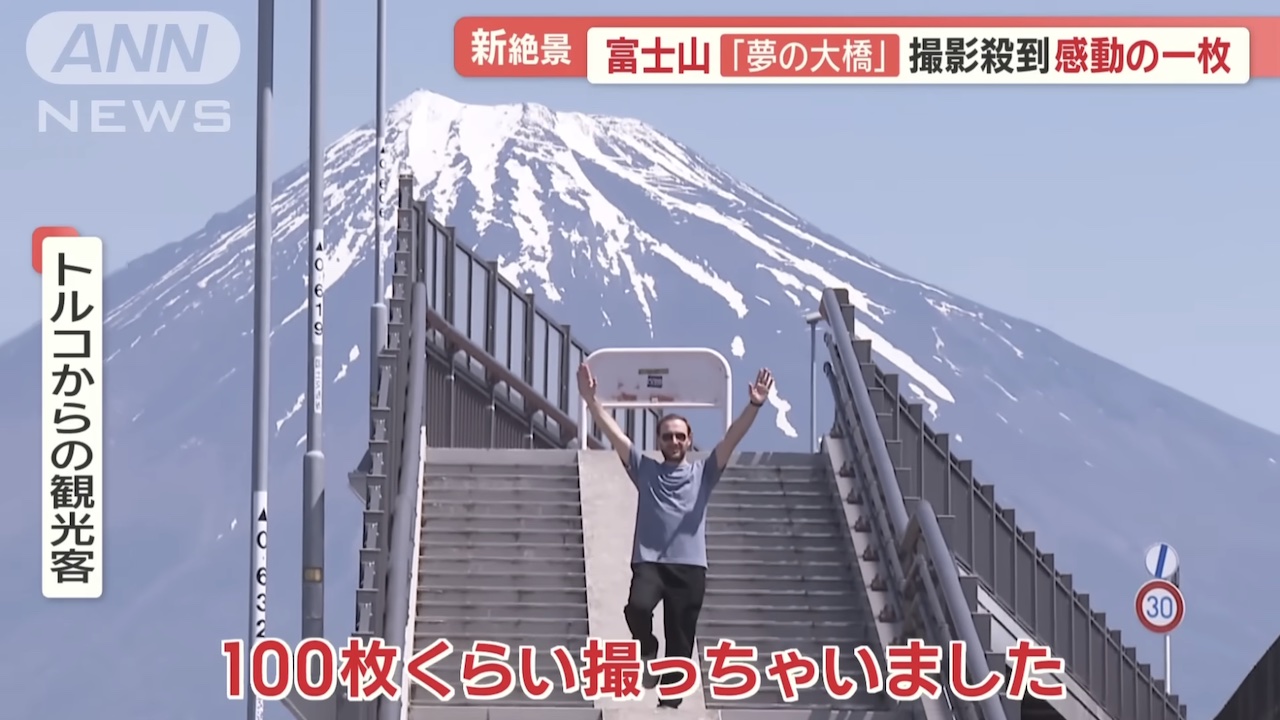
Since November last year, stairs that appear to lead directly to Mount Fuji have been trending on social media.
A tourist from Thailand said, "I saw it on TikTok, introduced as a famous photo spot."
A tourist from Turkey remarked, "The mountain and stairs align beautifully. I ended up taking about 100 photos to capture every moment."
One Turkish man's favorite photo is a pose at the top of the stairs with Mount Fuji in the background. Some tourists even sit in line to wait their turn.
A tourist from Brazil mentioned, "I want to take a photo on the stairs, but I'm waiting because of the crowd."
Finally, it was a Brazilian woman's turn to start her photo session.
When asked if she got a good shot, she replied, "Yes, I did."
Dangerous Photography on the Roadway
The excitement isn't limited to the stairs. Many foreign tourists also flock to the bridge to capture the majestic view of Mount Fuji. However, some sit on barriers between the sidewalk and roadway, lean out for poses, or cross the road to the median for photos.
Despite warning signs against crossing, two women were seen taking photos in the middle of the road while cars carefully maneuvered around them.
A family was spotted in the median, with a father making a big jump for a photo. Another group took commemorative shots while posing in the middle of the roadway. Some drivers parked at gaps in the pylons meant to prevent roadside parking to take pictures.
From a driver's perspective, the situation is dangerous as tourists engrossed in photography might suddenly step onto the road.
A Chinese tourist, pulling a suitcase while taking photos on the road, commented, "I know it's dangerous, but I think it's okay because no cars are coming, so everyone is taking photos there."
The Shizuoka National Highway Office, overseeing Fuji Dream Bridge, is considering installing fences to prevent entry into non-pedestrian areas.
Littering and Trespassing Add to Nuisances
The nuisance behavior extends beyond the bridge. Litter is scattered nearby, and some families trespass on private land to play. Despite available parking, some cars are parked on the street.
A local resident expressed frustration: "This is a private road, but with so many cars, they're turning around here, damaging our flower beds. We never know when a car might hit our house. It's really annoying. The noise is also a problem, especially with windows open. It's very disruptive, especially early in the morning."
In response to the sudden influx of foreign tourists, Fuji City officials have taken measures like installing multilingual signs and barricades to prevent illegal parking, and quickly setting up additional parking spaces.
Mount Fuji Entry Regulations Announced
Overcrowding on Mount Fuji has been a problem, with the trail filled with climbers and headlights stretching up the mountain. There have been numerous instances of inappropriate behavior such as climbing with inadequate gear and lighting fires.
To address these issues, Yamanashi Prefecture announced new regulations on May 13, including a 2,000 yen fee for the Yoshida Route from July and a daily cap of 4,000 climbers. A reservation system will be introduced, starting on the 20th.
Footage from last year showed long queues of people aiming for the summit, barely making progress.
Patrol officers asked climbers resting in restricted areas to move, to which one foreign climber responded, "I understand, but we can't go all at once. Look at this."
With the increase in climbers, many mountain huts were fully booked.
A group of foreign tourists said they planned to climb without securing accommodation, aiming for a non-stop ascent. Others were seen sitting or lying directly on the ground outside mountain huts.
Visitors to the fifth station had mixed reactions to the entry regulations.
A Chinese resident of Japan stated, "Charging a fee is normal. There are climbing fees in China too, around 1,500 yen depending on the mountain."
A Polish tourist commented, "If I came to climb but was told I couldn't because of the regulations, I'd be disappointed. That doesn't sound good."
Mixed Reactions to Mountain Railway Proposal
Another proposal to ease Mount Fuji's congestion is the "Mountain Railway Plan."
The plan involves introducing a low-vibration, low-noise light rail transit (LRT) system on the toll road connecting the base of the mountain to the fifth station. This would control the number of visitors and reduce congestion.
Additionally, restricting general vehicles, including buses and taxis, would help reduce emissions.
Governor Kotaro Nagasaki of Yamanashi Prefecture stated, "This won't destroy nature. We'll lay the tracks on the existing road, so there's no need for new tunnels or large-scale deforestation."
However, concerns about the unstable terrain prone to avalanches and landslides have been raised.
Karine Watanabe, who initiated a petition against the railway, said, "With electric buses available, there's no need to destroy nature for a railway."
Source: ANN