News On Japan

Ranking of Most-Watched AI Platforms

TOKYO - An analysis of posts on the creator platform note has produced a ranking of the most talked-about generative AI foundation models, based on a surge in articles about how these tools are being used across industries, with the top spot going to an AI increasingly adopted in education.

The ranking examines which models are attracting the most attention in 2025, drawing on posts by creators who share a wide range of content, including writing, images and technical insights, on the platform. The survey also includes on-the-ground reporting from workplaces using AI at the forefront, highlighting examples such as monetizing music, developing software without programming knowledge and experimenting with AI in classrooms.

In fifth place is Suno, an AI capable of generating music. Creators have been using it to produce songs by first generating lyrics with tools such as ChatGPT and then inputting them into the music model, which can produce a complete track, including vocals, in about a minute. The rapid improvement in audio quality and model performance over the past year has made it difficult to distinguish AI-generated songs from those performed by humans, and some creators are already distributing AI-produced tracks to earn revenue. The surge in posts sharing tips on how to get better songs from the model contributed to its jump in the rankings.

OpenAI’s ChatGPT placed fourth. While it still commands more than 60% market share among generative AI tools, its rate of growth ranked fourth amid rising competition from other models.

In third place is Claude, a generative AI developed by U.S. startup Anthropic, which has gained attention since last year with its ability to generate programming code. One example of its use comes from a metal parts manufacturer in Gifu Prefecture, where third-generation owner Tanaka has used the AI to build systems despite having limited programming knowledge. Using Claude, Tanaka developed a drawing management system that allows employees to view design diagrams on tablets and share manufacturing procedures with photos across the factory.

Tanaka said that while he initially struggled with the technology, he found that once he became accustomed to it, mistakes and oversights declined and overall efficiency improved significantly. The AI can generate large volumes of code in minutes and even identify and fix errors when they are pointed out. This conversational approach to development, sometimes called “vibe coding,” allows users to build software by describing what they want in natural language while the AI handles the technical implementation, a method increasingly seen as indispensable for engineers.

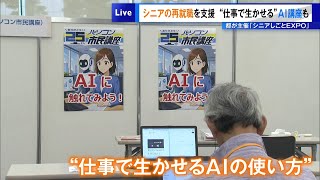
As the ranking moves toward the top spot, attention is turning to which AI has become widely used not only by companies and local governments but also in classrooms, where adoption is accelerating. Organizers also demonstrated how AI can generate videos based on user prompts, highlighting the expanding role of generative AI across everyday life and education.

Source: テレ東BIZ

News On Japan
POPULAR NEWS

A tropical depression south of Japan is expected to develop into a typhoon on September 15 and could affect Okinawa during Silver Week, raising concerns over travel and tourism as Japan prepares for its first five-day Silver Week holiday in 11 years.

Climbers who get into trouble on Mount Fuji during the official closed season could be charged for rescue by disaster-prevention helicopters under new safety measures being considered by Yamanashi Prefecture.

Genta Koja, a former deputy mayor of Naha who accepts the relocation of the U.S. Marine Corps Air Station Futenma to Henoko in Nago, won the Okinawa gubernatorial election on September 13, defeating incumbent Governor Denny Tamaki and bringing an end to 12 years of prefectural administrations committed to blocking the project.

Roads around the Fushimi Otesuji Shopping Street in Kyoto's Fushimi Ward were flooded on the evening of September 13 after water began gushing from a nearby road, forcing authorities to close part of the street to traffic.

China will sharply raise visa fees for Japanese nationals entering the country from September 14, with the cost of a single-entry visa increasing to 16,750 yen, about 7.4 times the current level.

MEDIA CHANNELS
         

MORE Web3 NEWS

High school students in Mishima, Shizuoka Prefecture, explored how humans and artificial intelligence might coexist in the future by interacting with an AI-powered humanoid robot during a class on September 11.

A medical institution opening in Nagoya's Showa Ward in October will use artificial intelligence-enhanced PET-CT and MRI equipment to produce clearer images and reduce the risk of cancer being overlooked during diagnostic examinations.

The rapid spread of generative artificial intelligence is fueling construction of data centers across Japan, but plans for two large facilities beside a residential neighborhood in Minoh, Osaka Prefecture, are raising concerns over sunlight, noise and low-frequency sound as authorities confront gaps in rules governing the increasingly important infrastructure.

Expectations are growing for the wider use of "physical AI" robots, but concerns over hacking, breakdowns and maintenance are prompting companies to develop new security and support systems as the technology moves closer to everyday use.

Isuzu Motors has begun full-scale development of a second-generation "AI truck" capable of making driving decisions on its own, as Japan's largest commercial vehicle maker by domestic market share aims to introduce Level 4 autonomous driving in fiscal 2027 to help address a worsening shortage of truck drivers.

Toridoll Holdings, the operator of Marugame Seimen, has introduced an artificial intelligence system trained on the thinking and speaking style of President Takaya Awata, giving employees a way to consult a virtual version of the company's founder as the restaurant group expands to around 1,200 locations in Japan and overseas.

Hitachi is stepping up the use of digital technology, autonomous robots and physical AI to address Japan's growing labor shortage, showcasing systems designed to automate factory work and maintain critical infrastructure at one of the group's largest technology exhibitions.

Japanese startup Enactic is developing physical AI technology that combines artificial intelligence with robotic hardware, earning recognition from Nvidia while pursuing an unusual open-development strategy that makes its technology available to the public.