France has seen days of protests in Paris over the rising cost of living and declining access to public services, including state education. Some demonstrations have been marred by violence and looting.
The "gilets jaunes" (yellow vests) movement has called for a new round of protests this weekend. The authorities are preparing to reinforce security deployments, and the government has said declaring a state of emergency remains an option if the situation requires it.
Some commentators and critics now argue that organizations linked to the Muslim Brotherhood are helping to inflame tensions. The Brotherhood is banned in several countries, but not in France or the EU.
Critics say organisations linked to the Muslim Brotherhood are exploiting demonstrations over living costs, claims the groups have previously rejected.
Critics accuse groups they describe as Brotherhood fronts, including Musulmans de France (formerly the Union of Islamic Organizations of France) and a number of local mosques and associations, of spreading a narrative of grievance and hostility towards the police and the French state. Musulmans de France has previously denied being part of the Brotherhood.
Student groups' statements
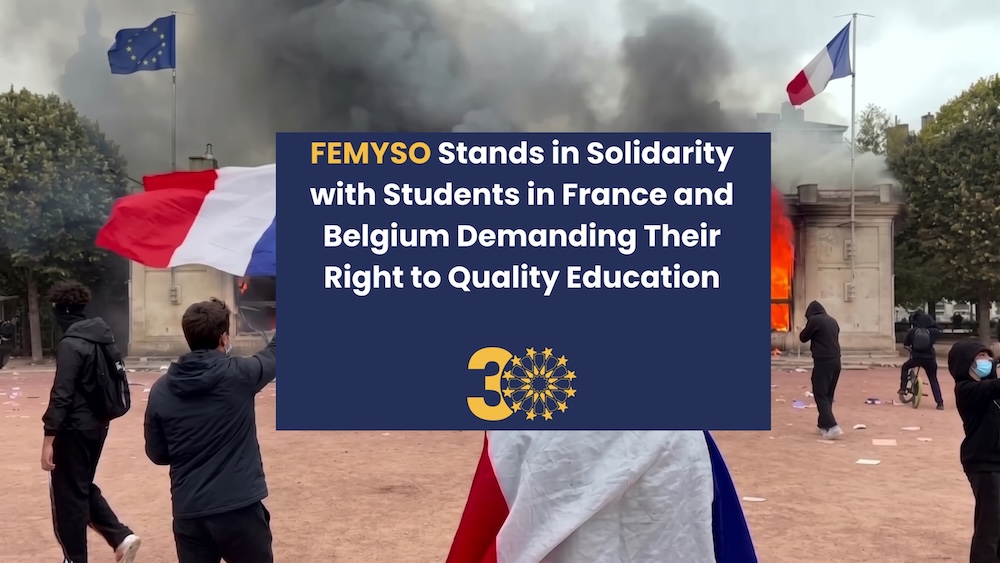
The Forum of European Muslim Youth and Student Organisations (Femyso) issued a statement expressing "firm solidarity" with students in France and Belgium protesting for better conditions, adequate funding and an education system that protects their basic rights.
The statement also condemned what it called police violence and excessive force against student protesters, most of whom it said were minors. Critics argue such language risks inflaming tensions, particularly among vulnerable young people.
The European Parliament recently decided to exclude Femyso from its official activities and events. Founded in 1996, the forum says it brings together around 32 youth organisations and presents itself as a civil rights body defending young Muslims against racism and discrimination. Its critics describe it as the Brotherhood's main umbrella organisation in Europe, a claim Femyso has consistently rejected.
The group Étudiants musulmans de France (EMF), which critics also link to the Brotherhood, said in a statement that the protests had put the question of equality in marginalised areas at the heart of the debate. It called on the state to be clearer on the issue.
The EMF highlighted discrimination, the collapse of educational services, social sorting and other inequalities in schooling, and urged student groups to join the protests. Its critics say the group is seeking to take control of the movement.
Some reports claim that the Brotherhood relies on a new generation of preachers and social media influencers who play down violence, looting and attacks on police officers. According to these reports, the influencers portray lawful policing as "systematic targeting". These claims have not been independently verified.
The protests in France, Spain, Belgium and Albania came days after the European Parliament voted on a non-binding resolution calling for a common European strategy against what it described as the Brotherhood's political infiltration of European societies and institutions.
The text calls for a unified approach to the Brotherhood's networks, activities and influence in Europe. This includes assessing whether linked entities or individuals should be added to the EU's terrorist list, a decision that rests with member states.
Government report
In May 2025, the French newspaper L'Opinion published leaked extracts from a confidential interior ministry report on political Islam and the Brotherhood in France.
The report warned that the movement's activities went beyond religious work and posed a threat to "the cohesion of French society". It said the Brotherhood sought deep social change, including bringing Islamic law into public life, and described a highly organised strategy of "soft infiltration" aimed at gradually changing the nature of the French state.
According to the report, between 130 and 140 mosques in France are suspected of links to the Brotherhood, along with educational institutions including the Averroès high school in Lille and the Al-Kindi high school near Lyon. Both schools have denied any such affiliation.
Following the report, President Emmanuel Macron announced an expansion of measures targeting the Brotherhood at a meeting of the Defence and National Security Council, about two months after the report's publication.
The measures included:
new financial and administrative sanctions;
powers to freeze cash and financial contributions, extending existing counter-terrorism tools;
wider administrative dissolution powers, potentially covering endowment funds;
a mandatory procedure for liquidating the assets of dissolved organisations, under which a court can appoint an official to carry it out.
Mr Macron also called for draft legislation by the end of that summer and said he would meet representatives of the Forum of Islam in France (Forif) in the autumn.
'Parallel societies'
Critics argue the Brotherhood works through schools, mosques and public institutions to recruit members and build what they call parallel societies in Europe, with different loyalties and less respect for European law.
In December 2019, the observatory on extremist fatwas run by Egypt's Dar al-Ifta claimed that the Brotherhood was expanding in Western societies by creating "parallel entities" to act as an alternative to the state for its members. It said this followed the instructions of the group's founder, Hassan al-Banna. Egypt banned the Brotherhood and designated it a terrorist organisation in 2013. None of the organisations named responded to the allegations in the sources cited.