News On Japan

Ehomaki Prices Up by 4% from Last Year

TOKYO - The price of Ehomaki sushi rolls, traditionally eaten during the Setsubun festival in February, has risen by approximately 4% compared to last year.
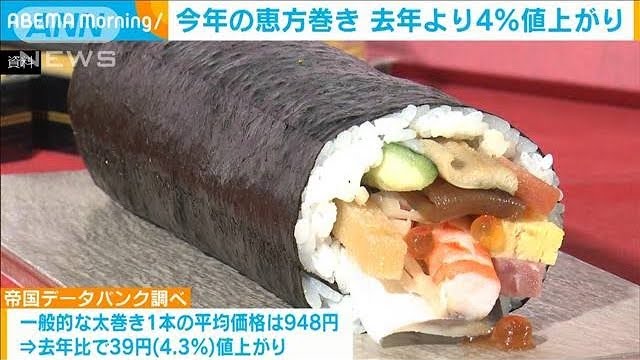
Ehomaki Prices Up by 4% from Last Year

A survey conducted by Teikoku Databank, which investigated the prices of Ehomaki sold at major convenience stores, supermarkets, and department stores across Japan (totaling 104 companies), revealed that the average price for a standard thick roll is now 948 yen. This is an increase of 39 yen or 4.3% from last year's average of 909 yen.

The price hike is attributed to the increased cost of raw materials. Seasoned gourd strips (kampyo), commonly used in Ehomaki and predominantly sourced from China, have seen a price surge of over 30% due to poor harvests. Additionally, nori (seaweed) has been affected by a record low yield.

However, there is a silver lining for seafood lovers. Prices for ingredients like tuna and salmon roe have dropped by up to 20% compared to last year. Consequently, luxury seafood Ehomaki are experiencing a more modest price increase, averaging 1,729 yen this year compared to 1,689 yen last year, an increase of 40 yen or 2.4%.

This year's price trends in Ehomaki reflect broader market dynamics, including global agricultural fluctuations and changes in seafood market prices. These shifts underscore the delicate balance between maintaining traditional culinary customs and adapting to economic realities. As consumers prepare for Setsubun, these price changes might influence their choices, possibly leading to a greater diversity in Ehomaki fillings and prices.

Source: ANN

News On Japan
POPULAR NEWS

Japan’s World Cup campaign ended in the cruelest possible fashion on June 29, as Gabriel Martinelli scored in the fifth minute of stoppage time to give Brazil a 2-1 victory over the Samurai Blue in their knockout match in Houston. Japan had led in the first half and were still level at 1-1 in the final moments, but Martinelli’s late strike sent Brazil into the Round of 16 and eliminated Japan from the tournament.

Strong earthquakes have continued to shake parts of Japan in recent weeks, with 11 temblors measuring lower 5 or above on the Japanese seismic intensity scale recorded across the country since April 2026.

A Kintetsu Railway train derailed inside Kyoto Station on the morning of June 29, forcing partial suspensions on the Kintetsu Kyoto Line for the rest of the day and causing long delays that hit commuters, students and tourists.

A section of stone wall at Hikone Castle, one of Japan’s few surviving original Edo-period castles and a National Treasure whose main keep remains intact more than 400 years after its construction, collapsed after heavy rain caused by Typhoons No. 7 and No. 8, Hikone city officials said.

Japan advanced to the knockout stage of the World Cup after a 1-1 draw with Sweden on June 25, finishing second in Group F and setting up a Round of 32 clash with Brazil in Houston.

MEDIA CHANNELS
         

MORE Food NEWS

A Nepalese manager of a busy Indian restaurant in Kodaira, Tokyo, says he fears for the future of his business after Japan tightened the requirements for foreign entrepreneurs seeking to stay in the country under the business manager visa.

Sushiro, Japan’s leading conveyor-belt sushi chain, drew heavy crowds to a new outlet near Ayase Station in Tokyo on June 11, with the first day of business revealing both the brand’s strength and the pressure behind running a high-volume sushi restaurant.

Japan Access, Japan's leading general food wholesaler, is expanding the potential of food logistics with frozen-to-chilled processing, a system that stores products frozen and thaws them only when orders arrive before shipping them to retailers as chilled goods.

Seven chefs tasked with developing athlete menus for the Asian Games opening in September visited a long-established Hatcho miso maker in Okazaki on June 22, as organizers look to promote Aichi’s food culture through fermented seasonings such as miso and soy sauce.

The rapid depreciation of the yen is driving up the cost of imported beef and other foods, prompting some restaurants and supermarkets to shift their focus toward domestic products as the price gap narrows.

A snack with the pungent smell and flavor of natto has been developed in Hakodate, Hokkaido, using no natto bacteria but delivering an aroma strong enough to make people react the moment the bag is opened.

Harvesting began on June 18 for Densuke watermelons, a specialty of Toma in Hokkaido known for their glossy black rind, crisp texture and rich sweetness, with the season’s first auctions scheduled for June 19 at markets in Sapporo and Asahikawa.

The harvest of fruit-like sweet corn has reached its peak in Hekinan, Aichi Prefecture, where farmers begin picking before dawn to preserve the crop's high sugar content and freshness.