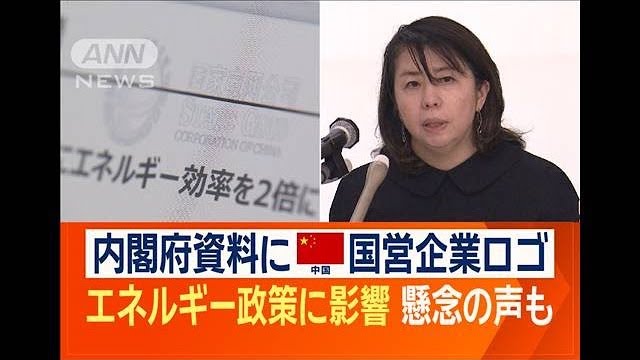
TOKYO - Materials presented at a Cabinet Office meeting to discuss renewable energy inadvertently included a logo of a Chinese state-owned enterprise, sparking concern among opposition parties and officials about the possibility of foreign influence on Japan's energy policies.
Voices of Concern from Within the Cabinet: "Must Avoid Foreign Interference"
Chief Cabinet Secretary Yasumasa Lin stated, "Under Minister Kono, the Cabinet Office will continue to investigate whether there has been any undue influence from the Chinese government."
The issue arose during an online meeting on the 22nd, focused on revising regulations to promote renewable energy.
Mika Obayashi, director of the Renewable Energy Institute, noted, "The year 2023 has been a significant turning point for the expansion of renewable energy globally."
Obayashi, who participated in the meeting as an expert, used materials that subtly included the logo of China's state-owned power company, State Grid Corporation of China.
This inclusion has raised concerns within the government.
Sanae Takaichi, Minister in charge of Economic Security, emphasized, "It is unacceptable for other countries to interfere in policy discussions."
The issue has been pursued by the opposition in the Diet.
Senator Taku Otsuji of the Nippon Ishin no Kai questioned, "The selection process for these experts, including why this individual was chosen, needs thorough examination."
Taro Kono, Minister in charge of Regulatory Reform, remarked, "Just because these materials had the company's logo does not imply a special relationship. We need to check thoroughly."
"A Simple Mistake," Says Presenter of the Materials
On the 27th, the individual responsible for the materials held a briefing to clarify the situation surrounding the "logo controversy."
Obayashi explained, "These materials were presented by someone from the State Grid Corporation of China at an internal research meeting. I used them as one of the examples to explain various concepts."
Despite attempts to remove the logo from the materials, it remained faintly visible, a detail that Obayashi admitted was overlooked until now.
Acknowledging the oversight, Obayashi expressed regret for any concern or misunderstanding caused, noting that while foreign materials have been referenced in the past, this incident inadvertently left a foreign company's logo visible.
Obayashi assured, "This incident has no connection whatsoever to any influence from other countries or distortion of the nation's energy policies."
National Democratic Party's Tamaki Raises Concerns Over Foundation's Direction
Yuichiro Tamaki, leader of the National Democratic Party, expressed apprehension about the stance of the foundation Obayashi represents.
Tamaki described a vision of connecting Japan with China, Russia, Mongolia, and the entirety of Asia through a single power grid network.
This initiative, known as the "Asia Super Grid Project," aims to link nearly all of Asia with transmission lines to mutually utilize natural energies like solar, wind, and hydroelectric power across borders.
Tamaki warned, "They are saying Japan should quit nuclear and thermal power. If we were to import electricity from China or Russia through this grid in case of a power shortage, our dependence on these countries for energy would increase."
About the Renewable Energy Foundation Established by Masayoshi Son
The Renewable Energy Foundation, affiliated with Obayashi, was founded by SoftBank Group CEO Masayoshi Son in August 2011, following the Great East Japan Earthquake.
The foundation's website states its mission to "realize a safe, secure, and affluent society through the spread of renewable energy," aiming to establish a society based on natural energy sources.
However, Tamaki voiced concerns on the 26th that such interconnectedness could lead other countries to have control over Japan's fate.
The foundation also became a board member of an international organization in 2016, aiming to build a global power network in line with the "Asia Super Grid Project." Despite recent resignations from the board following the controversy, the close relationship with China's State Grid Corporation, whose logo appeared in the materials, has been scrutinized.
Experts Emphasize the Importance of "Research Integrity"
Is China attempting to influence Japan's renewable energy policies?
Professor Kazuto Suzuki of the University of Tokyo's Graduate School of Public Policy suggests, "As explained at the press conference by the individual involved, this seems to be a careless mistake. If China intended to exert influence, it would not leave such an obvious error as a watermark of a company logo."
Suzuki also stressed the importance of research integrity when convening experts for discussions, suggesting that institutional measures should be considered to prevent foreign influence operations, not just from China but from any country.
Source: ANN