News On Japan

Golden Week Starts with Record Departures, Unseasonal Heat

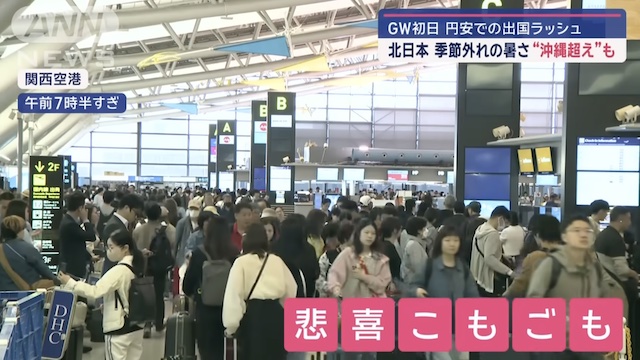
TOKYO - The start of Golden Week on April 27 saw a surge in departures abroad fueled by the weakest yen level in about 34 years. In northern Japan, regions including Hokkaido, Aomori, and Iwate experienced unseasonably hot temperatures, with highs surpassing 30C.
Golden Week Starts with Record Departures, Unseasonal Heat

Tourists in Sapporo were taken aback by the summertime heat, with many opting for short sleeves and shaved ice. "Sapporo is experiencing midsummer temperatures," remarked a visitor.

Even hotter conditions were reported in Tohoku, with several areas recording the highest April temperatures in their history. Mito in Aomori Prefecture reached a scorching 31.2°C, marking the earliest summery day on record for the region.

The Golden Week holiday, which can extend up to ten days, is expected to see about 22.8 million people traveling domestically, with the peak day for outbound Shinkansen travel being April 27.

Haneda Airport was so crowded that the floor was scarcely visible, with April 27 also marking the peak of air travel.

At a ranch in Shizuoka, the highlight was sheep shearing, a precaution against heatstroke before summer arrives.

Among those in line, some were dressed in cosplay, slowly making their way to Makuhari Messe. "It's relatively cool outside, but inside, it's extremely hot," one attendee observed.

The massive "Niconico Chokaigi" event was also taking place, featuring live performances by popular artists and various dance acts.

Doujinshi seller Eevee-chan commented, "I took a picture of Sachiko Kobayashi's mannequin dressed up; it's like a festival with Kobayashi as a gal. It’s nice to meet people you only see once a year."

Last year's playtime has made a comeback in some areas, with spring skiing being a popular choice. "Despite closing early last April due to a mild winter and snow shortage, this season's late cold snap has maintained about one meter of snow, allowing us to ski through the entire Golden Week as usual," said a local ski resort representative.

After physical activities, food is essential. In Toyama Prefecture, the Spring Firefly Squid Festival was in full swing, where children tried their hands at squid scooping instead of the usual goldfish, surprisingly finding the squid quite resilient.

The weather on April 28 is forecasted to be perfect for outings across Japan from Hokkaido to Kyushu, with cities like Nagoya and Kyoto expecting the year’s highest temperatures around 30°C.

About 780,000 people are expected to travel overseas from Haneda and Narita airports.

A woman traveling to Guam said, "The clear blue seas of the tropical island of Guam are alluring, but the sharp decline in the yen is troubling. Still, we must seize the chance to travel."

The yen's exchange rate plummeted to about 158 yen to the dollar, a level not seen in 34 years.

A man heading to Seychelles noted, "The rate worsened recently, but we need to go anyway."

A woman traveling to America shared, "I was shocked when I exchanged money; it's so little."

Adapting to the situation, a woman going to Italy mentioned, "We'll save by not eating out every meal, opting to shop at supermarkets instead."

Another woman traveling to Guam added, "I’m bringing 500ml bottles of water and tea since buying them there is expensive."

Amid mixed emotions, a group traveling to Germany and Italy encountered unexpected trouble. "I just came to see them off today because, actually...," one member revealed, "My passport had expired, and I found out just two days ago, so I can't go."

Source: ANN

News On Japan
POPULAR NEWS

Japan’s World Cup campaign ended in the cruelest possible fashion on June 29, as Gabriel Martinelli scored in the fifth minute of stoppage time to give Brazil a 2-1 victory over the Samurai Blue in their knockout match in Houston. Japan had led in the first half and were still level at 1-1 in the final moments, but Martinelli’s late strike sent Brazil into the Round of 16 and eliminated Japan from the tournament.

Strong earthquakes have continued to shake parts of Japan in recent weeks, with 11 temblors measuring lower 5 or above on the Japanese seismic intensity scale recorded across the country since April 2026.

A Kintetsu Railway train derailed inside Kyoto Station on the morning of June 29, forcing partial suspensions on the Kintetsu Kyoto Line for the rest of the day and causing long delays that hit commuters, students and tourists.

A section of stone wall at Hikone Castle, one of Japan’s few surviving original Edo-period castles and a National Treasure whose main keep remains intact more than 400 years after its construction, collapsed after heavy rain caused by Typhoons No. 7 and No. 8, Hikone city officials said.

Japan advanced to the knockout stage of the World Cup after a 1-1 draw with Sweden on June 25, finishing second in Group F and setting up a Round of 32 clash with Brazil in Houston.

MEDIA CHANNELS
         

MORE Travel NEWS

A section of stone wall at Hikone Castle, one of Japan’s few surviving original Edo-period castles and a National Treasure whose main keep remains intact more than 400 years after its construction, collapsed after heavy rain caused by Typhoons No. 7 and No. 8, Hikone city officials said.

The Japan Meteorological Agency said at around 2 p.m. on June 29 that the rainy season appeared to have ended in Okinawa, marking a later-than-usual start to summer after an especially wet period.

Japan’s weather agency carried out field inspections in Yamanashi Prefecture on June 28 after a powerful earthquake struck the Fuji Five Lakes area late on June 26, registering a lower 6 on Japan’s seismic intensity scale in Fujikawaguchiko and injuring six people.

According to updates on June 28, the double-typhoon system that brought record rain, flooding, landslides and fallen trees to parts of Japan has moved away, but Kanto remains under cloudy rainy-season skies, with intermittent rain still possible and saturated ground keeping the risk of landslides high in areas hit by heavy rain.

The Kanto region is experiencing an unusual June, with three typhoons approaching the area during the month and rainfall totals already reaching record levels in some locations.

Damage was reported across the Kansai region after a stationary seasonal rain front and an approaching typhoon brought torrential rain on June 26, triggering landslides in Seika, Kyoto Prefecture, flooding homes in Nara, and disrupting roads and railway services in Osaka and surrounding areas.

A powerful earthquake with a maximum seismic intensity of upper 6 struck off Iwate Prefecture at around 7:30 a.m. on June 25, shaking parts of Aomori Prefecture and leaving Hachinohe, which was hit by a similarly strong quake last December, facing fresh damage.

Rice field art depicting Los Angeles Dodgers star Shohei Ohtani and his dog Decoy is nearing its best viewing period in Oshu, Iwate Prefecture, Ohtani’s hometown.