News On Japan

To Discard or Not to Discard Tuna Can Juice?

TOKYO, May 08 (News On Japan) - Tuna sandwiches, tuna onigiri, and even tuna pasta are popular dishes, but what should be done with the juice inside tuna cans? Some people discard it, while others use it in cooking. The question arises, what's the manufacturer's recommendation?
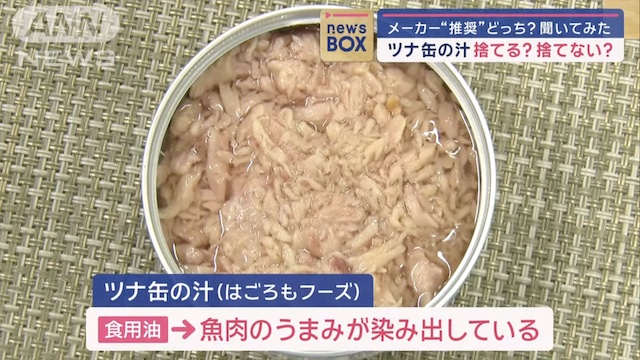
Various people have differing opinions on whether to keep or discard the juice from tuna cans:

An elderly individual in their 80s mentioned, "I usually throw it away when making salads."

A person in their 30s stated, "I discard around 50 to 60% of it because it might make the dish too oily."

A teenager commented, "I keep at best 20% and throw away 80%."

On the other hand, a person in their 70s shared, "I use it as it is. When making okara, I include the tuna oil, and it tastes great."

Manufacturer’s Advice: "Don’t Discard It"

To clarify what should ideally be done, Hagoromo Foods, a major tuna can manufacturer, was approached for advice.

Spokesperson Yasuyo Makita explained, "We believe our communication has not been clear enough."

So, should the juice be discarded or used in cooking? The manufacturer's recommendation is:

"Don't discard it. It's wasteful," said Makita.

Using the Juice as "Broth"

Makita further explained, "The oil used in Sea Chicken is primarily soybean oil and cottonseed oil. Both are common cooking oils, so they can be used in dishes. The flavor of the fish meat has seeped into the oil, so we recommend using it in cooking."

Interestingly, the juice from tuna cans is edible oil infused with fish flavor, which can serve as a substitute for broth.

Makita suggested, "Instead of using regular salad oil, use the tuna can oil to sauté vegetables. The fish flavor in the oil can substitute for broth, creating a fish-flavored stir-fry."

This information came as a revelation to some:

A person in their 30s said, "Oh, really? I can use all of it?"

A teenager remarked, "Wow! I didn't know that. Absorbing the oil with paper towels was cumbersome, so it's good to know it can be used in cooking."

Recommended Tuna Can Recipes

One highly recommended dish is miso soup. By sautéing vegetables with the tuna oil and adding the tuna to the miso soup, the oil serves as a broth substitute, providing a fish flavor without needing to make broth.

Source: ANN

News On Japan
POPULAR NEWS

Bear sightings across Japan have already climbed to nearly twice the level recorded during the same period last year, prompting entry bans in mountain areas behind Kyoto’s Ninna-ji Temple and the cancellation of hiking events in Kansai, while new research suggests that the key to reducing encounters may lie in understanding what bears eat in each region.

Copper roofing panels were stolen from several shrines in Hamamatsu, Shizuoka Prefecture, including a city-designated cultural property, in the latest case amid a nationwide surge in copper thefts targeting shrines and temples across Japan, where soaring metal prices have fueled crimes that leave historic religious buildings damaged, exposed to the elements, and facing repair costs of millions of yen.

Flames broke out on the morning of May 20th on Miyajima Island in Hiroshima Prefecture, home to one of Japan's World Heritage sites, destroying Reikado Hall near the summit of Mount Misen.

Uncertainty surrounding the situation in the Middle East is beginning to affect daily life in Japan, as concerns over crude oil supplies spread to restaurants, cleaning services and even household garbage disposal systems across the Kansai region.

A 25-year-old woman arrested as a suspected ringleader in a robbery-murder case in Tochigi Prefecture once posted cheerful dance videos on social media and was remembered by those who knew her as an energetic and outgoing young woman.

MEDIA CHANNELS
         

MORE Food NEWS

Japan’s Sushiro, the world’s largest conveyor-belt sushi chain, debuted in Shanghai in early December 2025, to much fanfare. (South China Morning Post)

Today I’m going behind the counter in Japan at Omori Ramen, a family run ramen shop tucked away near the mountains of Niigata, an area known across Japan as snow country. (Paolo fromTOKYO)

Tokyo is known as one of the world’s most expensive cities… but can you actually eat well here for under 1,000 yen?

A nostalgic Japanese sweet is making a major comeback, with lemon cakes appearing everywhere from convenience stores to specialty boutiques in Tokyo as demand for citrus-flavored desserts continues to surge.

Bluefin tuna, now being caught in unusually large numbers around areas such as Sado Island in Niigata Prefecture, is becoming significantly more affordable, with some restaurant operators even saying it is cheaper than horse mackerel.

Brand rice variety Yumepirika was being planted one after another in rice paddies in Higashikawa, Hokkaido, as rice planting work accelerates across Japan ahead of the autumn harvest, with attention now turning to how much this year’s new rice will cost.

Japan byFood and Shizuka are going behind the scenes to meet the international visionaries who are redefining the Tokyo food scene today. (Japan by Food)

Visitors began arriving early on May 10th for the Shirako Onion Festival in Shirako Town, Chiba Prefecture, where the region’s famous fresh onions—known for their mild flavor and rich sweetness—were sold in large quantities, with the town ranking as the prefecture’s top onion producer.