News On Japan

JSDF Soldier Dies in Grenade Training Accident

YAMANASHI, May 31, 2024 (News On Japan) - Shrapnel from a grenade struck a soldier in the neck during a grenade-throwing exercise at the Japan Ground Self-Defense Force's (JSDF) North Fuji Training Area in Yamanashi Prefecture, on Thursday morning. The soldier was transported to a hospital but was later confirmed dead.
JSDF Soldier Dies in Grenade Training Accident

The deceased has been identified as Takumi Yamamiya, a 29-year-old member of the 1st Division, 1st Infantry Regiment, 3rd Company.

General Yoshitoshi Morishita, Chief of Staff of the Ground Self-Defense Force, stated, 'Such incidents should never occur in an organization that handles weapons, and as Chief of Staff, I take this matter very seriously.'

Footage from past grenade-throwing exercises by other units shows soldiers immediately taking cover in a safe place after throwing a grenade. Former Eastern Army Commander Etsukazu Watanabe noted, 'You must take cover in a protected place the moment you throw the grenade. Failure to do so can result in dire situations.'

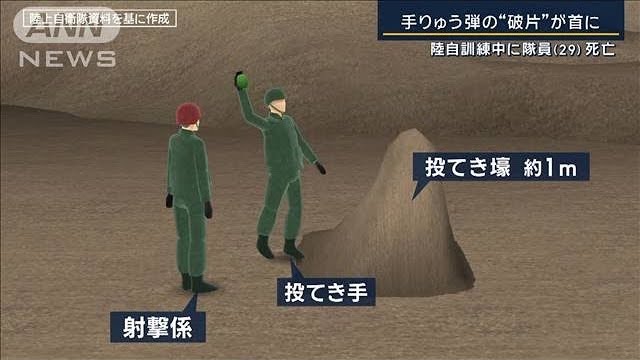
In a typical training setup, the grenade thrower and the instructor stand side by side, with a distance of over 25 meters to the target. Behind them, more than 15 meters away, is the safety officer. After the grenade explodes, the safety officer confirms the situation from the rear before moving on to the next step.

Yamamiya was serving as the shooting instructor during the exercise.

Watanabe suggested that the delay in taking cover might have been due to Yamamiya checking whether the thrown grenade hit the target.

General Morishita confirmed, 'The grenade was thrown near the target and exploded normally. The grenade itself appears to have functioned correctly, and there is no indication that anyone deliberately caused the incident.'

Following this incident, the JSDF has suspended all live-fire training until safety can be assured. An accident investigation committee has been established to determine the cause of the accident.

Watanabe concluded, 'This is truly regrettable. When accidents occur, various unstable elements are involved. It is essential to thoroughly and persistently eliminate unsafe conditions.'

Source: ANN

News On Japan
POPULAR NEWS

Japan began applying a new numerical alcohol threshold for dangerous driving offenses on July 21, introducing a clearer standard for cases involving impaired driving that could lead to fatal accidents.

Prime Minister Sanae Takaichi's government approved its first annual basic economic and fiscal policy on Tuesday, pledging "responsible and proactive fiscal policy" and envisioning about 370 trillion yen in public- and private-sector investment in strategic industries through fiscal 2040.

A covert network of shuttle tankers is carrying crude through the increasingly dangerous Strait of Hormuz as renewed fighting between the United States and Iran disrupts shipping and raises concerns over how Japan will secure the oil it needs.

Russian Deputy Foreign Minister Andrey Rudenko has criticized moves by Japanese and Ukrainian companies to cooperate on drone technology, warning that such ties would be regarded by Moscow as a "clear hostile act."

The rainy season ended in the Kanto-Koshin and Tokai regions on July 20 as strengthening high pressure brought intense heat across Japan, with temperatures forecast to reach 38 C in Kumagaya, Saitama Prefecture, and Kofu.

MEDIA CHANNELS
         

MORE Politics NEWS

Prime Minister Sanae Takaichi’s first economic policy roadmap took center stage on July 21, setting out a long-term investment strategy aimed at reviving growth, but the plan was immediately overshadowed by concerns in the bond market over fiscal discipline and the Bank of Japan’s independence.

Asset reports for all 465 members of Japan's House of Representatives elected in February 2026 have been released, showing average declared assets of 32.78 million yen, up 6.09 million yen from the previous disclosure.

Russian Deputy Foreign Minister Andrey Rudenko has criticized moves by Japanese and Ukrainian companies to cooperate on drone technology, warning that such ties would be regarded by Moscow as a "clear hostile act."

Prime Minister Sanae Takaichi entered the week of July 20 with her government facing a shortened but politically important stretch before the extended Diet session ends, as debate continued over Bank of Japan independence, domestic investment policy, the revised Imperial House Law and the ruling coalition’s unfinished legislative agenda.

Japan's revised Imperial House Law was enacted after clearing the House of Councillors with majority support, allowing female members to retain royal status after marriage and male-line descendants of former imperial family branches to enter the Imperial Household through adoption.

Prime Minister Sanae Takaichi closed the Diet session on July 17 under pressure from both parliament and financial markets, as lawmakers enacted a revised Imperial House Law while the government moved to clarify that monetary policy tools remain under the sole authority of the Bank of Japan.

A bill to revise the Imperial House Law was approved by an Upper House special committee on July 16, paving the way for its expected enactment on July 17.

A protest against Prime Minister Sanae Takaichi was held in Tokyo's Shibuya district on July 16 as public concern grew over a bill that would impose criminal penalties for damaging the Japanese flag.