OSAKA - The site of the methane gas explosion at the Osaka-Kansai Expo venue was opened to the media on Tuesday, revealing the area where the explosion occurred during restroom construction in March this year, when a spark from welding ignited flammable gas. It was found that methane gas had accumulated underground.
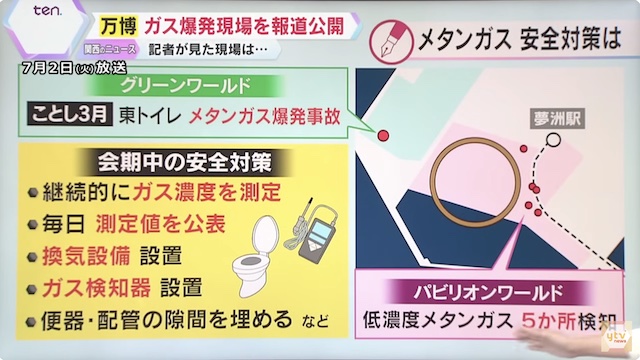
Last week, the Expo Association announced measures such as installing ventilation systems and daily public disclosure of gas concentration measurements during the event, emphasizing the "safety of the site."
Hiroyuki Warada, Director of the Expo Association’s Maintenance Bureau, commented, "We are measuring the concentration inside this room (the explosion site)." When asked about the current level, he said, "It's zero for methane. There are no problematic readings."
In June, the association also planned measures to release gas through manhole covers in areas where methane gas was detected among the pavilions.
News anchor Nakatani recapped, "Last week, the detection of methane gas exceeding safety levels was announced. Furthermore, about 550 red imported fire ants, a highly venomous invasive species, were found in Yumeshima. Amidst this, on the 2nd, the site of the methane gas explosion was opened to the media. What was the scene like?"
Reporter Maho Yamamoto provided a detailed report, stating, "I am currently in front of Sakishima Government Building in Suminoe Ward, Osaka City. I took a bus to Yumeshima around 1:30 p.m., visited the construction site of the restroom where the explosion occurred, and the nearby large event venue where methane gas was once detected underground, and then returned."
When asked about the condition of the site, Yamamoto said, "The approximately 6-meter-long damaged area remains as it was, with warning signs indicating 'No open flames' at the construction site. The association measured the methane gas level today, which read zero. There was no smell of gas, just the typical odor of a construction site."
Regarding the timing of the public disclosure, an association official mentioned, "We want the media to see and feel the reality of the site amidst increasing reports related to methane gas."
When asked if the safety measures announced last week are progressing, Yamamoto noted, "At this stage, they are not yet underway. The announced measures include installing ventilation systems and daily public disclosure of gas concentration measurements in the explosion area."
She also visited the pavilion world where methane gas was detected. The association is considering measures to release gas into the air by drilling holes in manholes or manually dispersing it once a week or every few days.
The official frequently used the word "safety" today, but another word that was repeatedly mentioned was "under consideration." From the interview, it felt that many detailed aspects, such as handling fire and gas during the event, are still "under consideration," raising concerns about whether the measures will be fully implemented before the opening. It is essential to keep a close watch on the situation.
News anchor Nakatani summarized the events: "In March this year, a methane gas explosion occurred in a restroom at Green World. Following an investigation, low concentrations of methane gas were detected in five other areas where pavilions are being constructed. The site revealed to the media on the 2nd is one of these locations."
Safety measures during the event include continuous gas concentration measurements, daily public disclosures, installation of ventilation equipment, gas detection devices, and sealing pipe gaps. However, these measures have not yet been implemented. Although no gas was detected today, it took four months from the explosion in March to the media reveal in July.
Commentator Takaoka added, "Such construction sites are not uncommon, and the Ministry of Land, Infrastructure, Transport, and Tourism has guidelines for construction. If gas emissions are known, gas vent pipes should be installed, and evacuation should occur if concentrations exceed safe levels. However, the existing measures were insufficient, leading to the explosion.
"To successfully host the Expo, it's essential to foster enthusiasm while transparently communicating facts daily, not just favorably or critically. Many visitors will come from abroad, and event management should not assume everyone will follow safety instructions, especially those who cannot read Japanese or English. Measures must consider the possibility of unexpected behavior, such as smoking."
Source: YOMIURI