News On Japan

Japan Moves to Block Chinese Tourists from Converting Foreign Licenses Using Hotel Addresses

TOKYO - A growing number of Chinese tourists in Japan are converting their foreign driver's licenses into Japanese ones by listing their hotel addresses as proof of residence, drawing criticism and prompting a policy shift from authorities.

Former Digital Minister Taro Kono posted on social media that the National Police Agency will no longer allow such conversions for Chinese nationals without a resident record.

The post has ignited widespread attention. According to Kono, the police have made it clear that foreign nationals without an official residence in Japan—specifically Chinese nationals—will no longer be permitted to switch to a Japanese license.

Kono's statement follows a report aired in October 2024 by the news program "It!" showing long queues of Chinese nationals at a driver's license center in Fuchu, Tokyo. Most were applying for what is known as a "foreign license conversion," a system that allows holders of overseas licenses to obtain a Japanese license by passing a written and practical test.

According to the National Police Agency, 56,022 foreigners obtained Japanese licenses through this system in 2023—more than double the number in 2014.

The issue lies in the ability to obtain a license even on a tourist visa, without a residency record. Many Chinese visitors have reportedly used the address of their hotel to apply, triggering concerns.

In one incident in August 2023, a Chinese tourist caused a rental car accident in Hokkaido. Traffic accidents involving drivers of Chinese nationality—including residents—have been rising annually.

Kono's remarks have sparked mixed reactions. Some Chinese tourists argue that the policy unfairly targets them. "Chinese people are the most active travelers today. If the rule bans all right-hand traffic countries or all of Asia, I could understand. But if it’s just China, it’s discriminatory," one visitor said.

Others, including Chinese residents in Japan, expressed support for tighter rules. "Road safety is important. Since China drives on the right and Japan on the left, a bit more training might be a good idea," one resident commented.

It remains unclear whether the restriction will apply solely to Chinese nationals without residency. The National Police Agency is currently reviewing the system with possible reforms under consideration.

Source: FNN

News On Japan
POPULAR NEWS

A newly formed tropical depression near Taiwan on June 9th is expected to intensify the seasonal rain front lingering over southwestern Japan, raising the risk of warning-level rainfall across Okinawa and the Amami Islands through around June 11th.

Japan's national soccer team arrived in Nashville, Tennessee, on June 8th from Monterrey, Mexico, where it had been conducting a pre-World Cup training camp, and held its first practice session at its base camp for the FIFA World Cup in North America.

A prolonged eruption at Sakurajima on June 7th blanketed parts of Kagoshima City in volcanic ash, turning roads gray and prompting long lines of vehicles seeking car washes after a plume of smoke rose 1,300 meters above the crater.

A powerful earthquake struck off Mindanao Island in the southern Philippines at 8:38 a.m. (Japan time) on June 8th, generating tsunami waves across parts of the Pacific, causing building collapses and casualties near the epicenter, and prompting the Japan Meteorological Agency to issue tsunami advisories along a wide stretch of Japan's Pacific coastline before lifting all of them at 4:50 p.m.

A clinic director and a former Peruvian staff member have been referred to prosecutors after the man allegedly performed medical procedures without a license, including an external cephalic version—a procedure used to manually turn a baby into the correct position before birth—at an obstetrics and gynecology clinic in Fukuoka City, raising concerns about patient safety and oversight in maternity care.

MEDIA CHANNELS
         

MORE Politics NEWS

Japan's parliament is expected to formally adopt a proposal on June 10th aimed at maintaining a stable number of Imperial Family members, endorsing measures that would allow female royals to retain their status after marriage and permit the adoption of male-line descendants from former imperial branches, while leaving the current line of succession unchanged.

Komeito has begun considering a plan under which all of its Upper House lawmakers would join the Centrist Reform Alliance, according to sources familiar with the discussions.

For several months, Japan has been moving in a more nationalist and conservative direction. The shift has been fuelled by economic challenges at home and growing regional tensions with China.

Prime Minister Sanae Takaichi's administration is facing mounting scrutiny over allegations that members of her campaign were involved in distributing online videos that disparaged rival candidates during the February House of Representatives election, with opposition parties intensifying their questioning in the Diet and demanding further clarification.

The Japanese government approved its 2026 Environment White Paper at a Cabinet meeting on June 5th, warning that a record-high 50,000-plus bear sightings recorded nationwide during fiscal 2025 have become a serious threat to public safety while also highlighting growing concerns over Japan's aging hunting population and the need to train a new generation of hunters.

Prime Minister Sanae Takaichi faced intense questioning in the House of Representatives Budget Committee on June 4th over allegations surrounding defamatory campaign videos, telling lawmakers she had not verified newly released audio published by Weekly Bunshun because she had no intention of becoming a paid subscriber to the magazine's online service.

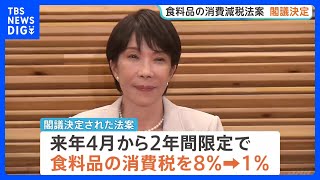
The Japanese government has presented estimates showing how long it would take to implement a reduction in Japan's consumption tax on food products, indicating that cutting the rate to either zero percent or 1 percent would require significant preparation time.

The Japanese government approved a supplementary budget proposal exceeding 3 trillion yen on June 3rd, including the creation of a new contingency reserve aimed at responding to developments in the Middle East and addressing rising energy prices.