News On Japan

Japan Postpones Recognition of Palestinian State

NEW YORK, Sep 23, 2025 (News On Japan) - Japan decided not to recognize Palestine as a state during a high-level meeting in New York aimed at resolving the Israeli-Palestinian conflict, even as about 10 other countries declared recognition.

The conference, held alongside the United Nations General Assembly, sought to promote a two-state solution and increase pressure on Israel.

At the meeting, five additional countries including France announced recognition of Palestinian statehood. Combined with earlier declarations by G7 members such as the United Kingdom and Canada, more than 150 countries—about 80 percent of UN members—have now formally recognized Palestine.

Foreign Minister Takeshi Iwaya explained that Japan’s decision was not a matter of “whether” but “when” recognition would occur. Speaking after his address, he emphasized in an interview with JNN that Japan remains aligned with the G7, where many members have recently declared recognition. “Each country may have its own judgment and approach, but the sentiment is the same. As the G7, we must unite our efforts toward resolving this issue,” Iwaya said.

In contrast, Israel and the United States boycotted the meeting. Israel’s ambassador to the UN criticized participating countries, claiming they were “supporting terrorism rather than peace.”

President Donald Trump is scheduled to address the UN General Assembly later tonight, Japan time, before meeting with Saudi Arabia and other Middle Eastern nations to discuss solutions to the Gaza conflict.

Source: TBS

News On Japan
POPULAR NEWS

Japan’s World Cup campaign ended in the cruelest possible fashion on June 29, as Gabriel Martinelli scored in the fifth minute of stoppage time to give Brazil a 2-1 victory over the Samurai Blue in their knockout match in Houston. Japan had led in the first half and were still level at 1-1 in the final moments, but Martinelli’s late strike sent Brazil into the Round of 16 and eliminated Japan from the tournament.

Strong earthquakes have continued to shake parts of Japan in recent weeks, with 11 temblors measuring lower 5 or above on the Japanese seismic intensity scale recorded across the country since April 2026.

A Kintetsu Railway train derailed inside Kyoto Station on the morning of June 29, forcing partial suspensions on the Kintetsu Kyoto Line for the rest of the day and causing long delays that hit commuters, students and tourists.

A section of stone wall at Hikone Castle, one of Japan’s few surviving original Edo-period castles and a National Treasure whose main keep remains intact more than 400 years after its construction, collapsed after heavy rain caused by Typhoons No. 7 and No. 8, Hikone city officials said.

Japan advanced to the knockout stage of the World Cup after a 1-1 draw with Sweden on June 25, finishing second in Group F and setting up a Round of 32 clash with Brazil in Houston.

MEDIA CHANNELS
         

MORE Politics NEWS

Japan’s political agenda on June 29 centered on Prime Minister Sanae Takaichi’s attempt to connect economic growth, national security and technological resilience, as the government moved toward a long-term economic blueprint while also responding to China’s expanded export controls and preparing a revision of Japan’s Arctic policy.

Japan remains among the world’s leading nations in seabed resource development and should accelerate work to sharpen its technology, Democratic Party for the People upper house lawmaker Yoshihiko Yamada said, calling for broader ocean policy investment, stronger protection of sea lanes and a more active Japanese role in mine-clearing operations near the Strait of Hormuz.

Chinese and Russian bombers and other military aircraft flew around Japan on June 27, prompting Defense Minister Shinjiro Koizumi to describe the joint activity as a show of force directed at Japan.

Defense Minister Koizumi met with South Korean Defense Minister Ahn Gyu-back in Seoul on the morning of June 28, with the two ministers agreeing to continue cooperation between Japan and South Korea, as well as among Japan, the United States and South Korea.

Japan’s political agenda on June 26 was dominated by national security, election regulation and Prime Minister Sanae Takaichi’s push to reshape the country’s long-term economic strategy, as the Diet advanced measures that point to a broader shift in how the government is preparing for defense, technology and political campaigning.

The Takaichi government said on June 24 that public and private investment in 17 strategic fields, including AI and semiconductors, is expected to exceed 370 trillion yen by 2040, as it seeks to draw out private-sector spending and turn advanced technologies into economic growth.

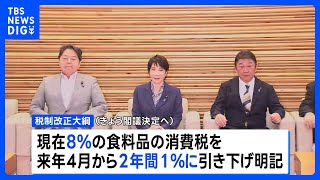
A cross-party national council discussing a reduction in the consumption tax on food will present a draft proposal on June 24 calling for the rate to be lowered to 1% from April next year.

The speakers and vice speakers of both houses of the Japanese Diet approved on June 22 the government’s outline for revising the Imperial Household Law and related measures aimed at securing the number of imperial family members, following what has been described as the consensus of the legislature.