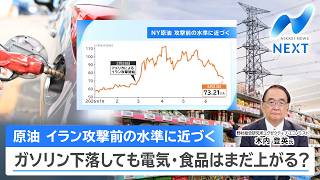
TOKYO - Former Mie Governor and Liberal Democratic Party Policy Research Council Special Adviser Eikei Suzuki has called for a stronger government role in Japan's energy policy, arguing that the country's heavy dependence on Middle Eastern oil is the result of decades of market-driven procurement and that rising energy prices now pose a greater threat than supply shortages.
Speaking on BS TV Tokyo's "NIKKEI Sunday Salon" on June 7th, Suzuki said Japan must use the current energy crisis as an opportunity to reform its legal framework and industrial policies, particularly in response to instability in the Middle East and disruptions affecting crude oil and naphtha supplies.
According to Suzuki, Japan's oil industry became increasingly dependent on the Middle East after the government reduced its involvement in oil procurement and fully privatized imports. While businesses naturally sought the most cost-effective sources of crude, he said the result was a sharp increase in reliance on supplies passing through the Strait of Hormuz.
Suzuki argued that the government should play a more active role in securing alternative sources of energy, including long-term contracts and procurement routes that bypass the Strait of Hormuz. He also called for industrial policies that support the use of crude oil from countries such as Alaska, Kazakhstan, Azerbaijan and Ecuador.
While concerns about supply shortages have dominated public discussion, Suzuki said the greater challenge now is rising costs.
"Attention has been focused on securing sufficient volumes, but from here the issue will be prices," Suzuki said. "Many businesses are already being told about price increases before they face supply shortages. This could undermine competitiveness."
He warned that higher procurement costs for oil, naphtha-derived products, paints and other industrial materials could place a significant burden on small and medium-sized enterprises, making government support essential.
Regarding naphtha supplies, Suzuki said current inventories and procurement plans should allow Japan to maintain supplies through next spring. He noted that recent shortages were caused not only by Middle East tensions but also by a concentration of refinery maintenance work.
He added that naphtha availability in May reached approximately 85% of the previous year's level and is expected to improve in the coming months. Some temporary shortages, he suggested, may also be linked to precautionary stockpiling by businesses concerned about future disruptions.
Suzuki acknowledged, however, that communication remains a challenge.
"Businesses hear that supplies are sufficient nationwide, but they still don't see products reaching them," he said, stressing the need for clearer information about future supply prospects. He argued that companies need greater visibility over the coming one to two months in order to avoid reducing operations or furloughing workers.
On fuel subsidies, Suzuki described gasoline support measures as a lifeline for rural communities but said they cannot continue indefinitely without review.
"From an economic policy perspective, lowering prices while supply uncertainty remains is not entirely natural," he said. "We cannot simply leave the current system unchanged forever."
Although he believes demand-suppression measures are unnecessary at present because alternative procurement efforts are progressing and electricity supplies remain stable, Suzuki suggested that future subsidy programs should become more targeted, focusing on lower-income households rather than broad-based support.
Beyond energy policy, Suzuki discussed Japan's long-term economic challenges, including regional revitalization and population concentration in Tokyo.
While supporting Tokyo's role as a globally competitive city, he argued that population concentration in the capital should be corrected and that more opportunities should be created in regional areas.
Suzuki also expressed concern about disparities in local government finances, noting that Tokyo enjoys large tax revenue surpluses while many regional governments struggle to maintain public services. Ensuring equitable access to public services across the country, he said, should be viewed as a national responsibility.
Looking ahead, Suzuki identified education, national security and energy policy as key priorities. He called for a comprehensive review of education policy in response to artificial intelligence and changing labor market demands, and argued that Japan must strengthen its defense industrial base by expanding cooperation between civilian and military technology sectors.
Quoting educator and political thinker Yoshida Shoin, Suzuki concluded by emphasizing the importance of turning aspirations into action.
"Without dreams there can be no success," he said, adding that politicians must focus not only on ideas but also on delivering tangible results.
Source: テレ東BIZ