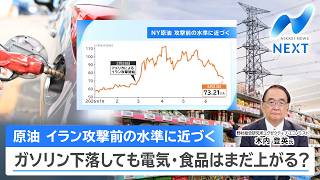
TOKYO - Crude oil prices have plunged to the low $70 range per barrel following the signing of a memorandum aimed at ending fighting between the United States and Iran, but while the immediate risk of an energy crisis appears to have eased, economists warn that price increases for electricity, food and everyday goods may still be about to intensify.
Oil futures in New York have fallen to around $73 a barrel, moving closer to levels seen before the U.S. attack on Iran. The decline followed signs that traffic through the Strait of Hormuz was beginning to recover, including an announcement by Oman’s government on June 23 that it would establish an evacuation route for tankers stranded in the Persian Gulf.
Takahide Kiuchi, executive economist at Nomura Research Institute, said crude prices could briefly return to the $60 range but are unlikely to remain there. After the attack on Iran, the unexpected risk of a closure of the Strait of Hormuz emerged, and Kiuchi said that possibility is likely to continue adding a risk premium to prices if tensions between the United States and Iran flare again in the future.
Kiuchi said the current decline toward the $60 range also reflects a temporary shift in financial markets toward risk aversion, partly caused by a drop in artificial intelligence-related stocks. Because crude oil is considered a risk asset, it has also been sold during the broader retreat from risk.
The fall in crude prices is expected to affect gasoline first. The Agency for Natural Resources and Energy announced on June 25 that the national average retail price of regular gasoline was in the 169 yen range per liter. Government subsidies have been used to keep prices around 170 yen, but the subsidy is set to fall to 6 yen.
Kiuchi said gasoline wholesale prices are closely linked to overseas crude prices. If crude remains at current levels, oil distributors are likely to lower wholesale prices, reducing the need for subsidies. He said the subsidy could disappear as early as next week, allowing the national average gasoline price to fall slightly below 170 yen. That would be the first time households could clearly feel the benefit of lower crude prices, although Kiuchi said the impact would be limited if crude does not remain in the $60 range, with gasoline likely to stay in the 160-yen range.
Electricity bills are expected to follow a different path because fuel cost changes are reflected with a delay. According to an estimate by the Central Research Institute of Electric Power Industry, electricity bills for standard four-person households could rise by 840 yen a month by March next year compared with January this year.
Kiuchi said electricity charges from the September billing period, which households would pay in the October-December quarter, are likely to rise sharply as past cost increases are reflected. Whether the government extends subsidies to restrain the increases has not yet been decided, but Kiuchi said he expects the subsidies will probably be extended.
Even if lower crude prices eventually reduce electricity costs, Kiuchi said households are unlikely to feel the effect until early next year. The impact of recent crude price declines would not start pushing down electricity bills until the December billing period, which would be paid in the January-March quarter.
Food prices are also expected to continue rising. A Teikoku Databank survey indicates that the number of food and beverage items subject to price hikes is expected to exceed 10,000 in a year for the fifth consecutive year as of June.
Kiuchi said the pace of food price increases had been slowing after last year’s peak as the impact of the weaker yen on food costs began to fade. However, he said the effect of higher crude prices has not yet been fully reflected and is likely to push food prices higher from here. He said price increases for petroleum-related products, including those made from naphtha, are likely to become more visible from July through October.
The impact is expected to extend beyond gasoline and utilities to everyday goods such as garbage bags, plastic wrap, tires, shampoo, detergent and clothing made from chemical fibers. Some items, including garbage bags and plastic wrap, have already risen sharply, but Kiuchi said many products made with higher-cost materials will climb as older inventories run out.
Food price increases are expected to spread more gradually and could continue into next year. Kiuchi said the effect of naphtha-related products may peak around October, while food-related price increases will take longer to work through the economy.
Asked whether prices could return to previous levels if crude falls, Kiuchi said some individual items that rose sharply, such as plastic wrap and garbage bags, could decline. However, he said overall inflation is unlikely to turn negative. Instead, the pace of price increases may slow from autumn toward the end of the year, but prices as a whole are unlikely to fall.
The weaker yen remains another major driver of inflation. The yen traded in the upper 161 range against the dollar on June 25, approaching the 162 level for the first time in about 39 and a half years since December 1986. Market caution over possible foreign exchange intervention has been growing.
Kiuchi said the end of gasoline subsidies could reduce concern over fiscal deterioration, and cheaper crude from the Middle East could improve the trade balance, both of which might normally ease pressure on the yen. However, he said the government’s growth strategy appears likely to involve heavy spending, which could instead increase downward pressure on the currency.
He also noted that the Bank of Japan’s interest rate increase last week has not been enough to halt the yen’s decline. Kiuchi said the outlook for U.S. monetary policy is now the larger factor affecting exchange rates. Expectations for U.S. rate increases this year have strengthened, making the yen more likely to weaken. Intervention may be used to restrain the move, but Kiuchi said it is increasingly uncertain whether it will be enough.
If expectations grow that the Federal Reserve will raise rates twice this year and continue tightening into next year, Kiuchi said the yen could move beyond the current 160 range and, in the worst case, approach 170 to the dollar.
Source: テレ東BIZ