News On Japan

Recycling Technology Takes On Naphtha Shortage

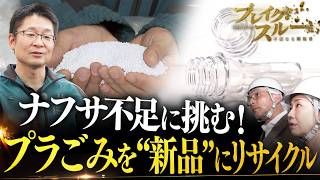
TOKYO - Japan's reliance on Middle Eastern crude oil has left manufacturers exposed to rising costs for plastic containers, ink and other products that use naphtha, but JEPLAN President Masaki Takao is pushing a recycling technology that could reduce the need for petroleum-derived raw materials by turning used plastic back into material close to new.

The technology, known as chemical recycling, breaks PET bottles down to the molecular level and removes impurities that have long limited conventional recycling. Takao says the process allows plastic to be reused repeatedly without loss of quality, creating what he describes as a semipermanent resource cycle.

"The more recycled material we use, the more we can reduce petroleum-based raw materials," Takao said. "Basically, it can be used almost semipermanently."

JEPLAN collects used PET bottles and restores them to a quality equivalent to petroleum-derived material before returning them to the market. Takao said the approach is rare globally because it goes beyond waste treatment and treats discarded plastic as an industrial raw material. "I did not want this to be an extension of garbage disposal. I wanted to do proper manufacturing, and it just happened that the raw material was waste. I believe waste is a resource," he said.

At a large plant built on a site about the size of Tokyo Dome with an investment of about 13 billion yen, crushed and washed PET bottles are brought in as feedstock. The plant receives about 60 tons of material a day from municipalities across Japan, equivalent to roughly 3 million PET bottles.

The incoming material is not perfectly clean. Some flakes are discolored, and some contain different types of plastic. Such impurities have been a major obstacle to recycling because they accumulate each time plastic is reused, lowering quality.

Takao said JEPLAN developed its process to solve that problem by purifying the material so it can be circulated many times. "With conventional methods, impurities inevitably build up and quality deteriorates," he said. "We wanted to solve that by refining the material so it can be circulated repeatedly. If it circulates, there is less need to introduce new petroleum resources."

Japan is often described as having a high plastic recycling rate, but much of that comes from thermal recycling, in which waste is burned and the heat is recovered as energy. Thermal recycling accounts for 66% of Japan's plastic recycling, while mechanical recycling, which melts plastic and returns it to material use, accounts for 20%.

Mechanical recycling has limits because impurities build up after repeated processing, making about three cycles the practical ceiling before the plastic ultimately has to be burned. Chemical recycling, the field Takao is pursuing, accounts for only about 2%.

At the plant, JEPLAN showed a white liquid produced by breaking down PET flakes at the molecular level. "The PET flakes from earlier have been decomposed to the molecular level, and this is the result," Takao said. "Because we decompose and refine them at the molecular level, we can return them to the level of new material."

JEPLAN is also applying the technology to polyester used in clothing, drawing interest from European companies facing strict environmental standards. Takao is betting that the process can address both resource shortages and environmental pressures by creating a circular system in which plastic waste is repeatedly reborn as high-quality material.

Source: テレ東BIZ

News On Japan
POPULAR NEWS

Typhoon No. 7 (Mekkhala) was moving west-northwest at 30 kilometers per hour over waters east of the Philippines as of 3 a.m. on June 22, maintaining strong intensity with a central pressure of 955 hectopascals and maximum sustained winds of 40 meters per second, and is forecast to strengthen further as it raises the risk of impacts on Okinawa later this week.

Japan delivered their strongest performance of the World Cup so far with a 4-0 victory over Tunisia in Monterrey on June 21, moving to four points in Group F and putting themselves in a strong position to reach the knockout stage ahead of their final group match against Sweden.

Mosquitoes are appearing earlier than usual this year, raising fears of a major summer outbreak as experts warn that warm May weather and repeated light rain have created ideal breeding conditions across residential areas.

Bear attacks and sightings are increasing across Japan, with multiple people injured on June 17 and experts warning that bears are becoming more accustomed to human environments, potentially leading to more dangerous and unpredictable encounters in the years ahead.

JR Central and JR West on June 17 announced pricing and service details for the new private-room seating that will be introduced on the Tokaido and Sanyo Shinkansen from October, creating a new top-tier class above the existing Green Car service.

MEDIA CHANNELS
         

MORE Oil Crisis NEWS

Japan's reliance on Middle Eastern crude oil has left manufacturers exposed to rising costs for plastic containers, ink and other products that use naphtha, but JEPLAN President Masaki Takao is pushing a recycling technology that could reduce the need for petroleum-derived raw materials by turning used plastic back into material close to new.

A rice ball chain based in Yokkaichi, Mie Prefecture, is feeling the effects of turmoil in the Middle East through higher costs and supply shortages for packaging film and other materials essential to selling onigiri.

The global oil market could face a major supply surplus in 2027 if the United States and Iran maintain an agreement aimed at ending hostilities, the International Energy Agency said in its monthly report released on June 17.

Calbee's potato chips in black-and-white packaging appeared on convenience store shelves in Tokyo on June 17, reflecting the company's response to concerns over the stability of printing ink supplies derived from naphtha as tensions in the Middle East disrupted procurement.

Japan's trade balance fell into the red for the first time in four months in May, as soaring crude oil procurement costs linked to tensions in the Middle East pushed import prices to record levels despite a sharp decline in import volumes.

A Japanese-linked vessel anchored in the Persian Gulf sustained damage to part of its hull, but remained capable of sailing under its own power and no crew members were injured, Land, Infrastructure, Transport and Tourism Minister Kaneko said.

Sapporo began accepting household garbage in non-designated bags on June 15 as plastic product shortages linked to tensions in the Middle East continue to affect supplies, with home improvement stores reporting a sharp increase in demand for transparent and semi-transparent bags.

A shortage of naphtha-derived products is beginning to affect some of the best-known local products in Shizuoka Prefecture, threatening everything from peaches to tofu as producers struggle with rising costs and uncertain supplies.