News On Japan

SLIM's Special Camera Reveals Possible Earth-Origin Moon Formation

TOKYO, Jun 03 (News On Japan) - 'How was the moon born?' Among various hypotheses, the most supported is the 'Giant Impact Hypothesis.' This theory suggests that material from Earth forms part of the moon's interior. To investigate this, Japan's first successful lunar lander, SLIM, deliberately landed in a challenging area near a crater. The special camera onboard captured significant images. What does the analysis of these images reveal about the moon's origin?
The success of SLIM, Japan's first lunar lander, hinged on its landing location. It touched down on a slope near a crater, where rocks are abundant. The challenging landing site was chosen to fulfill the crucial mission of probing the moon's origin. Approximately 4.6 billion years ago, the solar system was formed from gas and dust in space. As the temperature, pressure, and density at the center increased, the sun was born. The remaining gas and dust collided to form planets like Earth. However, the exact formation process of the moon remains unclear.

Four major theories exist regarding the moon's origin. The 'Twin Theory' proposes that the moon and Earth formed simultaneously. The 'Parent-Child Theory' suggests the moon split from a part of Earth. The 'Capture Theory' posits that the moon formed elsewhere and was captured by Earth's gravity. The most supported theory, however, is the 'Giant Impact Hypothesis,' which suggests a Mars-sized body collided with Earth, causing material from Earth's mantle to scatter into space, eventually forming the moon.

To support the Giant Impact Hypothesis, it is crucial to confirm that the moon's internal materials are similar to Earth's mantle. The key is olivine, a mineral formed from cooled mantle material, which is also found around volcanoes on Earth. The presence of similar stones on the moon's surface, particularly around the crater where SLIM landed, is vital for this research. Craters form from meteorite impacts, scattering stones from the moon's interior around the impact site. SLIM was strategically positioned to examine these stones closely.

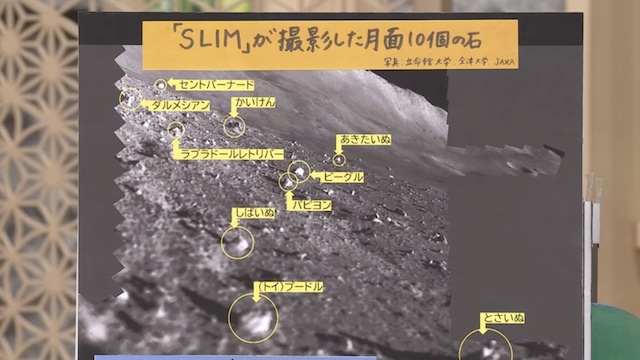
The research team marked ten stones captured by SLIM's special camera, naming them after dog breeds. The camera analyzes light wavelengths to identify the substances in the rocks. One stone, named 'Dalmatian,' was found to contain olivine. Further analysis of this olivine, comparing it to Earth's, could strengthen the Giant Impact Hypothesis. How close can we get to unraveling the moon's origin?

Source: TBS

News On Japan
POPULAR NEWS

Bear sightings across Japan have already climbed to nearly twice the level recorded during the same period last year, prompting entry bans in mountain areas behind Kyoto’s Ninna-ji Temple and the cancellation of hiking events in Kansai, while new research suggests that the key to reducing encounters may lie in understanding what bears eat in each region.

Copper roofing panels were stolen from several shrines in Hamamatsu, Shizuoka Prefecture, including a city-designated cultural property, in the latest case amid a nationwide surge in copper thefts targeting shrines and temples across Japan, where soaring metal prices have fueled crimes that leave historic religious buildings damaged, exposed to the elements, and facing repair costs of millions of yen.

Flames broke out on the morning of May 20th on Miyajima Island in Hiroshima Prefecture, home to one of Japan's World Heritage sites, destroying Reikado Hall near the summit of Mount Misen.

Uncertainty surrounding the situation in the Middle East is beginning to affect daily life in Japan, as concerns over crude oil supplies spread to restaurants, cleaning services and even household garbage disposal systems across the Kansai region.

A 25-year-old woman arrested as a suspected ringleader in a robbery-murder case in Tochigi Prefecture once posted cheerful dance videos on social media and was remembered by those who knew her as an energetic and outgoing young woman.

MEDIA CHANNELS
         

MORE Sci-Tech NEWS

A safety alert is expected to be issued as early as May 21st over Tavneos, a drug used to treat vasculitis, after 20 patients who took the medication died from serious liver dysfunction, according to people familiar with the matter.

As aging underground infrastructure becomes an increasing concern across Japan, the city of Yokkaichi in Mie Prefecture has developed a digital underground map designed to improve the management of sewer, water, gas, and electrical systems.

Japan's Health, Labour and Welfare Ministry said on May 18th it had instructed Kissei Pharmaceutical to report the facts surrounding the deaths of 20 patients who had taken a treatment drug for vasculitis.

A mysterious object floating softly through the air has captured widespread attention online, with researchers at Nagoya University developing an ultra-lightweight material that appears to behave like a real-life “flying carpet.”

Japan has approved the application of public health insurance to a regenerative medicine product using iPS cells to treat Parkinson’s disease, marking the world’s first practical use of iPS cell-based regenerative medicine.

A crack was found in the cover surrounding the high-pressure turbine at Kansai Electric Power’s Mihama Nuclear Power Plant No. 3 reactor in Mihama, Fukui Prefecture, following a steam leak that occurred last week, the utility said.

Japan has approved the domestic manufacture and sale of an MMR vaccine that protects against measles, mumps, and rubella with a single injection, paving the way for its use in children aged one and older.

A steam leak was detected early on May 8th at the Mihama Nuclear Power Plant's Unit 3 in Fukui Prefecture, prompting Kansai Electric Power to manually shut down the reactor.