News On Japan

Japan Drafts Guidelines for Leftover Takeaway

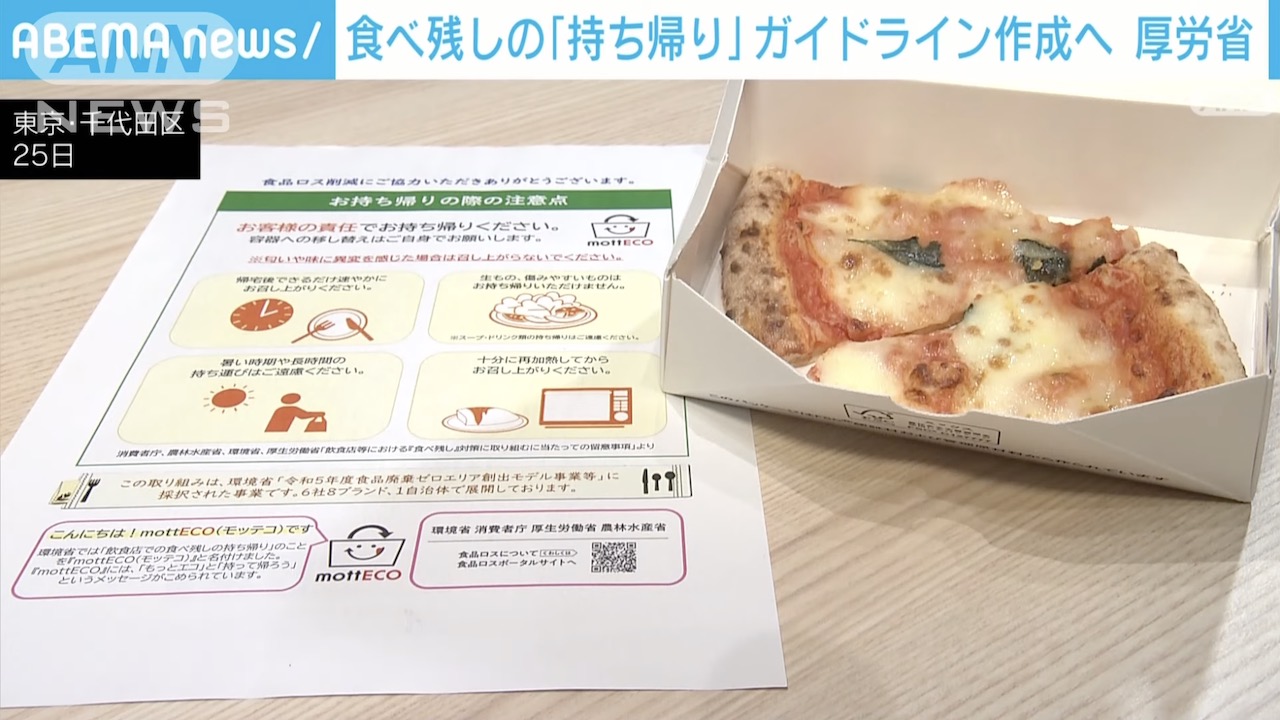
TOKYO, Jul 27 (News On Japan) - Japan's Ministry of Health, Labour and Welfare has initiated the creation of guidelines for taking home leftovers as part of its efforts to reduce food waste. Restaurants are hopeful for clear directions on preventing food poisoning.

According to the Consumer Affairs Agency, Japan's domestic food waste in fiscal 2022 amounted to 4.72 million tons. This is equivalent to each person discarding about a bowl of food every day.

The ministry aims to develop hygiene guidelines for taking home leftovers from restaurants and held its first discussion meeting on the matter on July 26.

A hotel in Chiyoda Ward, Tokyo, has been actively working to reduce food waste since 2019, successfully cutting down the amount of kitchen waste by approximately 16%, including from banquets.

The hotel has implemented its own cautious rules for takeaways, such as generally not allowing them during the summer.

Iwasaki, the Executive Chef of Hotel Metropolitan Edmont, explained, "The most frightening thing for us chefs is food poisoning. As a rule, we select items for takeaway that have been heated to 75 degrees Celsius for more than a minute."

While takeaways are based on the customer's responsibility, addressing food poisoning remains a challenge.

Matsuda, the General Manager of Hotel Metropolitan Edmont, shared, "We feel deeply troubled when the food we have prepared is discarded. By establishing a certain system or rules, we believe we can alleviate these concerns and advance this initiative."

The ministry plans to finalize the guidelines for restaurants and buffets by the end of the fiscal year.

Source: ANN

News On Japan
POPULAR NEWS

As of 9 p.m. on June 20, Typhoon No. 7 (Mekkhala) was gradually developing over waters far south of Japan and is expected to strengthen into a strong typhoon early next week before possibly moving toward the Sakishima Islands, while moist air around the storm could later feed a rainy season front stalled near Honshu and raise the risk of heavy rain across western and eastern Japan.

Japan will face Tunisia in its second match of the FIFA World Cup 2026 on June 21 in Monterrey, a northern Mexican city known for its mountains, modern skyline and unexpectedly strong connections with Japan.

Mosquitoes are appearing earlier than usual this year, raising fears of a major summer outbreak as experts warn that warm May weather and repeated light rain have created ideal breeding conditions across residential areas.

Bear attacks and sightings are increasing across Japan, with multiple people injured on June 17 and experts warning that bears are becoming more accustomed to human environments, potentially leading to more dangerous and unpredictable encounters in the years ahead.

JR Central and JR West on June 17 announced pricing and service details for the new private-room seating that will be introduced on the Tokaido and Sanyo Shinkansen from October, creating a new top-tier class above the existing Green Car service.

MEDIA CHANNELS
         

MORE Food NEWS

A snack with the pungent smell and flavor of natto has been developed in Hakodate, Hokkaido, using no natto bacteria but delivering an aroma strong enough to make people react the moment the bag is opened.

Harvesting began on June 18 for Densuke watermelons, a specialty of Toma in Hokkaido known for their glossy black rind, crisp texture and rich sweetness, with the season’s first auctions scheduled for June 19 at markets in Sapporo and Asahikawa.

The harvest of fruit-like sweet corn has reached its peak in Hekinan, Aichi Prefecture, where farmers begin picking before dawn to preserve the crop's high sugar content and freshness.

Japan byFood featuring Shizuka spends 24 hours exploring Yokohama, Japan’s second-largest city located just 30 minutes south of Tokyo.

The first auction of Raiden Watermelon, a specialty product of Kyowa in Hokkaido's Shiribeshi region, was held in Sapporo on June 9th, with a pair of melons fetching a record-high 400,000 yen.

Seven-Eleven Okinawa and local dairy farmers have begun working together to find new uses for milk produced during the summer vacation period, when school lunch programs are suspended and demand for fresh milk declines.

The harvest of Nanko plums, a specialty product of Minabe Town in Wakayama Prefecture, Japan's largest ume-producing region, has reached its peak, with farmers busy gathering the highly prized fruit despite another disappointing crop year.

Major meat processor Itoham announced on June 5th that it will launch a new lower-priced product line next month as companies continue to grapple with rising costs driven by inflation and instability in the Middle East.