News On Japan

Japanese-Style Town Emerges in Thailand

Japanese-Style Town Emerges in Thailand

BANGKOK, Nov 05, 2024 (News On Japan) - A new trend has emerged in Thailand, known for its friendly ties with Japan, where Japanese-style townscapes are being faithfully recreated.

In a bustling store in Tokyo that specializes in daily goods and food items, Thai tourists are eagerly filling their baskets with Japanese treats. One Thai visitor commented, “I’ve always wanted to try Japanese gummies since they’re not available in Thailand.” Another held a bottle of air freshener, saying, “I’ve never seen anything like this in Thailand; it’s like an angel descending in your bathroom.”

This Tokyo store, Takeya, has become particularly popular among inbound tourists from Thailand, now the largest group of customers from overseas. The store has Thai-speaking staff and Thai-language signs prominently displayed to cater to these visitors.

According to Shiori Ogawa, a cosmetics staff member, “We see around 17,300 customers each month, and most are from Thailand.”

The demand for Japanese products has also driven the rise of local influencers, such as Aki Yamaguchi, whose videos showcasing lively Tokyo spots have attracted 1.7 million followers, mostly in Thailand. Aki noted that “Thai people love the vibrant atmosphere. Food is key—good appearance, good taste, and reasonable prices at Ameyoko make it popular.”

The increase in Thai interest in Japanese culture is partly due to an uptick in anime viewing during the pandemic, leading many Thai people to develop a deep interest in Japan's cultural landscape. Now, it seems some are no longer content with just watching—new facilities that offer a Japanese-like ambiance are even popping up in Thailand.

According to Aki, “The atmosphere is so authentic that it feels like Japan, especially for those who miss traveling. It brings a sense of comfort.”

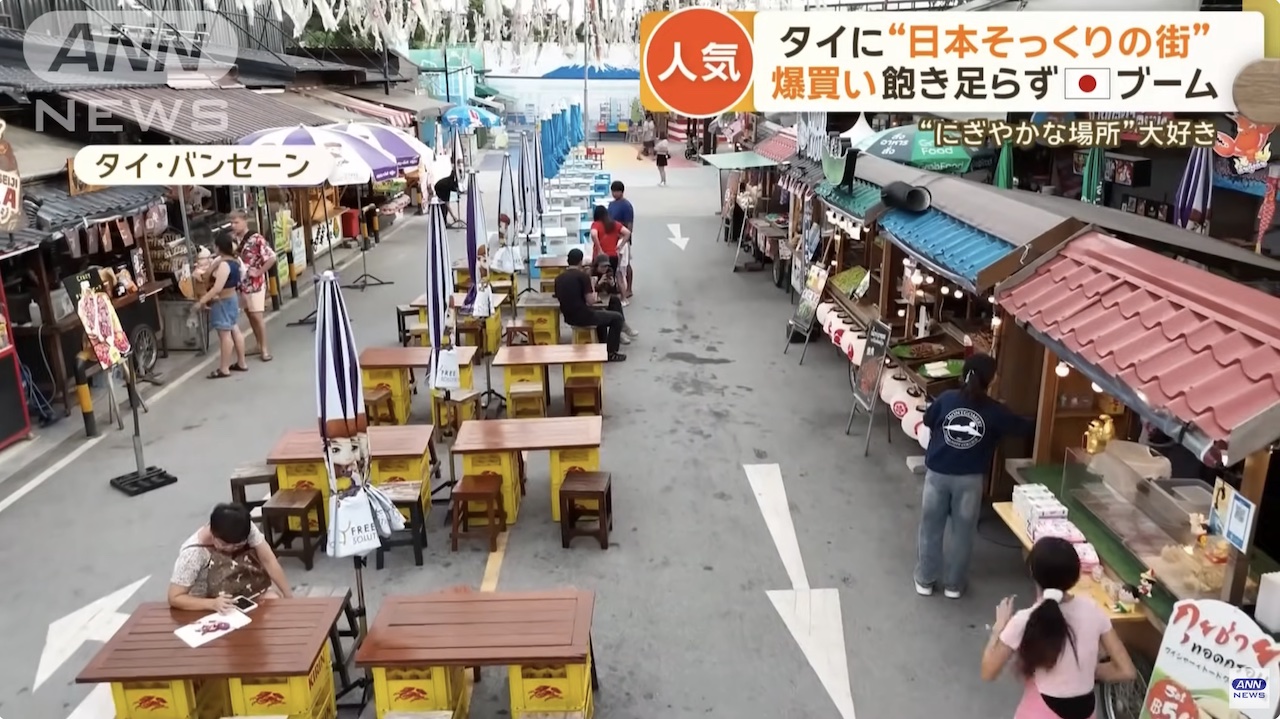
One such facility can be found just a 90-minute drive from Bangkok, where a sign reads ‘Bang Saen Fish Market.’ While the name suggests a traditional market, visitors are instead greeted by a setting reminiscent of Showa-era Japan, complete with tile-roofed buildings and familiar Japanese signs—albeit with some humorous mistranslations.

One visitor expressed delight, saying, “The decorations are amazing! I feel like I’m in Japan even without leaving Thailand. It brings back fond memories of my trips to Japan.”

The facility’s creator, Joe, initially opened it as a Thai food court three years ago, but it saw little foot traffic. However, a Japanese-style senbei, ‘Sugoi Senbei,’ became a hit, inspiring him to reimagine the space as a Japanese-themed town. The renovation led to a surge in popularity, with 5,000 to 6,000 visitors on weekends and over 10,000 during holidays.

Even Japanese tourists have started to visit, often pointing out amusing language errors. Joe laughs, recalling mistakes such as labeling watermelon juice as ‘strawberry’ and selling tamagoyaki as ‘unadon,’ but says the store owners are working hard to improve the Japanese feel of the experience.

Joe plans to open a similar facility at another location soon, as Japan’s appeal continues to grow in Thailand.

Source: ANN

News On Japan
POPULAR NEWS

A 9-minute, 13-second drone video filmed inside Aeon Mall Kumamoto two days after the deadly explosion has provided a detailed view of the destruction, showing collapsed ceilings, heavy dust and widespread damage that may have affected between one-third and nearly half of the shopping center.

Strong Typhoon No. 18 was moving northwest through the East China Sea on the night of August 26, gradually pulling away from Okinawa and the Amami Islands as lingering rain, strong winds and high waves were expected to ease. As of 9 p.m. on August 26, the typhoon was over waters north-northwest of Kume Island and moving northwest.

A series of mysterious illegal dumping incidents involving about 39 kilograms of sliced bread has been reported around Mount Daisen and other parts of Tottori Prefecture in August, with officials investigating whether the food may have been deliberately placed to attract wild animals.

An 85-year-old couple have donated a combined 400 million yen to Osaka City with a request that the money be used to create a giant Myaku-Myaku statue about 20 meters tall at the former site of the Osaka-Kansai Expo, envisioning a landmark that could become a lasting symbol of the event and of renewed prosperity for Kansai and Japan.

Lawson plans to cut prices on its main line of onigiri rice balls by 10 yen from September 29 as falling rice prices begin to feed through to retail costs.

MEDIA CHANNELS
         

MORE Travel NEWS

ANA Holdings' All Nippon Airways and Japan Airlines will begin coordinating departure times on the Haneda-Okayama route from October 25, an unusual move by Japan's two largest airline groups as weak business travel, a weaker yen and rising fuel and labor costs put increasing pressure on domestic operations.

Haneda Airport has unveiled a new boarding area at Terminal 1 that will begin operations in September, featuring extensive wood interiors and self-driving transportation within the facility.

A new 220-meter pedestrian suspension bridge has been completed at Biwako Valley in Otsu, Shiga Prefecture, offering visitors sweeping views of Lake Biwa from mountains about 1,100 meters above sea level.

Police have established a temporary police post in the whaling town of Taiji, Wakayama Prefecture, ahead of the September 1 opening of the annual drive hunt for whales and dolphins.

Air travel in Okinawa is beginning to be disrupted by the approach of Typhoon No. 18, with All Nippon Airways canceling 119 flights and more than 20,000 passengers expected to be affected.

Kyoto is stepping up efforts to capture Japan's growing nighttime economy, with Toei Kyoto Studio Park extending its hours to 9 p.m., a new theater drawing visitors near Kyoto Station and nighttime tours expanding in Gion as the city seeks to encourage tourists to stay out longer and explore more areas after dark.

The whistle of a steam locomotive still echoes through the mountains of Engaru in northeastern Hokkaido, where the historic Amemiya No. 21 continues to run through a region once sustained by forestry.

A foreign tourist was injured after being attacked by a bear near an observation deck on the shore of Lake Towada in Towada, Aomori Prefecture, on August 22, suffering a bite to his right arm and a bruised right shoulder.