News On Japan

Kyoto’s Philosophers’ Path: Should It Be Paved or Left Untouched?

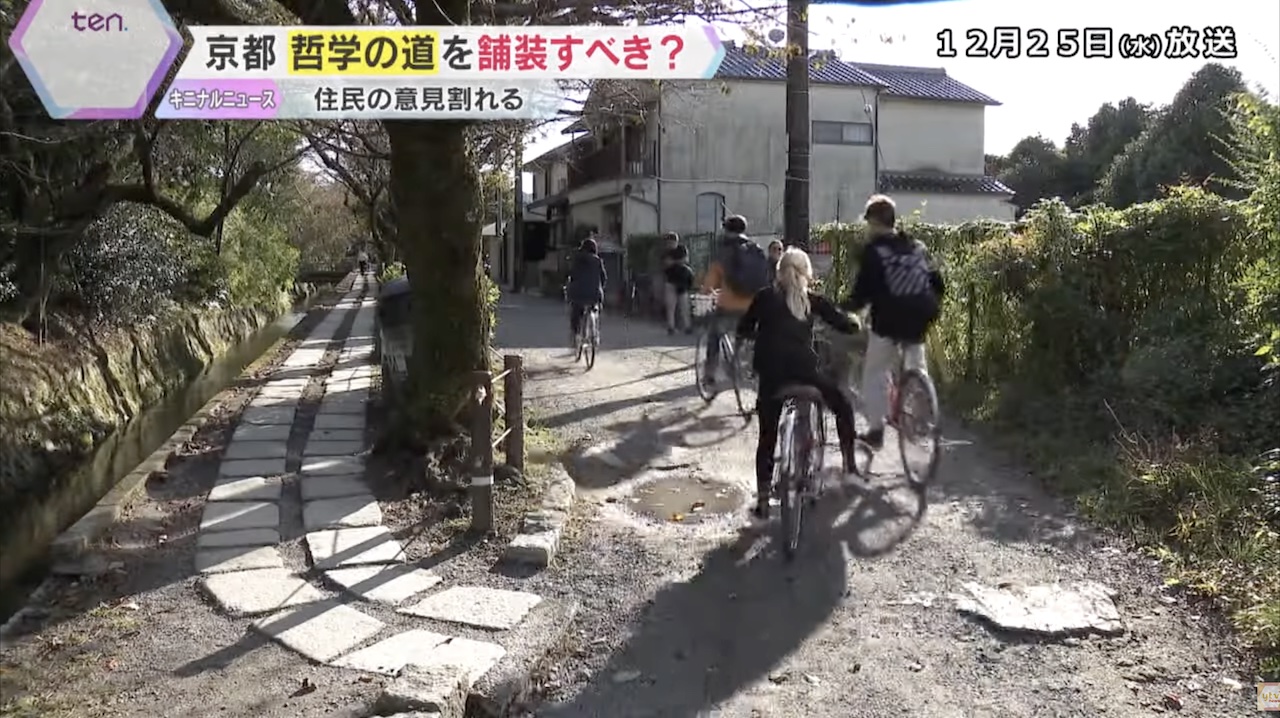
KYOTO, Dec 26 (News On Japan) - Debate is growing over whether Kyoto’s iconic Philosophers’ Path should be paved with asphalt or preserved in its natural state.

On December 25th, three groups dedicated to preserving the environment of the Philosophers’ Path visited Kyoto City Hall. They submitted a request to maintain the path as a natural dirt trail, emphasizing the need to protect the surrounding environment, including the iconic cherry blossom trees.

A member of a local resident group remarked, “Differences in opinions among those living along the path have caused divisions. We hope for a solution that benefits everyone without causing harm.”

Located in Kyoto’s Sakyo Ward, the Philosophers’ Path stretches about 2 kilometers from near Ginkaku-ji Temple to the south, offering picturesque scenery. In spring, approximately 400 cherry trees bloom, and the area is home to fireflies, making it beloved by both locals and tourists.

According to Kyoto City, parts of the path have already been paved with asphalt. However, opposition from some residents who wish to preserve the scenery has stalled further paving in other sections.

One local resident expressed their thoughts: “If the path is paved with concrete, it will become just another ordinary road. The Philosophers’ Path should remain a dirt trail, preserving its unique character for future generations. Altering it could disrupt the natural ecosystem, affecting insects, birds, and other wildlife.”

However, leaving the path unpaved has caused some challenges.

A local resident pointed to a crack in a nearby door, saying, “Look at this. It’s caused by stones kicked up from the gravel path. Even vehicles get damaged.”

Another resident mentioned, “We built this parking space for our car, but it’s constantly covered in dust. It’s quite inconvenient.”

There are also complaints about muddy conditions on rainy days, with some residents calling for improvements.

In response, Kyoto City has formed a discussion panel, including experts, advocates for paving, and cautious locals. On December 17th, they conducted an on-site inspection to explore possible solutions that balance maintaining the landscape and improving livability.

Takahiro Sawai, a representative of the Philosophers’ Path Preservation Society, urged caution: “It’s important to consider the entire environment, including the habitat of Genji fireflies, which are designated natural monuments in Kyoto.”

On the other hand, local resident Fumio Ninobe, who supports paving, argued, “Some parts of the path are already paved with asphalt, and it hasn’t affected the local environment. Fireflies still thrive here.”

Masafumi Kawasaki, a professor at Kyoto University’s Graduate School of Global Environmental Studies, noted, “Even if the gravel path is compacted, vehicles passing through can dislodge stones, requiring repairs. We need to carefully plan the path’s maintenance based on specific locations, considering whether there are houses nearby.”

Source: YOMIURI

News On Japan
POPULAR NEWS

Shibuya Ward has approved an ordinance that would impose a 2,000-yen fine for littering on public streets, while also penalizing shops that fail to provide trash bins. The measure was passed on December 10th and targets both individuals who discard waste and businesses near major stations that offer takeout services, raising questions about whether the approach will meaningfully reduce trash on the streets.

Shogi player Kana Fukuma, who currently holds six women’s titles, revealed on December 10th that she has submitted a formal request calling for revisions to the Japan Shogi Association’s rule that prevents players from competing in title matches during a set period before and after childbirth.

The most popular baby names of 2025 were led by Minato for boys and Sui for girls, according to rankings released by Meiji Yasuda Life, which highlighted continued enthusiasm for certain kanji characters and showed how naming trends have evolved since the survey began in the first year of the Taisho era.

A powerful earthquake with a seismic intensity of 6+ struck Aomori late on December 8th, prompting the Meteorological Agency to issue a temporary tsunami warning for coastal areas along the Pacific side of the prefecture. While the warning has since been downgraded, the government is urging caution after authorities announced, for the first time, a heightened possibility of another large earthquake occurring off Hokkaido and the Sanriku coast.

A plan to sharply raise Japan’s departure tax is taking shape as the government and ruling coalition have begun coordinating a proposal to lift the current 1,000 yen levy to a flat 3,000 yen per person in next fiscal year’s tax reform, adding new momentum to calls for expanded funding to deal with overtourism across the country.

MEDIA CHANNELS
         

MORE Travel NEWS

On the morning of December 9th, the chill in the air surrounded the Imperial Palace as a long line stretched from the Otemon Gate along the moat, with more than 200 people waiting from the early hours in pursuit of what has become known as the “Imperial Palace Wallet.”

Fukuoka Mayor Takashima said during a press conference held on December 9th that the city will begin studying a subway extension to the international terminal at Fukuoka Airport as part of broader efforts to address transport challenges across the city.

A powerful earthquake with a seismic intensity of 6+ struck Aomori late on December 8th, prompting the Meteorological Agency to issue a temporary tsunami warning for coastal areas along the Pacific side of the prefecture. While the warning has since been downgraded, the government is urging caution after authorities announced, for the first time, a heightened possibility of another large earthquake occurring off Hokkaido and the Sanriku coast.

A plan to sharply raise Japan’s departure tax is taking shape as the government and ruling coalition have begun coordinating a proposal to lift the current 1,000 yen levy to a flat 3,000 yen per person in next fiscal year’s tax reform, adding new momentum to calls for expanded funding to deal with overtourism across the country.

Chinese tourists are disappearing from major destinations across the Kansai region as diplomatic tensions between Japan and China continue to deepen on the heels of comments by Prime Minister Takaichi regarding a potential Taiwan contingency, prompting Beijing to urge its citizens to refrain from traveling or studying in Japan.

Autumn travel to Nikko, which draws visitors from across Japan for its bright foliage, is seeing an unexpected wave of vehicle troubles on mountain roads, with everything from flat tires and sudden breakdowns to off-road mishaps and stranded foreign tourists prompting repeated calls for roadside assistance during busy weekends in November.

China’s major airlines have extended the period during which Japan-bound tickets can be cancelled free of charge, with carriers announcing by today that the deadline—initially set to run through the end of this year—will now continue until March 28th 2026.

Osaka’s Minami district, one of the busiest entertainment areas in Kansai, is grappling with a worsening garbage problem as the sharp increase in foreign visitors coincides with a rise in litter throughout the area, and when the reporting team walked through the neighborhood last week they found trash piling up in abandoned bicycle baskets and food containers tossed into alleyways just off the main shopping streets.