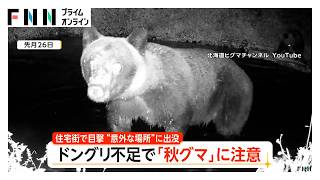
HOKKAIDO, Mar 31, 2026 (News On Japan) - A large bear, its massive body swaying as it walked sluggishly, was recently spotted just after emerging from hibernation, already showing signs of hunger as it devoured food in early spring.
The reporting team visited Bear Mountain in Shintoku, Hokkaido, where brown bears are raised in an environment close to nature, and where all 11 bears had spent the winter quietly in hibernation.
Inside one of the enclosures, a bear that had only just awakened in March was seen gripping food with its sharp claws and eating eagerly.
Masaru Sakade, director of Bear Mountain, said: "This year, we did not feed them for 88 days, and when one bear reacted to the smell of food, the others woke up all at once."
One bear that had weighed 420 kilograms before hibernation lost around 60 kilograms during the fasting period, having built up fat reserves beforehand.
Its ribs were clearly visible, highlighting how much weight it had lost.
After hibernation, the bears are given specially formulated feed high in calories and protein, and their weight is gradually restored while monitoring their condition.
Loud banging noises echoed from the enclosures, as newly awakened bears struck the doors from inside.
Sakade explained: "They want us to open the doors quickly and give them food. Their reaction to food is intense. When they see it, they rush toward the enclosure and become excited, almost as if demanding to be fed."
In 2025, bear-related incidents became a serious issue across Japan, and reports of so-called "spring bears" emerging from hibernation have already begun to rise this year.
In Furano, Hokkaido, there have been three reported sightings in just the past week.
On the night of March 24th, a car traveling along a national highway collided with a bear that suddenly darted out from a field. While the vehicle was left unable to drive, the driver was unharmed.
As residents grow increasingly anxious about bear sightings, a local home improvement store has already begun stocking bear deterrent products.
The store has doubled its retail space compared to 2025, offering a wider range of items such as bear bells and deterrent sprays.
Taichi Miyashita, deputy manager of a DCM store in Furano, said: "The season has started unusually early. Normally, we would not begin displaying these products in early March. The periods before and after hibernation are the most dangerous, and we are already receiving inquiries."
In Iwamizawa, Hokkaido, a veteran hunter with 55 years of experience, Katsuo Harada, 85, has begun patrols.
Harada said: "We’re starting to see them here and there. Once it rains, they will come out all at once."
He explained that when snow melts due to rain, bears emerge from their dens and descend from the mountains.
Harada lost his left eye in a bear attack about 25 years ago while hunting deer, and has since worked to protect local communities from bear-related dangers.
While on patrol, he sensed something unusual near a box trap he had set, suddenly sniffing the air.
Harada said: "I smell something—it's a bear. It's coming. It's here!"
Having captured 19 bears in 2025, Harada noted that food shortages are a serious issue for bears emerging from hibernation.
"The lack of food is a reality. It’s becoming a very harsh time for bears. They are starving and will eat anything. Even if it’s somewhat dangerous, they will enter traps because of hunger," he said.
As "spring bears" continue to appear across the country, authorities warn that bears that have previously found food in urban areas may return to the same locations, increasing the need for vigilance.
Source: FNN