HAMAMATSU, May 21, 2026 (News On Japan) - Copper roofing panels were stolen from several shrines in Hamamatsu, Shizuoka Prefecture, including a city-designated cultural property, in the latest case amid a nationwide surge in copper thefts targeting shrines and temples across Japan, where soaring metal prices have fueled crimes that leave historic religious buildings damaged, exposed to the elements, and facing repair costs of millions of yen.
At a shrine in Hamana Ward, Hamamatsu City, copper roofing panels were stripped from shrine buildings in what authorities believe may be a string of connected thefts. Damage has been confirmed at at least four locations.
"This is the main shrine building. The whole front section was taken," said Hatsuoi Shrine chief priest Hideo Suzuki. "Some parts remain, but they probably rushed the theft midway through. I never imagined something like this could happen in such an open and visible location."
The roof of the shrine's main hall was later seen covered with blue tarps.
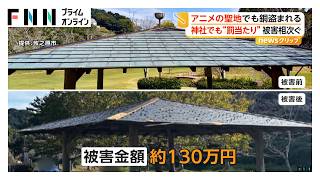
According to Hamamatsu City officials and police, the damage was discovered early on May 19th at Hatsuoi Shrine in Mikkabi Town, Hamana Ward. Copper roofing panels had been peeled away from both the main shrine building and the shrine storehouse, known as the "Shinko," which is designated by the city as a tangible folk cultural property.
No abnormalities had been noticed as of May 18th.
A nearby resident reportedly heard a ripping sound early on May 19th, leading investigators to believe that someone forcibly removed and stole the copper sheets.
Reporter Kenichi Kanekuni said another shrine located about 300 meters away also suffered similar damage, with clear signs that the roofing had been forcibly torn away.
"I'm beyond anger—I'm simply speechless," said Hideo Suzuki, a Shinto priest at Hamana Sosha Shinmeigu Shrine. "It's truly sacrilegious."
Police said similar thefts have also been confirmed at at least two other shrines within Hamana Ward, and investigators are treating the cases as possible serial thefts.
Copper thefts targeting shrines and temples have become an increasing problem across Japan in recent years, driven largely by soaring global metal prices and the ease with which stolen copper can be sold through scrap channels.
Religious sites have become particularly vulnerable because many traditional shrine and temple buildings use copper sheets for roofs, decorative fittings, rain gutters, and ornamental features. In many cases, these structures are old, lightly monitored at night, and located in rural or mountainous areas where thieves can operate unnoticed for hours.
One of the largest waves of thefts emerged around 2022 and 2023, when police departments across multiple prefectures began reporting organized groups targeting cultural properties. In some cases, entire roof sections were stripped overnight, leaving historic wooden structures exposed to rain damage and decay.
In Nara Prefecture, several temples reported copper roof thefts from auxiliary buildings and storehouses, raising fears about damage to structures connected to Japan’s ancient Buddhist heritage. Similar incidents were reported in Kyoto, where temple officials warned that repairs were becoming increasingly costly because traditional copper roofing requires specialized craftsmen.
Shrines in rural areas of Tochigi, Gunma, Ibaraki, and Fukushima prefectures have also been repeatedly targeted. Police in some regions suspected organized criminal groups traveling between prefectures and scouting isolated religious sites in advance.
The thefts are not limited to shrines and temples. Across Japan, copper has been stolen from solar power facilities, construction sites, vacant houses, railway infrastructure, and even public parks. However, attacks on religious and cultural properties often attract stronger public outrage because of the symbolic and historical importance of the sites.
Several shrine priests interviewed by Japanese media over the past few years described the crimes as more than simple theft. Many referred to them as acts that desecrate sacred places. Some priests said they felt especially shocked because shrines traditionally operate on trust and openness, with many grounds remaining accessible around the clock.
Repair costs can be severe. Replacing traditional copper roofing on historic buildings may cost millions of yen, and some shrines struggle to secure funding because they rely heavily on donations from local worshippers. In certain cases, temporary blue tarps have remained in place for months while shrine officials seek financial support.
Police have attempted to crack down by increasing patrols and monitoring scrap metal dealers more closely. Some prefectures introduced stricter identification requirements for metal sales, while shrine organizations have begun discussing additional surveillance cameras, motion sensors, and neighborhood watch cooperation.
Despite these measures, thefts continue to occur intermittently, particularly when copper market prices rise sharply. Experts say the crimes reflect a broader trend in which economic pressures and high commodity prices are increasingly colliding with Japan’s aging and difficult-to-protect cultural infrastructure.
Previously: Copper Thieves Target Mountain Shrine in Japan
Source: SBSnews6