News On Japan

Black Bamboo Flowers Blossom Once Every 120 Years

FUKUOKA - In a rare botanical event, a photographer in Fukuoka captured the blossoming of bamboo flowers, a phenomenon said to occur only once every 120 years.
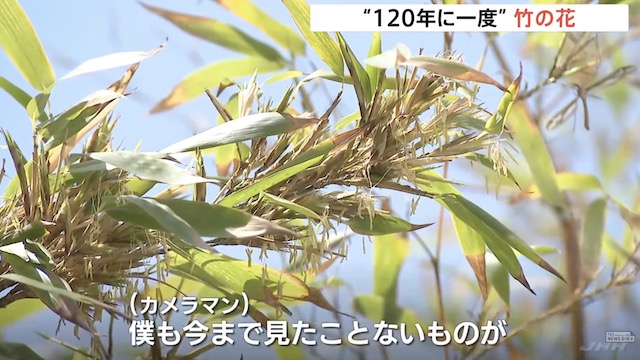
Black Bamboo Flowers Blossom Once Every 120 Years

The tranquil residential area of Sawara Ward in Fukuoka became the focus of this unusual occurrence. “I have never seen anything like it before,” said the photographer, who discovered what looked like fluffy rice panicles emerging from the bamboo nodes. The bamboo, a species known as black bamboo, was planted 18 years ago and has never exhibited such characteristics until now.

“I thought they were insect eggs,” the photographer admitted, referring to the peculiar formations. Suspecting they might be something else, he decided to take the mysterious specimens to a botanical garden for expert analysis.

“Ah, I see, they are indeed blooming. These are black bamboo flowers. They resemble rice flowers, don’t they? They are definitely flowers,” explained Futamata Tokuko, a flower and greenery consultancy expert. She confirmed that bamboo, belonging to the grass family, blooms in a manner similar to rice.

Further insights were provided by Futamata, who noted, “This black bamboo is a type of 'hachiku', and a mass flowering of hachiku species has begun. It was predicted that a mass flowering could occur around the 30th year of the Heisei era, about 120 years since the last one.”

This marks a significant blooming period for black bamboo, the first since the Meiji era, according to the Forestry Research Institute. When asked why bamboo undergoes such a transformation every 120 years, researcher Kobayashi Keito admitted, “That’s the real charm and mystery of bamboo. Hopefully, our research can clarify this phenomenon.”

Source: TBS

News On Japan
POPULAR NEWS

Residents in Nara Prefecture are celebrating after UNESCO's advisory body recommended the archaeological complex known as the Asuka-Fujiwara Ancient Capitals for inscription as a World Heritage site, bringing the historic birthplace of Japan's ancient state one step closer to international recognition.

A tropical depression is expected to move northward this weekend and could bring another round of heavy rain to parts of Japan, following a week in which Typhoon Jangmi (Typhoon No. 6) caused significant rainfall and left some areas vulnerable to further weather-related damage.

Prime Minister Sanae Takaichi's administration is facing mounting scrutiny over allegations that members of her campaign were involved in distributing online videos that disparaged rival candidates during the February House of Representatives election, with opposition parties intensifying their questioning in the Diet and demanding further clarification.

The Japanese government approved its 2026 Environment White Paper at a Cabinet meeting on June 5th, warning that a record-high 50,000-plus bear sightings recorded nationwide during fiscal 2025 have become a serious threat to public safety while also highlighting growing concerns over Japan's aging hunting population and the need to train a new generation of hunters.

Japan could face a more active typhoon season than usual in 2026, with private weather forecaster Weathernews predicting around 28 typhoons to form during the year—above the long-term average of 25.1—and warning that approximately 14 could approach Japan, increasing the risk of weather-related disruptions across the country.

MEDIA CHANNELS
         

MORE Sci-Tech NEWS

The Japanese government has unveiled a draft target to replace between two and five nuclear reactors by the 2040s, marking the first time numerical goals for nuclear power development have been presented since the Fukushima Daiichi nuclear disaster 15 years ago.

The video explains how a tiny, remote Japanese island called Minami Torishima (Marcus Island) could become one of the most strategically important locations in the world due to enormous deposits of rare earth elements buried in deep-sea mud beneath the Pacific Ocean.

A large solar power facility built on a mountainside in Fukushima City is generating reflected sunlight for far longer than originally projected, with a city survey finding that glare at some locations lasted up to 53 minutes per day—more than ten times the maximum duration predicted by the operator.

Japan’s largest space business exhibition opened at Tokyo Big Sight on May 27th, showcasing a growing wave of companies from outside the traditional aerospace sector entering the rapidly expanding space industry.

JR Tokai held its first-ever resident briefing session in Shizuoka City on May 26th regarding construction of the Linear Chuo Shinkansen, outlining measures for water resource management and environmental conservation as the company seeks to gain local support ahead of the start of construction in Shizuoka Prefecture.

A seasonal spectacle has begun on the Miwasaki coast in Shingu, Wakayama Prefecture, where tiny male chigogani crabs are emerging from their burrows at low tide and rhythmically waving their claws in a movement resembling a dance.

A small onshore wind turbine collapsed in Oga, Akita Prefecture, in March, raising fresh concerns among local residents following a series of wind turbine-related accidents in the city over recent years.

Japan's next-generation homegrown supercomputer, Fugaku NEXT, is being developed with a radically different strategy from its predecessors, abandoning the single-minded pursuit of the world's fastest calculation speed in favor of artificial intelligence capabilities expected to accelerate breakthroughs in fields ranging from drug development and batteries to disaster prevention and food production.