News On Japan

Princess Kako's Visit to Greece Sparks Fashion Frenzy with Sold-Out Knitwear and Dresses

TOKYO, Jun 01 (News On Japan) - Princess Kako, who visited Greece, has returned to Japan. The local media has been reporting on her as the 'Diana of the East' and her clothing choices have caused a significant stir, with items selling out rapidly.

Princess Kako, the second daughter of Prince Akishino, was seen smiling and shaking hands with hotel staff before departing for the airport. Her visit commemorated the 125th anniversary of diplomatic relations between Japan and Greece. This marks her third official overseas visit.

Kako remarked, 'Through this visit, I have been able to experience Greece's diverse charms and feel the strong connection between our countries. I am very pleased.'

During her busy schedule, Princess Kako even learned a few phrases in Greek to use during her interactions.

Kako greeted, 'Yasas (Hello), it's nice to meet you.'

She visited landmarks like the Parthenon Temple and a monastery where Japan has contributed to restoration efforts. Additionally, she engaged with local students, showcasing her warm and friendly demeanor.

Kako expressed her gratitude, 'Thank you very much. I am delighted that you are studying Japanese and have a deep affection for Japan. Please stay well. Efcharisto para para para poli (Thank you very much).'

The local media showed great interest in Princess Kako, reporting on her role in international goodwill.

Local outlets referred to her as the 'Diana of the East' and highlighted her gentle personality, natural elegance, and beauty. They also noted the recent challenges faced by the Japanese royal family, which have brought attention to Kako.

Fashion Craze: Blue Knit and Light Blue Dress Sell Out

In Japan, Princess Kako's outfits, chosen to suit her visit, have also garnered significant attention.

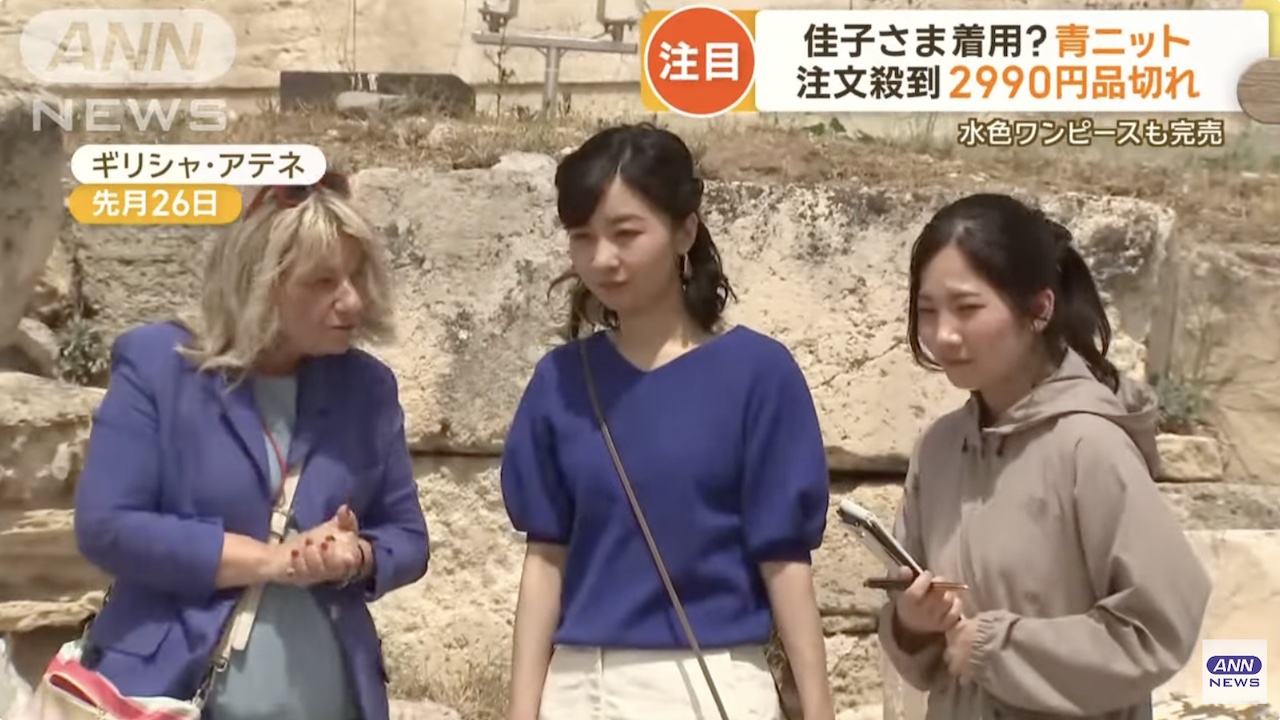
While visiting the Parthenon Temple, Kako wore a blue knit and white pants, inspired by the Greek flag.

Mayuko Tomohiro from Pierrot Press commented, 'If she indeed wore our product, it is a great honor and quite surprising.'

The blue knit, believed to be from an online-only retailer, quickly became a hot item. Priced at 2,990 yen, it sold out after the news broke. The next sale date is yet to be determined. This isn't the first time Princess Kako's fashion choices have caused a stir; a jacket she wore during a visit to Peru last year also sold out quickly.

Kako expressed her appreciation, 'I am very happy to have been warmly welcomed by everyone.'

On the day she visited the old town of Corfu, a UNESCO World Heritage site, Kako wore a light blue lace dress with a black belt accent. This dress also sold out, with CELFORD chief press officer Ichimayuko saying, 'The dress is sold out, and the number of requests has surged. Inquiries are flooding in.'

During her six-day stay, Princess Kako maintained her cheerful demeanor, contributing to the goodwill between Japan and Greece. She returned to Japan on the afternoon of June 1st.

Source: ANN

News On Japan
POPULAR NEWS

Bear sightings across Japan have already climbed to nearly twice the level recorded during the same period last year, prompting entry bans in mountain areas behind Kyoto’s Ninna-ji Temple and the cancellation of hiking events in Kansai, while new research suggests that the key to reducing encounters may lie in understanding what bears eat in each region.

Copper roofing panels were stolen from several shrines in Hamamatsu, Shizuoka Prefecture, including a city-designated cultural property, in the latest case amid a nationwide surge in copper thefts targeting shrines and temples across Japan, where soaring metal prices have fueled crimes that leave historic religious buildings damaged, exposed to the elements, and facing repair costs of millions of yen.

Flames broke out on the morning of May 20th on Miyajima Island in Hiroshima Prefecture, home to one of Japan's World Heritage sites, destroying Reikado Hall near the summit of Mount Misen.

Uncertainty surrounding the situation in the Middle East is beginning to affect daily life in Japan, as concerns over crude oil supplies spread to restaurants, cleaning services and even household garbage disposal systems across the Kansai region.

A 25-year-old woman arrested as a suspected ringleader in a robbery-murder case in Tochigi Prefecture once posted cheerful dance videos on social media and was remembered by those who knew her as an energetic and outgoing young woman.

MEDIA CHANNELS
         

MORE Business NEWS

The impact of tensions in the Middle East is spreading to familiar snacks in Japan, with Morinaga & Co. temporarily suspending sales of some caramel products, including its long-selling Hi-Soft brand, after difficulties emerged in securing certain raw materials.

The Nikkei Stock Average rebounded sharply on May 21st after falling below 60,000 at the previous day's close, briefly rising more than 2,200 points as hopes grew for progress in talks toward ending the fighting between the United States and Iran, while SoftBank Group gave the market a major boost following reports that OpenAI was preparing to file for an initial public offering.

Japan’s imports of crude oil from the Middle East plunged 67.2% in April from a year earlier, as the impact of the effective closure of the Strait of Hormuz began to ripple through the country’s trade and energy supply chains.

Sumitomo Mitsui Banking Corporation and Toshiba announced on May 20th that they had jointly developed a new stock index utilizing quantum technology.

TOTO, a major Japanese manufacturer of housing and bathroom equipment, reopened its showroom in London, England, on May 20th after undergoing its first major renovation in 16 years.

Uncertainty surrounding the situation in the Middle East is beginning to affect daily life in Japan, as concerns over crude oil supplies spread to restaurants, cleaning services and even household garbage disposal systems across the Kansai region.

U.S. President Donald Trump was found to have traded large amounts of stock, including shares in Kura Sushi USA, in a wave of more than 3,700 transactions over a three-month period that has sparked criticism over possible conflicts of interest.

As conflict in the Middle East drags on, shortages of naphtha — a key raw material used in a wide range of petroleum-based products — are beginning to affect even Japan's traditional cheap snacks, with manufacturers facing steep rises in packaging and material costs while trying to keep products affordable for children.