News On Japan

New Banknotes to Debut in July for the First Time in 20 Years

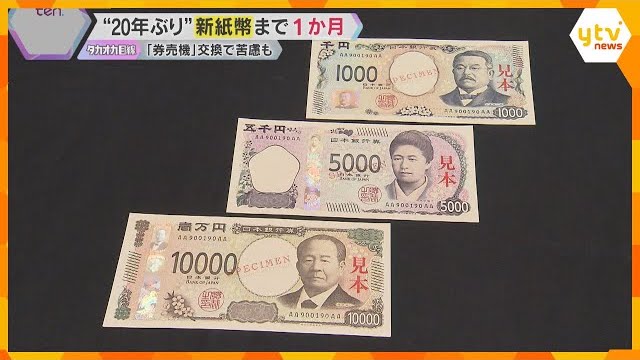
TOKYO - Japan will introduce new banknotes in July for the first time in 20 years, featuring Shibusawa Eiichi on the 10,000 yen note, Tsuda Umeko on the 5,000 yen note, and Kitasato Shibasaburo on the 1,000 yen note. However, the change poses challenges for vending machine replacements.
New Banknotes to Debut in July for the First Time in 20 Years

The new 5,000 yen note features Tsuda Umeko: 'We will soon be the faces on the banknotes.'

The new 1,000 yen note features Kitasato Shibasaburo: 'It's exciting to see a new design after 20 years.'

The new 10,000 yen note features Shibusawa Eiichi: 'The new notes will be issued starting from the 3rd of next month.'

The 1,000 yen note honors Kitasato Shibasaburo for his contributions to medical science. The 5,000 yen note commemorates Tsuda Umeko, a pioneer in women's education. The 10,000 yen note celebrates Shibusawa Eiichi, the father of modern Japanese economics.

NTV reporter Hiroshiba Manabu demonstrated the new 1,000 yen note: 'When you tilt this part, the design changes.'

The new banknotes incorporate advanced anti-counterfeiting technologies, including designs that change when viewed from different angles. The transition to these new banknotes is imminent.

After five years of preparation, the new banknotes are ready to be issued. However, a recently opened ramen shop faces challenges with its ticket vending machine.

Miura Shuhei, owner of Menya Bukotsu, said, '(Replacing the vending machine) won't be done in time, so I might just go with it as it is. We can temporarily accept the new banknotes and exchange them for old ones at the store.'

The cost of a new vending machine is at least 600,000 yen, posing a significant burden for businesses.

Miura added, 'I thought, "Here we go with more expenses." Changing the machines doesn't directly impact the business or the store, so it feels like we're spending money on something unnecessary.'

Can the new banknotes be used immediately in the numerous vending machines around the city? A major beverage manufacturer commented, 'We started preparing for the replacement of vending machines in January this year, but it will take two years to replace all of them.'

With just one month left until the new banknotes are issued, we are now in the era of cashless transactions. What does the future hold for our evolving relationship with money?

Source: YOMIURI

News On Japan
POPULAR NEWS

Tokyo's Fuchu Prison is adapting its meals and living arrangements to a growing foreign inmate population, with about one in four prisoners coming from overseas and staff balancing religious, cultural and dietary needs against tight budgets and the demands of running one of Japan's largest prisons.

Tesla unveiled its Cybercab in Japan for the first time on September 11, showcasing an AI-powered autonomous taxi designed without a steering wheel or pedals.

China will sharply raise visa fees for Japanese nationals entering the country from September 14, with the cost of a single-entry visa increasing to 16,750 yen, about 7.4 times the current level.

Tada Shrine in Kawanishi, Hyogo Prefecture, has filed for protection under Japan's Civil Rehabilitation Act, becoming the first shrine in the Kansai region and only the third nationwide to enter bankruptcy proceedings, according to Teikoku Databank.

Japan has asked for changes to an Equal Earth world map that depicts the Russian-controlled Northern Territories in the same color as Russia, prompting the map's creator to say the Japanese-language version will be revised while the English version will remain unchanged.

MEDIA CHANNELS
         

MORE Business NEWS

Tokyo stocks fell sharply on September 11, with the Nikkei 225 closing at 63,442, down 2.8%, as oil prices above $108, renewed Middle East tensions, U.S. rate-hike fears and expectations for another Bank of Japan increase triggered a broad selloff led by artificial intelligence and semiconductor-related shares.

Japan's corporate goods prices rose 7.6% in August from a year earlier, remaining above 7% for a third consecutive month as escalating tensions in the Middle East pushed up prices for petroleum, coal and chemical products.

Business sentiment among Japan's large companies returned to positive territory in the July-September quarter for the first time in two quarters, supported by growing demand for semiconductor manufacturing equipment and AI data centers as well as improving conditions in hospitality, restaurants and finance.

Tokyo stocks fell sharply on September 11, with the Nikkei average at one point dropping more than 2,000 points as escalating attacks between the United States and Iran drove oil prices higher and intensified concerns about inflation and corporate earnings.

Tada Shrine in Kawanishi, Hyogo Prefecture, has filed for protection under Japan's Civil Rehabilitation Act, becoming the first shrine in the Kansai region and only the third nationwide to enter bankruptcy proceedings, according to Teikoku Databank.

Protein powder prices are rising sharply in Japan as booming overseas demand for whey, partly linked to the growing use of weight-loss drugs, combines with the weak yen to make the key ingredient increasingly expensive for Japanese buyers.

The takeover battle for Kakaku.com, operator of restaurant review site Tabelog and price-comparison service Kakaku.com, intensified on September 11 after Swedish investment firm EQT raised its tender offer price to 3,680 yen per share, surpassing a rival proposal from a group led by LINE Yahoo.

Amazon has opened its third logistics facility in Amagasaki, Hyogo Prefecture, creating the company's largest distribution hub in the Kansai region with capacity to handle up to 1 million packages a day.