News On Japan

2,500 Fireworks Light Up Kamakura in Sweltering Heat

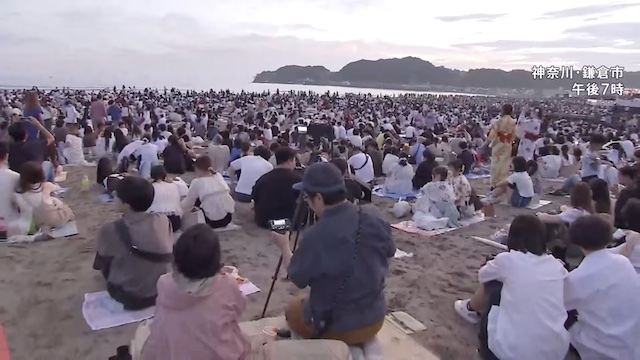
KAMAKURA, Jul 18, 2024 (News On Japan) - On the night of July 17, Kamakura held its first fireworks festival in five years. Despite recent rain keeping Tokyo's temperatures below 30°C, dangerous heat is expected to return by Saturday.
2,500 Fireworks Light Up Kamakura in Sweltering Heat

At 7 PM, the Kamakura fireworks festival saw many spectators gathering to enjoy the show. A temperature reading at the site showed 27.2°C.

Overcoming the challenges of the pandemic and financial difficulties, the Kamakura fireworks festival attracted around 160,000 attendees.

"It's so humid, it's unbearable. We're staying hydrated and using fans," said one attendee. A family enjoying the event commented, "We're eating cold pineapple to beat the heat. Looking forward to the fireworks!" A child added, "The fireworks are fun!"

Approximately 2,500 fireworks lit up the summer night sky.

In Kyoto, the "Yamahoko Junko" procession, the highlight of the Gion Festival, took place, attracting 140,000 spectators to this thousand-year-old tradition.

Across Japan, the full arrival of summer seems imminent. On July 17, the Kagoshima Meteorological Observatory announced that the rainy season has likely ended in southern Kyushu.

"It's hot," said a child in Kagoshima, where temperatures exceeded 35°C.

In Kagoshima City, couples were seen taking commemorative photos in a park.

"Really, the rainy season is over in southern Kyushu? It's too hot. I'm using ice packs inside my kimono," commented one person.

Even in other parts of Kyushu that haven't yet seen the end of the rainy season, the heat is intense.

A resident of Hita City, Oita Prefecture, remarked, "I can feel the heat of the basin intensely. It's not humid but scorching."

On July 17, the highest temperature in the nation was recorded in Dazaifu City, Fukuoka Prefecture, at 36.7°C. A gelato shop on the approach to Dazaifu Tenmangu Shrine, known for academic success, saw long lines of customers.

In the afternoon of July 17, the atmosphere in the Kanto region became unstable, leading to sudden downpours. People rushed to the station while a delivery woman braved the rain to deliver packages. The sudden rain continued into the night.

In the Tokai and Kanto regions, the rainy season may be declared over as early as the 18th. As for the temperatures after the rainy season...

Meteorologist Mika Kunimoto warned, "The Japan Meteorological Agency has issued a 'General Weather Information on High Temperatures.' This information is not frequently released and aims to raise awareness about the risks of heatstroke and health management. We already experienced a heatwave at the beginning of July, but the heatwave period is expected to be very long. There are concerns that temperatures in inland Kanto and Tokai regions may approach 40°C."

Source: TBS

News On Japan
POPULAR NEWS

Japan's World Cup campaign begins on June 14 when the Samurai Blue face the Netherlands at Dallas Stadium in Texas, a clash that will showcase some of the game's most talented players and pit two ambitious teams against one another in a crucial Group F opener. While Japan arrives without injured winger Kaoru Mitoma, one of its most recognizable stars, the squad still boasts a wealth of talent drawn from Europe's top leagues.

The Japan Meteorological Agency (JMA) announced that an El Niño phenomenon is believed to have developed this spring, warning that Japan is likely to experience above-average temperatures nationwide this summer despite the climate pattern's traditional association with cooler summers.

Narita International Airport Corporation is expected to announce next month that it will apply to the national government for project certification as part of the process to enable compulsory land acquisition for the construction of a new runway at Narita Airport, according to sources familiar with the matter.

A fire broke out at Arima Inari Shrine near the Arima Onsen hot spring resort area in Kobe on the night of June 9th, destroying multiple buildings and leaving an elderly Shinto priest and his wife with minor injuries.

Japan's national soccer team arrived in Nashville, Tennessee, on June 8th from Monterrey, Mexico, where it had been conducting a pre-World Cup training camp, and held its first practice session at its base camp for the FIFA World Cup in North America.

MEDIA CHANNELS
         

MORE Travel NEWS

A newly formed tropical depression near Taiwan on June 9th is expected to intensify the seasonal rain front lingering over southwestern Japan, raising the risk of warning-level rainfall across Okinawa and the Amami Islands through around June 11th.

The calming smoke and subtle fragrances of Japanese incense are fueling growing global interest, pushing exports to a record high of more than 1.8 billion yen.

Japan's public bathhouse industry is being reshaped by the sauna boom, with a growing number of "next-generation bathhouses" succeeding in tripling customer spending and returning to profitability even as many traditional neighborhood bathhouses struggle with rising costs and aging facilities.

Passengers traveling on JR East services may soon no longer need to insert paper tickets into ticket gates, as the railway operator announced plans to gradually phase out its traditional black-backed paper tickets beginning next spring.

Foreign tourists continue to climb Mount Fuji despite strict access restrictions ahead of the official climbing season, prompting local officials to renew calls for tougher penalties and requiring climbers to pay for rescue operations conducted during the mountain's closed period.

A slope collapse alongside the JR Dosan Line between Tsubojiri and Hashikura stations in Tokushima Prefecture, detected after a rockfall warning system was activated in the early hours of June 8th, has forced the suspension of train services with no timetable yet established for the restoration of operations.

Japan Airlines will once again operate seasonal flights between Chubu Centrair International Airport and the Hokkaido cities of Obihiro and Kushiro throughout August, offering travelers from hot Nagoya a chance to enjoy the region's cooler summer climate.

A prolonged eruption at Sakurajima on June 7th blanketed parts of Kagoshima City in volcanic ash, turning roads gray and prompting long lines of vehicles seeking car washes after a plume of smoke rose 1,300 meters above the crater.