MITO, Jul 19, 2024 (News On Japan) - Trying to solve the problem of finding a successor, a historic natto producer was taken over, only to have its funds siphoned off in a scam that is becoming increasingly common in Japan.
We conducted an in-depth investigation of the company exploiting the M&A system. What do they have to say for themselves? TBS Insiders is accepting information on issues with small business M&As and various whistleblower reports. Please share your information with us.
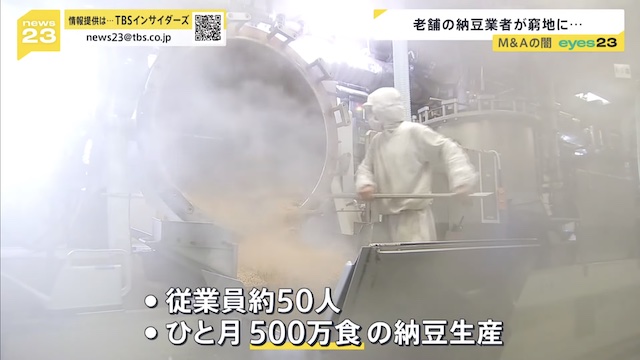
Located in Ibaraki Prefecture, the historic natto manufacturer Kinzakura Foods employs about 50 people and produces 5 million packs of natto per month.
Yukio Nagata (61), the president of Kinzakura Foods.
Kinzakura Foods President Yukio Nagata: "Whether customers become repeat buyers depends largely on the taste. We are confident in our product."
However, last year, the company faced a dire crisis.
Kinzakura Foods President Yukio Nagata: "At its worst, sales dropped by 40%. It was tough. Continuing operations would have inevitably led to the company's bankruptcy."
What exactly happened?
Targeted: Small Businesses Seeking Successors
There are over 3 million small businesses nationwide, with one-third facing issues of aging and lack of successors.
President Nagata also struggled to find a successor and decided to go through with an M&A, selling the company to another firm to take over its management.
Kinzakura Foods President Yukio Nagata: "I wanted to keep the company in the local area, and the best way to do that was to partner with a capable company while it still had a solid business foundation."
A major brokerage firm recommended an investment company called Lucian Holdings, describing it as a company with diverse management and around 30 subsidiaries.
This photo is from the day the M&A was concluded last March. President Nagata is pictured with Lucian Holdings' CEO and director. At that time...
Kinzakura Foods President Yukio Nagata: "My greatest hope was that the company would grow steadily in line with the contract."
However, right after transferring management...
Kinzakura Foods President Yukio Nagata: "At first, I was outraged. It was nothing like the promises made, and their actions were haphazard. Including financial matters, it was unacceptable. I was extremely upset."
Lucian Holdings showed little interest in managing the natto production. Their first directive was to transfer approximately 35 million yen from Kinzakura Foods' account to Lucian's.
Moreover, part of Kinzakura Foods' monthly sales was also reportedly sent to Lucian, and...
Kinzakura Foods President Yukio Nagata: "Employee salaries were delayed, and social insurance and taxes went unpaid."
Kimura, the factory manager who has worked in natto production for 30 years, said he couldn't understand what was happening.
Factory Manager Kimura: "It was a bolt from the blue, completely unexpected. We were all filled with anxiety about the future."
Eventually, the CEO and director of Lucian Holdings became unreachable, and their whereabouts unknown.
As a result, the 36 million yen that was supposed to be paid to President Nagata at the time of the contract was never paid. The responsibility for the company's loan guarantees, which were supposed to transfer to Lucian, remained with President Nagata.
In the end, President Nagata repurchased the shares and returned as president. With the cooperation of local banks and business partners, he managed to rebuild the company.
Kinzakura Foods President Yukio Nagata: "It took about a year to normalize operations by liquidating assets and improving cash flow through measures like cashing out my life insurance."
What were Lucian Holdings' true intentions? We managed to contact a current executive (30) of Lucian Holdings.
Lucian Holdings Current Executive: "This is the main room where documents and materials are kept."
Located in a small office within a multi-tenant building in Ibaraki Prefecture, this was Lucian Holdings' headquarters. Now, it's littered with scattered invoices.
Lucian Holdings Current Executive: "There are just too many bills for things like phone, electricity, and taxes to handle."
This executive, who appeared in the photo with President Nagata at the signing ceremony, claims to have been instructed to handle transfers from acquired companies. He held a titular role only.
Lucian Holdings Current Executive: "This is my business card from when I was supposedly with Kinzakura Foods. There were many instances where people were given executive titles without actually holding any real position."
Lucian Holdings was controlled by the CEO and director, while the executives claimed they were used.
Lucian Holdings Current Executive: "I had no idea what tasks I would be assigned or the outcomes. I wondered why I was photographed next to the former president."
In about two years, Lucian Holdings acquired 37 companies, targeting those with significant deposits.
Lucian Holdings Current Executive: "The CEO was always looking for new companies to buy, saying 'We've acquired this one, we've acquired that one.' They were actually just lining their own pockets..."