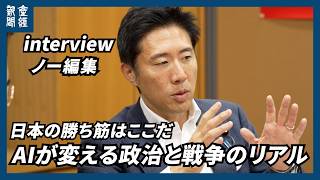
TOKYO - Tokyo University professor Yutaka Matsuo said he expects the global balance of power in artificial intelligence to change sharply in 2026, arguing that breakthroughs in chips, robotics and autonomous driving could quickly reshape which companies, and which countries, lead the field.
Speaking on a science and technology program aired on December 26, 2025, Matsuo said the “surprise” scenario for 2026 is a sudden rearrangement of the AI pecking order, including the possibility that the semiconductor sector’s current dominance could be disrupted, that progress toward artificial general intelligence (AGI) could alter corporate competitiveness, and that so-called “physical AI,” robots powered by advanced models, could begin changing everyday life faster than many expect.
In the race between OpenAI and Google, Matsuo pointed to growing attention on Google’s Gemini 3, which he said is widely viewed as a high-performing model and is reported to be scoring strongly on benchmarks, while also noting that OpenAI is unlikely to cede ground easily. He cited public signs of heightened urgency in the sector and said the contest will likely hinge on how each side leverages talent, funding and product speed, with Google’s scale on one side and OpenAI’s aggressive iteration on the other.
Matsuo also highlighted the momentum behind lower-cost models and open strategies, especially from China, saying the spread of open-source or open-weight approaches is creating a situation where models developed with massive investment can be approached by systems that are inexpensive, or even free to use. He suggested the balance between closed and open ecosystems may depend on the pace of technical progress, with closed models tending to lead during rapid advances, and open approaches catching up when progress slows.
On AGI, Matsuo said predictions are diverging, with some prominent voices arguing it could arrive within a few years, while others have begun to question whether the pace of improvement is cooling. Even so, he said the scale of global competition makes it plausible that a breakthrough could appear suddenly, and that the path may require methods beyond the current transformer architecture, even if “workarounds” or unexpected innovations emerge.
For Japan, Matsuo argued for pursuing both adoption and domestic development, framing the debate through the concept of “sovereign AI,” the idea that a country should retain the capability to build core AI systems at home. Relying too heavily on other countries, he said, carries risks ranging from service disruption to supply constraints in semiconductors. At the same time, he cautioned that attempting to match the world’s top models head-on would demand investment on the scale of U.S. and Chinese giants, and said Japan should weigh cost-effectiveness while pushing industrial innovation through real-world applications.
The discussion broadened into semiconductors, where Matsuo said moves to challenge Nvidia are accelerating, including efforts based on Google’s in-house TPU chips, alternatives from AMD, new startups, and China’s push to build domestic chips comparable to GPUs. The program also introduced a Japanese challenger: a semiconductor startup launched at the Japan Advanced Institute of Science and Technology, led by Kenji Fujiwara, a former Sony engineer involved in chips for the PlayStation 2 and PlayStation 3. The startup is developing a new computing architecture called CGLA, which it says can run AI with dramatically lower power consumption, potentially using up to 90% less electricity than Nvidia’s GPUs, by reducing the amount of data shuttled back and forth during computation.
Fujiwara argued that while Google’s TPU is highly power-efficient, it is strongest in a narrower set of computations, and said the opportunity lies in combining high versatility with low power use. The program framed the effort as part of a wider Japanese push to regain competitiveness in advanced chips, including the government-backed foundry project Rapidus, which was described as receiving support totaling 2.9 trillion yen. Matsuo said the strategic value of domestic manufacturing capacity is significant, but added that long-term success depends on building customers and linking fabrication to the broader AI value chain, from applications to data centers.
A separate segment aired on December 23, 2025, looked at how U.S. monetary policy and “AI bubble” worries could shape markets in 2026, with commentary from Miyuki Obata of SMBC Nikko Securities America. The program said the S&P 500 had risen about 15% year-to-date by late December despite volatility, and focused on uncertainty around the Federal Reserve leadership transition expected by May 2026, with Kevin Hassett and Kevin Warsh discussed as leading contenders and Christopher Waller also mentioned in reporting. Obata said market pricing pointed to around two rate cuts, while the median of Federal Open Market Committee projections implied fewer, and warned that overly aggressive cuts under political pressure could reignite inflation concerns or raise questions about the Fed’s independence.
On the question of an AI-driven bubble, Obata said there are signs of froth, but argued the risk of a full-scale collapse is limited, in part because investors have begun scrutinizing business plans and profitability more closely, leading to greater stock-by-stock selection within the AI sector. She also said AI demand remains strong and that policy support could continue to underpin investment.
In Tokyo, a market outlook segment aired on January 5, 2026, described a strong start to the year, with the Nikkei average rising 1,493 points to 51,832 on the first trading day, and street investors naming AI, semiconductors and financials as areas of interest while acknowledging geopolitical risks. Commentators on the program debated how far the rally can extend, with some suggesting a range that includes potential volatility and a mid-year correction, and others keeping a 60,000 level in view later in 2026 or beyond, while warning that the clearest downside scenario would be a sharper-than-expected unwind of enthusiasm around AI.
Source: テレ東BIZ