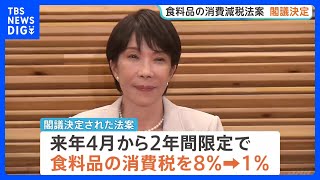
TOKYO - Prime Minister Sanae Takaichi’s government formally approved a plan on August 5 to reduce the consumption tax rate on food and nonalcoholic beverages from 8% to 1% for two years beginning in April 2027, setting the stage for a difficult parliamentary battle over how to cover an estimated 10 trillion yen revenue shortfall and whether the politically sensitive tax can be restored afterward.
The decision was made at an extraordinary Cabinet meeting held on a Wednesday evening, departing from the regular schedule of Cabinet meetings on Tuesday and Friday mornings. The government is expected to submit the necessary legislation to an extraordinary session of the Diet in the fall so that the reduced rate can take effect in April.
The accelerated approval reflected the government’s determination to complete its internal deliberations by August 5, before a politically busy period that includes the Hiroshima atomic bombing anniversary on August 6, the Nagasaki anniversary on August 9 and the anniversary of the end of World War II on August 15.
Supporters described the timetable as evidence that the administration was acting quickly to fulfill a central election pledge. Critics within the ruling Liberal Democratic Party said the process had been rushed and that the government had failed to explain how the measure would be financed.
The tensions were highlighted by comments from senior LDP officials. Former General Council Chairman Nobuteru Ishihara said the proposal lacked substance on funding and that the government’s explanation was insufficient.
LDP Secretary-General Suzuki also said the government should present the funding plan. The remark drew particular attention because the secretary-general is normally responsible for managing the ruling party and implementing the policies of the prime minister, who also serves as LDP president.
Suzuki’s decision to place responsibility for the funding explanation on the government was viewed as a sign of a widening divide between the party leadership and the administration.
The LDP’s General Council, the party’s highest decision-making body on policy matters, also held an unusual meeting before the Cabinet decision. The council has 25 members and traditionally approves government legislation unanimously before it is submitted to the Diet.
When members strongly oppose a proposal, they sometimes avoid blocking unanimity by staying away from the meeting or leaving before a vote. Such measures were used during debate over reducing the number of seats in the House of Representatives in December 2025. Before that, similarly serious dissent had not been seen since deliberations over Japan’s security legislation in 2015.
Traditionally, the General Council chairman postpones a decision when strong disagreements emerge, allowing senior officials to negotiate privately until a compromise can be presented at a later meeting. Critics say that consensus-building process has weakened under Takaichi as the administration places greater emphasis on meeting predetermined deadlines.
The government has defended the food tax reduction as necessary to honor its election commitment and provide consumers with relief they can recognize whenever they shop. Officials have argued that direct payments are less visible and may not leave households with a lasting sense of assistance.
Previous measures included a 20,000 yen payment for each child to households receiving child allowances as part of efforts to address rising prices. The money was added to the bank accounts already registered for child allowance payments.
Under the previous administration of Prime Minister Fumio Kishida, the government also introduced a combined 40,000 yen reduction in income and resident taxes. The reduction was reflected through payroll deductions, but critics said many people found it difficult to understand how much support they had received.
The food tax plan would produce a much larger fiscal impact. Lowering the rate from 8% to 1% is estimated to reduce government revenue by about 5 trillion yen annually, creating a shortfall of roughly 10 trillion yen over the two-year period.
Takaichi has said the government will not rely on deficit-financing government bonds. The administration has instead examined reductions in subsidies, revisions to special tax treatments and additional nontax revenue.
Finding sufficient savings has proved difficult. Programs regarded as wasteful by some groups may be considered essential by the people and industries receiving them, leaving few expenditures that can be eliminated without resistance.
Officials have also considered drawing on funds in special government accounts, including the foreign exchange fund special account. Much of that money, however, already has designated purposes and cannot easily be redirected.
Senior administration officials increasingly expect higher-than-projected tax revenue to cover much of the cost. Rising wages are increasing income tax receipts, while inflation is lifting the nominal value of transactions and corporate earnings, potentially pushing total tax revenue above initial forecasts.
The government has not yet provided a detailed public explanation of how much additional revenue it expects or how much of the tax cut would be financed through those gains.
Another potential source of funds has emerged through a renewed dispute between the national government and the Tokyo Metropolitan Government.
The Internal Affairs and Communications Ministry estimates that Tokyo has about 2 trillion yen a year in revenue exceeding the amount required to provide what the national government regards as a standard level of municipal services.
Tokyo’s annual general-account budget is about 7 trillion yen. Under the ministry’s calculations, the capital would need only about 5 trillion yen to provide services at the national standard, leaving an apparent surplus of approximately 2 trillion yen.
Tokyo strongly rejects that assessment, arguing that the national government is applying an inappropriate standard that fails to reflect the capital’s unique costs.
Tokyo’s daytime population is far larger than its residential population because large numbers of people commute from neighboring prefectures such as Saitama and Kanagawa. When commuters become ill, are injured or are involved in accidents while in the capital, Tokyo police, firefighters, ambulances and other public services must respond even though the commuters pay resident taxes elsewhere.
The metropolitan government therefore argues that its financial needs cannot be calculated solely according to the number of registered residents.
Tokyo also provides an array of subsidies and benefits that are rarely available on the same scale elsewhere in Japan, adding to national claims that the capital has excessive financial resources.
Tokyo residents aged 15 or older are eligible to receive points worth about 11,000 yen through the Tokyo metropolitan government’s official smartphone application. The points can be linked with private-sector cashless payment services, making the program similar in practice to a direct cash payment.
Households with children can receive 5,000 yen per child each month under a metropolitan child support program. Tokyo also provides extensive assistance with children’s medical expenses, contributing to visible differences in support between families living on opposite sides of the capital’s borders.
Electric vehicle buyers can receive subsidies from both the national and metropolitan governments. The national government provides assistance of about 580,000 yen, while Tokyo offers additional subsidies of up to 1.3 million yen.
The combined assistance can reduce the effective price of a small electric vehicle costing about 2.5 million yen to less than 1 million yen, creating strong demand among Tokyo consumers and benefiting automakers and dealers.
Tokyo also offers residents aged 65 or older subsidies of up to 30,000 yen toward the purchase of a new smartphone. The program is intended to prevent older residents from being left behind as government services increasingly rely on digital identification, online applications and the My Number system.
The national government and ruling parties raised the question of Tokyo’s finances during tax negotiations at the end of 2025 and said the matter would be resolved in 2026. Discussions over redistributing some of the capital’s revenue are therefore expected to intensify.
Even if the government secures the money needed for the two-year reduction, it faces a second and potentially more difficult problem: restoring the food tax rate from 1% to 8% in April 2029.
For consumers, returning the rate to 8% would feel much like a tax increase. Concern over the political consequences of that move is one of the main reasons some LDP lawmakers have resisted the temporary reduction.
The party’s history with consumption tax increases has reinforced those fears.
Prime Minister Masayoshi Ohira proposed an early version of a broad consumption tax nearly 50 years ago. Prime Minister Noboru Takeshita eventually introduced the tax at 3%, while Prime Minister Ryutaro Hashimoto raised it from 3% to 5%.
In each case, the LDP suffered a major defeat in a subsequent election. Those experiences established a widely held belief within the party that changing the consumption tax damages the economy and causes the ruling party to lose votes.
Former Prime Minister Shinzo Abe was the notable exception.
Abe returned to power after the Democratic Party of Japan administration had reached a three-party agreement with the LDP and Komeito on an integrated reform of social security and taxation. Under the agreement, the consumption tax was to rise in stages.
Abe raised the tax from 5% to 8% soon after becoming prime minister. Consumer spending weakened sharply, prompting him to postpone the planned increase to 10%.
Abe called a House of Representatives election based partly on the decision to delay the increase, and the ruling coalition won a decisive victory. He later delayed the increase again before an election for the House of Councillors and secured another victory.
During the 2017 House of Representatives election, Abe stopped short of announcing a third postponement. Instead, he promised to use more of the additional tax revenue for child-rearing assistance and a social security system covering all generations. The coalition again won the election.
Takaichi has repeatedly described Abe as her political mentor, and some within the LDP believe his strategy could influence the administration’s handling of the food tax rate in 2029.
One possibility is that the government could postpone the return to 8% as a campaign pledge before a national election. The timing could coincide with an election for the House of Councillors and a possible dissolution of the House of Representatives, allowing the government to seek public support for extending the reduced rate.
Such a strategy would deepen the fiscal challenge because the government would need to find additional revenue beyond the original two-year period.
Before reaching that point, Takaichi faces a more immediate political test. An LDP presidential election is expected in 2027, and opposition within the party over the tax proposal could threaten her ability to secure another term as party leader.
The government must also win approval in the Diet, where the ruling coalition does not hold a majority in the House of Councillors. Passage will require cooperation from opposition parties or concessions that could alter the scope, duration or funding structure of the proposal.
The plan has therefore become more than a household relief measure. It is developing into a test of Takaichi’s control over the LDP, her ability to negotiate with the opposition and her government’s capacity to deliver a major tax reduction without increasing Japan’s dependence on debt.
Source: YOMIURI