News On Japan

Japan Airlines' First Female President Discusses "Diversity in Talent"

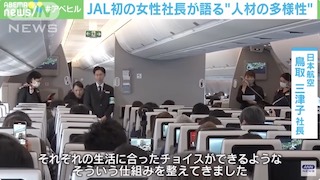
TOKYO - Mitsuko Tottori, the first female president of a major airline in Japan, discusses her strategies for promoting diversity within Japan Airlines during a recent interview.
Japan Airlines' First Female President Discusses

Having taken the helm on the first of April, Tottori gave her first solo media interview, expressing a modest discomfort with her new role, noting the increased public attention has limited her freedom somewhat.

When asked how she has adjusted to being president, she replied, "It's hard to say; I haven't quite settled into it yet. It’s certainly made it more difficult for me to go out and about."

Advocating for Gender Neutrality in Leadership

Tottori emphasized her desire to be recognized not for her gender but for her capabilities. "I hardly hold any special feelings about being a woman myself. I want to be approached as an individual, and I hope it soon becomes normal not to make a point of saying, 'Ah, the president is a woman.' I look forward to a world where women becoming presidents is a common occurrence."

Reflecting on a Recent Incident

A few weeks prior to the official announcement of her presidency, a Japan Airlines aircraft was involved in a collision with a coast guard plane at Haneda Airport. The cabin crew were lauded for their calm and efficient handling of the situation, which attracted international attention. "If I happen to meet the crew members involved, I would like to personally tell them, 'You did really well,'" Tottori commented. Although the incident resulted in the tragic loss of five aboard the coast guard plane, all passengers and crew of the Japan Airlines flight were unharmed.

Diversity and Inclusion Initiatives

President Tottori has played a significant role in shaping policies to support women's career development within the airline. She discussed the importance of creating systems that allow women to easily return to their careers after life events. "We've worked on enabling mechanisms such as carrying over the career credits accumulated before a break and offering part-time work options to those with children."

With these efforts, Japan Airlines is on track to achieve a target set by Keidanren (Japan Business Federation) to have 30% of management roles filled by women by March next year.

Outlook on Male Cabin Crew Representation

Despite male cabin crew making up only about 5% of new hires this spring, Tottori is optimistic about increasing their presence, "We're gradually increasing their numbers without setting a specific target. We want to make the cabin crew role appealing to men as well and choose candidates on their merits."

In conclusion, Tottori's leadership at Japan Airlines marks a significant step toward embracing diversity in the aviation sector, underscoring a progressive outlook towards inclusive growth within the industry.

Source: ANN

News On Japan
POPULAR NEWS

A tropical depression is expected to move northward this weekend and could bring another round of heavy rain to parts of Japan, following a week in which Typhoon Jangmi (Typhoon No. 6) caused significant rainfall and left some areas vulnerable to further weather-related damage.

Prime Minister Sanae Takaichi's administration is facing mounting scrutiny over allegations that members of her campaign were involved in distributing online videos that disparaged rival candidates during the February House of Representatives election, with opposition parties intensifying their questioning in the Diet and demanding further clarification.

The Japanese government approved its 2026 Environment White Paper at a Cabinet meeting on June 5th, warning that a record-high 50,000-plus bear sightings recorded nationwide during fiscal 2025 have become a serious threat to public safety while also highlighting growing concerns over Japan's aging hunting population and the need to train a new generation of hunters.

Japan could face a more active typhoon season than usual in 2026, with private weather forecaster Weathernews predicting around 28 typhoons to form during the year—above the long-term average of 25.1—and warning that approximately 14 could approach Japan, increasing the risk of weather-related disruptions across the country.

A bear that injured four people in Fukushima City escaped despite efforts to capture it using tranquilizer darts and box traps, prompting authorities to urge residents to remain on high alert.

MEDIA CHANNELS
         

MORE Business NEWS

Japan's household spending fell for the fifth consecutive month in April, highlighting continued pressure on consumers as rising prices and growing concerns over instability in the Middle East weighed on household budgets.

Japan's largest electronics retailer, Yamada Holdings, and Osaka-based Edion announced on June 5th that they have agreed to integrate their businesses, creating a group with annual sales of approximately 2.5 trillion yen as competition in the consumer electronics industry intensifies and companies seek new ways to boost growth in a shrinking domestic market.

Japan's real wages rose 1.9% in April from a year earlier, marking the fourth consecutive month of growth and the longest stretch of positive gains in about five years as this year's spring labor-management wage negotiations began feeding through into workers' paychecks.

Nissan Motor has begun accepting orders in Japan for the Murano sport utility vehicle, which is produced in the United States, marking one of the first uses of a new vehicle certification framework established following a tariff agreement between Japan and the United States.

Uber Japan unveiled its latest strategy for its mobility business, including its taxi-hailing app operations, as the company seeks to expand its presence in a market where ride-hailing app usage remains lower than in many other countries.

The Office of the United States Trade Representative (USTR) announced on June 2nd that it is considering imposing an additional 12.5% tariff on Japan, arguing that the country's measures to prevent the import of products made with forced labor are insufficient.

As labor shortages deepen across Japan, more companies in Okinawa are turning to foreign workers not only to fill vacancies but also to build long-term careers, creating support systems that help employees settle into local communities and remain in the workforce.

Quantum computing is attracting growing attention from investors as governments around the world increase support for the technology, raising expectations that it could become the next major investment theme after artificial intelligence.